



Use Wozber and land your dream job
Create CV
No registration required
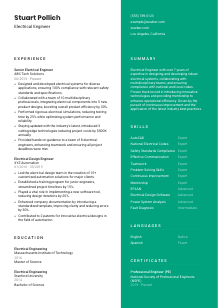
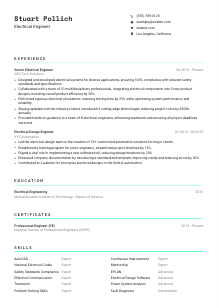
Juggling currents, but your CV seems dim? Spark some brilliance with this Electrical Engineer CV example, created with Wozber free CV builder. Learn how to power up your engineering expertise to match job requirements, lighting the path to a career that truly electrifies you!
Electrical engineering CVs are read through the lens of execution. Hiring teams want to see whether you can design safe, compliant systems, troubleshoot failures, work across mechanical and project teams, and improve performance with sound analysis rather than broad claims about innovation.
When that experience is tailored to the posting, the first pass becomes much clearer. A hiring manager can quickly connect your background in design software, simulations, code compliance, testing, and team coordination to the actual work in front of them. Wozber's free CV builder helps you shape that experience into an ATS-friendly CV format that matches the language of the role and makes your engineering scope easier to judge.
Electrical engineers work in disciplines where small specification errors can create large downstream problems. Your contact section should show the same care you bring to drawings, test plans, and compliance documentation.
Use your full name as the main header in a clean, readable size. This is basic, but it matters. A cluttered heading or an overly styled format can distract from the technical substance of your CV.
Place "Electrical Engineer" directly under your name when that reflects the role you are targeting. If your background is more specialised, a variant such as "Electrical Design Engineer" can work when it matches the posting more closely, but keep it accurate to your actual experience.
Hiring teams need a direct way to reach you for interviews, design discussions, or follow-up questions on project work. Make sure every contact field is current and formatted simply.
Some engineering roles are tied to plant access, site visits, lab work, or local code familiarity. Here, the Los Angeles, California requirement is explicit, so listing that location directly helps remove uncertainty about availability or relocation.
Include LinkedIn or a portfolio site if it supports your candidacy with project summaries, CAD samples, publications, or system work. Make sure it aligns with the CV and reflects the kind of electrical design, analysis, or troubleshooting work you want to be hired for.
This section should answer the logistical questions immediately and without friction. Clean contact details, a role-aligned title, and the right location give the hiring team a smooth start before they review your technical background.




For electrical engineers, experience carries the most weight when it shows technical scope, engineering judgment, and measurable outcomes. Design work, simulation, troubleshooting, compliance, testing, and cross-functional delivery all belong here when they reflect your actual contribution.
Read the posting for the work patterns behind the keywords. In this case, the priorities are electrical system design, analysis, troubleshooting, software use, code compliance, collaboration, and mentoring. Those themes should guide which projects and bullets you surface first so the CV speaks to real engineering tasks, not generic responsibility statements.
List positions in reverse chronological order with employer, title, and dates. That format helps reviewers track how your scope has grown, whether from hands-on design into senior review work, cross-functional integration, or leadership of junior engineers and project deliverables.
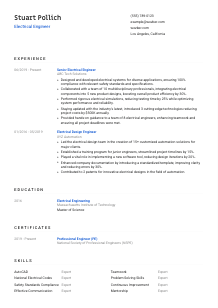
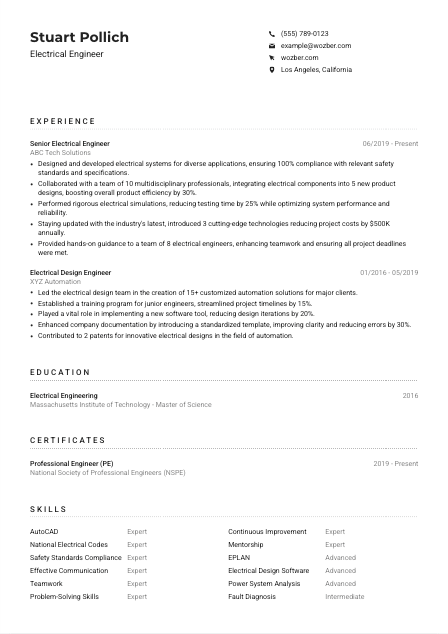
Write bullets around what you designed, analysed, tested, fixed, improved, or reviewed. Good lines include the system or application, the action you took, and the result. The sample CV does this well with points such as reducing testing time through electrical simulations and integrating components into new product designs, which tells the reader both the workflow and the outcome.
Metrics are especially persuasive when they reflect how electrical work is evaluated: compliance rates, efficiency gains, test-cycle reductions, cost savings, defect reduction, project volume, design iterations, or delivery speed. Figures like "30% efficiency improvement," "25% less testing time," or "$500K annual cost reduction" are effective because they show business impact tied to engineering decisions.
If a past role included unrelated work, keep only the parts that strengthen your case for this position. Prioritise bullets on electrical design software, system analysis, troubleshooting, safety standards, documentation quality, and collaboration with mechanical engineers or project managers. Relevance matters more than listing every task you have ever handled.
Your experience section should show that you can take electrical work from design through validation, communicate across disciplines, and deliver results that hold up in production, testing, or field conditions. That is the level of detail that moves an application forward.
Most electrical engineering roles still use education as a baseline qualification, especially when the posting names a required degree. Keep this section direct and easy to verify so the reviewer can quickly confirm that your academic background supports the technical work on the page.
If the role asks for a Bachelor's degree in Electrical Engineering or a related field, that information should be unmistakable. List the degree and field clearly rather than assuming the employer will infer it from the school name or surrounding sections.
For each degree, include school, degree, field of study, and graduation year. This straightforward structure works well for ATS parsing and keeps the focus on the qualification itself rather than decorative formatting.
If you hold a master's degree, list it prominently because it can strengthen your profile for design-heavy or analysis-intensive work. In the example, the master's degree adds depth, but the bachelor's still matters because it matches the stated requirement directly.
Early-career candidates can include senior projects, power systems coursework, control systems, embedded design, electronics labs, or capstone work if those details help bridge limited professional experience. Once you have several years of hands-on engineering work, that extra detail usually becomes optional.
Honors, research, thesis work, or competition projects can help if they connect to the kind of engineering the employer needs. Choose items that reinforce electrical design, simulation, testing, reliability, or systems thinking rather than filling space with general academic recognition.
This section does not need much narrative. It needs to confirm that you meet the degree requirement and, where relevant, show technical depth that supports your design and analysis experience.
Certifications are not mandatory for every electrical engineering role, but the right credential can strengthen your standing in regulated, design-heavy, or safety-critical environments. Use this section to highlight qualifications that carry real weight in engineering practice.
Even when a posting does not require a certification, include ones that speak to professional standard, code knowledge, or specialised expertise. A PE license is a strong example because it signals formal competence and can be especially relevant in roles involving stamped work, compliance, or public safety considerations.
List certifications that connect to the responsibilities of the role, such as design, controls, safety, power systems, or industry-specific tools. The point is not to collect every course you have ever taken. It is to show development that supports the engineering work you want to do next.
Add issue dates or active periods for licenses and certifications, especially when they require renewal or signal current standing. That helps the employer see whether the credential is active and still relevant to present-day standards and regulations.
Electrical engineering changes through new tools, revised codes, testing methods, and system architectures. Updating this section over time shows that you stay current with the practices that affect design quality, reliability, and compliance, not just that you earned one credential years ago.
A well-chosen certificate section adds depth to your profile, especially when it reinforces code awareness, design responsibility, or technical specialization. Keep it focused on credentials that mean something in practice.
The skills section should read like a snapshot of how you actually work as an electrical engineer. Hiring teams look for a mix of technical tools, engineering knowledge, and collaboration skills that match the demands of design reviews, simulations, troubleshooting, and project delivery.
Start with the posting, but also read for implied capabilities. A role that mentions system design, analysis, troubleshooting, and collaboration may call for CAD tools, simulation work, electrical codes, test methods, documentation discipline, and cross-functional communication. This gives you a more accurate and ATS-aware list than copying isolated words.
Combine technical tools with core engineering competencies and the interpersonal skills needed to deliver projects. For this role, software such as AutoCAD or EPLAN belongs alongside code knowledge, safety standards, problem-solving, and teamwork. The sample CV also includes mentorship, which supports the responsibility of guiding junior engineers.
Prioritise the skills most likely to be used and discussed in interviews. A shorter, relevant list is usually stronger than a long inventory of vague capabilities. Lead with the tools, standards, and problem-solving strengths that support electrical design, analysis, compliance, and coordination with other engineering functions.
Your skills section should make it easy to see how you design, analyse, troubleshoot, and collaborate. If the right tools and engineering competencies appear early, the rest of the CV lands more clearly.
Language skills matter in engineering when they affect documentation, safety communication, client interaction, or teamwork across sites and disciplines. Keep this section simple, accurate, and tied to the communication demands of the role.
Some roles treat language as a preference. Others make it a firm requirement because of documentation, meetings, or coordination needs. Here, fluency in English is stated directly, so it should appear clearly on the CV.
List English at the top if the posting requires it, and note your proficiency honestly. That makes it easy for the reviewer to confirm you can handle written specifications, code-related communication, reporting, and technical discussions.
If you speak additional languages, include them when they are relevant to the workplace or client environment. They can be useful in multinational teams, manufacturing settings, field support, or supplier communication, even when they are not part of the formal requirements.
Terms like Native, Fluent, Advanced, or Conversational are usually enough. Avoid overstating your level. If you may need to discuss drawings, testing procedures, or troubleshooting steps in that language, your stated proficiency should reflect reality.
For some electrical engineering positions, multilingual ability is a bonus rather than a deciding factor. Still, it can support smoother coordination across teams, vendors, and project stakeholders, especially when work spans countries or mixed-language environments.
List the language requirement clearly, then add any additional languages that strengthen your ability to work with teams, documentation, or clients. Accuracy matters more than volume here.
Your summary should quickly establish the kind of electrical engineer you are, the work you have handled, and the technical strengths most relevant to the opening. A short, specific summary does more than introduce you. It frames the rest of the CV around the engineering problems you are equipped to solve.
Before writing, identify the priorities in the job description. Here, those include electrical design, analysis, troubleshooting, code compliance, collaboration, and mentoring. Using those themes keeps the summary aligned with the actual role instead of sounding broadly technical.
Start with your title and years of experience, such as "Electrical Engineer with 7+ years of experience." That gives immediate context for the scope of work the reader can expect, whether you are focused on design execution, systems integration, testing, or team leadership.
Mention capabilities that map directly to the role, such as designing compliant electrical systems, running simulations, improving reliability, or coordinating with multidisciplinary teams. The example summary works because it connects code compliance, collaboration, innovation, and mentorship to actual engineering practice rather than generic ambition.
Aim for three to five lines. That is enough space to establish your technical profile and a few meaningful strengths without repeating bullet points from the experience section. Concision matters because the summary should sharpen focus, not compete with the rest of the CV.
A good summary tells the reader, within seconds, what kind of electrical engineer is in front of them and where your strongest value sits. If it points clearly to design capability, analysis depth, compliance awareness, and team contribution, it is doing its job.
A well-tailored electrical engineer CV makes your design experience, software proficiency, code knowledge, testing work, and collaboration history easy to connect to the job at hand. That is what helps both ATS screening and human review move in your favor.
Use Wozber's free CV builder and ATS CV scanner to align your wording with the posting, strengthen section-level match, and present your background in an ATS-compliant CV that reflects how you actually engineer, troubleshoot, and deliver.
The final read should leave no doubt about your ability to build safe, reliable electrical systems and contribute effectively from day one.