



Use Wozber and land your dream job
Create CV
No registration required
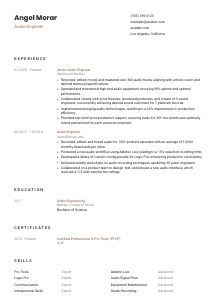
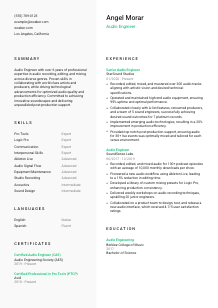
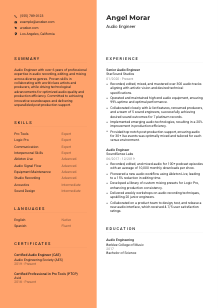
Tweaking soundscapes, but your CV hits a flat note? Sync up with this Audio Engineer CV example, created with Wozber free CV builder. Learn how to align your sonic skills with job requirements, harmonizing your career journey to flow as smoothly as a well-mixed track!
Audio engineering CVs are read through the lens of execution. Hiring teams want to know what kinds of sessions you handled, how strong your mixing and editing work is, whether you can keep signal flow and equipment reliable, and how well you collaborate when artists, producers, or event teams all want different things from the same project. Your CV should make that operating range visible fast.
A tailored CV changes which part of your background gets attention first. For an Audio Engineer role, that usually means surfacing the right DAWs, recording and post-production work, and the environments you support so your experience reads as relevant in both human review and ATS screening. Wozber's free CV builder helps organise that language into an ATS-compliant CV that quickly shows where you can contribute, from studio tracking to final mix and live event support.
In audio hiring, the top of the CV should answer practical questions immediately. Can the employer reach you, do you present yourself professionally, and do basic details line up with the role's requirements? Keep this section clean and useful.
Use your full name as the clearest text at the top of the page. Skip nicknames unless they are part of your professional brand on credits, your website, or your portfolio. In studio and production work, consistency matters. The name on your CV should match the name attached to session credits, LinkedIn, and any project reels you share.
Place "Audio Engineer" directly under your name when that is the role you are applying for. If your background leans toward a specialty such as recording, mixing, mastering, post-production, or live sound, reflect that in your experience bullets rather than changing the title unless the posting calls for it. Matching the role title helps recruiters and ATS tools sort your CV correctly from the start.
List a phone number you answer, a professional email address, and your city and state. For this job, Los Angeles, California matters because the posting specifically requires local availability. More broadly, location belongs here when a role is studio-based, event-based, or tied to in-person collaboration. Check every character carefully. One typo in your email can cost you an interview.
If you have a website, portfolio, LinkedIn, or credits page, include it. Audio hiring often moves faster when a CV links to real work such as mixed tracks, post-production samples, live event clips, or discography credits. Make sure the content supports the story on your CV. If you say you have strong mastering experience or high-profile collaborations, the linked work should reinforce that claim.
Do not include age, marital status, photo, or other personal details that are unrelated to recording, editing, mixing, mastering, or team collaboration. This section should stay focused on professional access points and any detail that directly supports eligibility, such as location when required.
When your personal details are clear and complete, the hiring team can move straight to your credits, tools, and production history without getting stuck on missing basics.




For Audio Engineers, experience carries most of the decision weight. Employers want to see what you recorded, edited, mixed, mastered, maintained, improved, or supported, and in what setting. Studio work, post-production, live environments, and equipment upkeep each tell a different story, so your bullets should show where you operate best.
Read the posting and mark the functions that appear repeatedly. Here, recording, sound editing, mixing, mastering, equipment operation, collaboration, and post-production support are the clear priorities. Build your recent experience bullets around those same work areas using truthful language that matches your background. This helps ATS matching, and it also makes your CV easier to read for producers or studio managers scanning for relevant workflow experience.
List employer name, job title, and dates for each position in reverse chronological order. That structure is standard, and it matters in production hiring because people often move between studios, freelance projects, technical teams, and event support roles. Clear dates and titles help a reviewer understand whether your experience comes from long-form studio work, short project cycles, or a mix of both.
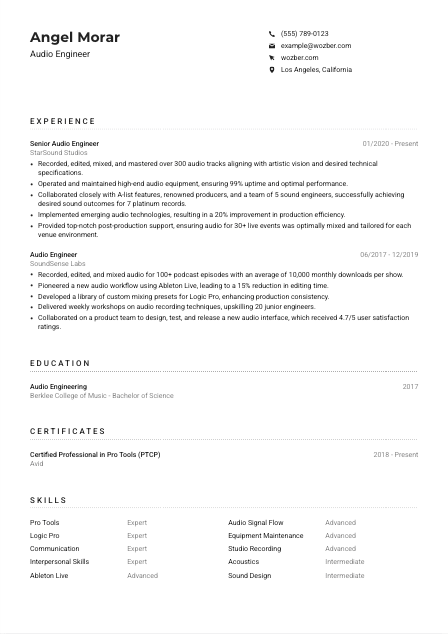
Each bullet should show what you handled and what came out of it. Strong Audio Engineer bullets often include track count, turnaround improvement, equipment uptime, audience or release scale, or venue support volume. The sample CV does this well by citing 300+ audio tracks, 99% equipment uptime, 20% production-efficiency gains, and support for 30+ live events. Those details tell the reader far more than "responsible for recording and mixing."
If the role emphasizes artistic direction and technical specifications, highlight projects where you balanced creative choices with clean delivery. If live event post-production appears in the posting, make room for venue-specific audio work. If the job leans heavily on artist collaboration, include bullets that show how you worked with producers, vocal talent, or engineering teams. Cut older or weaker bullets that do not support the target version of Audio Engineering you want to be hired for.
Audio teams value engineers who keep sessions moving. Include examples of workflow changes, template creation, preset libraries, equipment troubleshooting, or new technology adoption when they saved time or improved consistency. In the example, introducing an Ableton Live workflow and building Logic Pro presets makes the candidate look useful beyond the mix itself. That kind of contribution matters in fast studios where efficiency affects bookings, deadlines, and client experience.
Your experience section should leave no doubt about the projects, tools, and production environments you can handle. If a hiring manager can picture you in the room, at the console, or supporting the event from these bullets, the section is doing its job.
Education matters most when it confirms formal training in audio, music production, acoustics, or related technical work. For early-career candidates it can carry more weight. For experienced engineers, it usually works as supporting context behind your production history and tool proficiency.
If the posting asks for a bachelor's degree in Audio Engineering, Music Production, or a related field, make sure that information is easy to find. This job does, so the degree should be listed plainly with no extra digging required. When your degree is adjacent rather than exact, the field of study becomes especially important because it helps explain your technical base.
List degree, school, field of study, and graduation year or date. Keep the entry simple unless your academic work directly strengthens the role. The example does this effectively with a Bachelor of Science in Audio Engineering from Berklee College of Music, which aligns tightly with the posted requirement without overexplaining.
If you are early in your career, relevant details can help. Capstone work in recording, acoustics, mixing, mastering, sound design, or studio operations can support a lighter experience section. If you already have several years of professional sessions, releases, or event credits, those project details usually matter less and can be omitted.
Student studio work, recording labs, production clubs, campus radio, or ensemble engineering experience can help if they demonstrate hands-on use of DAWs, consoles, microphones, or signal routing. Only keep these details if they strengthen the professional story. They are especially useful when your paid experience is still building.
After a few years in the field, your CV should spend more space on sessions completed, artists supported, workflow improvements, and post-production results than on academic detail. Education still matters, but it should not crowd out the production evidence that now defines your value.
This section should quickly show that you have the academic grounding expected for the role, then make room for the studio, editing, and mixing work that carries more hiring weight.
Certifications are not required for every Audio Engineer role, but the right ones can strengthen your case when they validate key software, technical standards, or continued professional development. They are especially useful when a posting names specific platforms or when you want to show current expertise in a competitive market.
Some audio jobs require platform certifications, safety training, or specialised live-sound credentials. This posting does not require certifications, so treat them as supporting value rather than a substitute for experience. Start with the certs that are closest to the tools and workflows mentioned in the job description.
When the role asks for Pro Tools, Ableton Live, or Logic Pro, certifications connected to those platforms deserve attention. The example leads with Certified Professional in Pro Tools, which directly supports one of the named software requirements. That is the kind of cert that strengthens credibility because it aligns with how the work is actually done.
List the full certificate name, issuing body, and date or active period. Hiring teams need enough detail to understand what the credential covers and whether it is current. A clear entry such as an Avid-issued Pro Tools certification carries more weight than a vague line that simply says "audio certified."
Audio production changes through new plugins, hybrid workflows, immersive formats, AI-assisted tools, and evolving post-production standards. Updated certifications or recent training help show that your methods are current. That matters when studios want engineers who can adapt without slowing down sessions or compromising quality.
Well-chosen certifications sharpen your profile when they reinforce the DAWs, technical standards, or specialised workflows the job actually values.
A useful Audio Engineer skills section is specific. It should tell the reader which DAWs you use, what technical knowledge you bring into sessions, and which collaboration skills help you work with artists, producers, and technical teams. Broad lists without context do not do much here.
Start with the software, technical knowledge, and working habits named in the posting. For this role, that includes Pro Tools, Ableton Live, Logic Pro, acoustics, audio signal flow, equipment handling, communication, and interpersonal collaboration. These belong near the top because they map directly to recording, editing, mixing, mastering, and session support.
Order matters. DAWs, recording systems, editing, mixing, mastering, signal flow, and equipment maintenance usually deserve first position because they tell the employer what you can do on day one. Follow them with collaboration strengths such as client communication, artist support, and cross-team coordination. The sample CV handles this well by leading with software and core audio capabilities before softer traits.
Do not turn this section into an inventory of every plugin, instrument, or adjacent creative interest. Choose the skills that match the job's environment and your actual strengths. If you are applying for a studio-heavy role, prioritise tracking, editing, mixing, mastering, DAWs, and acoustics. If live event support is central, include FOH, monitor mixing, system tuning, or venue optimisation when they reflect your background.
This list should back up your experience, not compete with it. When the right tools and technical areas appear here, the rest of the CV reads with much more confidence.
Language skills matter in audio roles when they affect session communication, client management, artist collaboration, or cross-cultural work. Even when only one language is required, listing proficiency clearly helps the employer understand how you will operate in the room, on calls, and during feedback cycles.
Check the job description first. This role specifically asks for strong English language communication abilities.
When a posting names English, list it at the top with an honest proficiency level such as Native, Fluent, or Professional. In Audio Engineering, this matters because session notes, artist feedback, technical handoffs, and revision requests all depend on clear communication. The example's "English - Native" works because it answers the requirement directly and cleanly.
Additional languages can help in studios, live events, podcast production, media work, and artist-facing roles, especially in diverse markets. Spanish, for example, may be valuable in certain production communities or client settings, but it should remain secondary to any required language unless the posting says otherwise.
Use familiar labels such as Native, Fluent, Advanced, Intermediate, or Basic. Avoid vague descriptions that make your communication ability hard to interpret. If you can run sessions, discuss revisions, or explain technical issues in a language, your proficiency should reflect that level of practical use.
Some Audio Engineer roles are heavily client-facing, while others focus more on internal technical execution. When the work involves artists, producers, event teams, or international stakeholders, language skills can add real value. When language is not central, keep the section brief and accurate.
For audio roles, language listing is less about decoration and more about whether you can handle feedback, direction, and coordination smoothly in the environments the job involves.
The summary should quickly tell the reader what kind of Audio Engineer you are, how much relevant experience you bring, and which strengths deserve attention before they reach the first job entry. Keep it specific enough to sound real and broad enough to support the rest of the CV.
Before writing, review the posting and identify the few themes that deserve front position. In this case, the priorities are audio recording, editing, mixing and mastering, DAW proficiency, technical reliability, collaboration, and live-event post-production support. Your summary should echo the parts of that mix you genuinely bring.
Start with a direct introduction such as "Audio Engineer with 6+ years of experience in studio recording, editing, and mixing" if that is accurate. This gives the reader an immediate frame. Avoid generic labels or dramatic wording. In production hiring, a clear operating profile is more persuasive than a flashy phrase.
Use the next lines to mention the environments, tools, or outcomes that define your work. That might include collaborating with artists and producers, improving workflow efficiency, supporting live events, or delivering high-volume post-production work. The sample summary succeeds because it combines years of experience with collaboration, technology adoption, and production efficiency rather than offering empty claims about passion.
Aim for a short paragraph of about three to five lines. Every sentence should add usable information. If a detail already appears strongly in your experience section, summarise it rather than repeating it word for word. The summary should guide the reader into your CV, not duplicate the whole thing.
Once the summary, experience, skills, and supporting sections all point to the same kind of Audio Engineer, your CV becomes much easier to shortlist. Use Wozber's free CV builder to shape that content into an ATS-friendly CV template, refine the language with ATS optimisation in mind, and keep the final version focused on the sessions, tools, and outcomes that matter for the role.
A finished Audio Engineer CV should make your recording background, mixing range, DAW proficiency, technical reliability, and collaboration style easy to understand without extra interpretation.
Before you apply, review the language against the posting one more time and make sure the most relevant tools, production settings, and measurable outcomes appear early. That is what helps the CV hold up in both ATS review and human screening.