



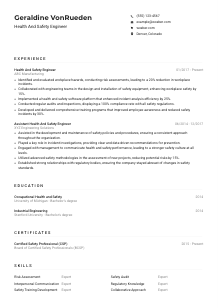
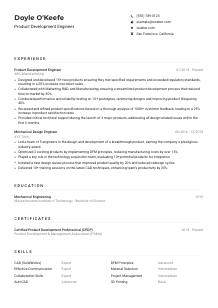
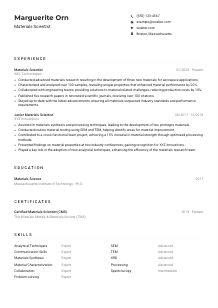
Use Wozber and land your dream job
Create CV
No registration required
Juggling circuits, but your CV feels short-circuited? Power up with this Electrical Project Manager CV example, created with Wozber free CV builder. Learn how to channel your leadership and electrical expertise to match job requirements, lighting the way to your project management career!
Electrical Project Managers are trusted with work that has little margin for drift. Hiring teams want to see whether you can move an electrical project from kickoff to closeout while keeping schedule, budget, safety, and coordination under control across clients, engineers, subcontractors, and field teams. Your CV needs to make that operating range visible quickly.
A tailored CV changes how your project history is read. When your bullets use the same delivery language the employer uses, from change orders to schedule tracking and cost analysis, your scope is easier to recognize in an ATS and easier to place at the right level of responsibility. Wozber's free CV builder helps organise that alignment in an ATS-friendly CV format so the hiring team can quickly see whether you have handled projects with the complexity, reporting rhythm, and accountability this work requires.
For an Electrical Project Manager, the top of the CV should answer practical questions immediately: who you are, what role you do, and whether you are reachable for a project-driven position that often moves fast from screening to interview scheduling.
Use your full name as the most prominent line on the page. Keep it easy to read and slightly larger than the body text so it anchors the document without looking styled for style's sake. In a role built around coordination, reporting, and client communication, clean presentation matters.
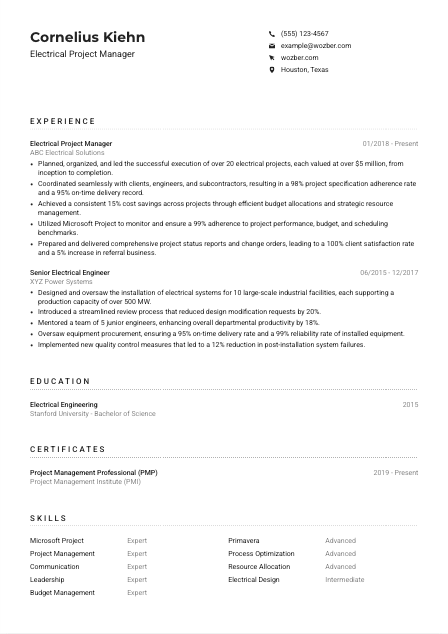
Place "Electrical Project Manager" under your name when that is the role you are pursuing. This removes ambiguity, especially if your background includes titles such as Senior Electrical Engineer, Project Engineer, or Construction Manager. In the example CV, using the exact target title helps frame earlier engineering experience as a progression toward project ownership.
Include a phone number and a professional email address you check regularly. Electrical project hiring often involves quick follow-up around interviews, site discussions, or schedule availability, so accuracy matters. If you include a website or LinkedIn profile, make sure the projects, dates, and titles match your CV.
If the employer specifies a city or relocation requirement, show that clearly in your contact details. Here, Houston, Texas is relevant because the posting names it directly. If you are relocating, say so in a straightforward way rather than leaving the hiring team to guess whether geography will slow the process.
A LinkedIn page, portfolio, or professional website can help if it reinforces your CV with project scope, industries served, or leadership history. For this profession, that might mean project values, commercial or industrial work, software proficiency, or major delivery milestones. Leave it out if it is sparse or outdated.
This section should remove friction, not add personality filler. Clear identity, direct role alignment, and accurate location details help the employer move straight to your project background.




This is the section that carries the most weight. Electrical Project Manager hiring usually turns on delivery history: what you led, how large it was, who you coordinated with, and whether you kept the work on time, within budget, and compliant with project requirements.
Start by marking the responsibilities and performance expectations in the job description. For this role, that includes leading projects from inception to completion, coordinating with clients and subcontractors, monitoring budget and schedule, preparing status reports and change orders, and closing projects with lessons learned. Those points should guide which bullets you keep and which you rewrite.
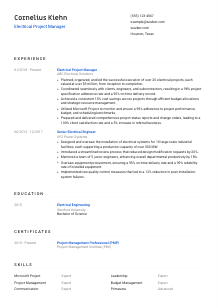
List each role with your job title, company name, and employment dates, starting with the most recent. That structure helps hiring teams see whether you already hold project-level responsibility or are stepping up from design, field engineering, or senior engineer work. The example CV does this well by showing direct project management experience first and earlier engineering experience second.
Your bullets should show the work you owned and the result you produced. Strong examples in this profession mention project count, contract value, delivery timing, cost control, coordination, safety, or client reporting. The sample bullet about leading more than 20 electrical projects valued above $5 million works because it establishes scale immediately, then later bullets add schedule, specification, and budget performance.
Use numbers that belong naturally in project management. That can include on-time delivery rate, budget variance, cost savings, adherence to specifications, change order turnaround, equipment reliability, rework reduction, or project value. Metrics such as 95% on-time delivery, 15% cost savings, or 99% schedule and budget adherence tell a hiring manager far more than broad claims about leadership.
Keep older or adjacent roles only if they strengthen your case for managing electrical work. Design, installation oversight, procurement, quality control, and mentoring can all be relevant when framed as preparation for project execution. In the example CV, the Senior Electrical Engineer role stays useful because it shows industrial facility work, procurement oversight, and process improvement, all of which support the move into full project management.
After this section, a reader should know the size of work you have handled, how you managed schedule and cost, and whether you can coordinate the mix of technical and stakeholder demands that electrical projects bring.
Education is usually not the deciding factor for an experienced Electrical Project Manager, but it still matters because it confirms the engineering foundation behind your project decisions, vendor discussions, and coordination with technical teams.
If the posting asks for a Bachelor's degree in Electrical Engineering or a related field, state your degree clearly and use the full field name. A hiring team scanning quickly should not have to infer whether your education meets the baseline requirement.
List the degree, field of study, school, and graduation year. Keep the formatting simple so both recruiters and ATS parsing can read it cleanly. For most mid-career project managers, that is enough.
Write the credential as it appears academically, such as "Bachelor of Science in Electrical Engineering." In this guide's example, that wording directly matches the employer's requirement and reinforces technical alignment without extra explanation.
Most experienced candidates do not need course lists. Include them only if they strengthen a less direct degree path or support a role with specialised electrical scope, such as power systems, industrial controls, or construction management. Otherwise, let your project experience carry the section.
Honors, capstone work, or leadership in engineering organizations can help if you are earlier in your career or if the accomplishment connects to project delivery, technical rigor, or team leadership. If you already have years of project results, keep this part brief.
This section should quickly show that your project management experience rests on relevant engineering training. Once that is clear, the CV can return attention to delivery history and project outcomes.
Certifications can add weight when they reinforce how you run projects, manage risk, or communicate with stakeholders. For Electrical Project Managers, they are most useful when they support execution, governance, or recognized project standards.
The posting here does not require a certification, but a relevant one can still improve your case. A PMP is a strong example because it speaks to project planning, scheduling discipline, stakeholder management, and formal delivery practices that are central to the role.
Do not pad this section with unrelated short courses. Include certifications that connect to project execution, construction safety, contract administration, or leadership in technical environments. The point is to reinforce your operating capability, not to show volume.
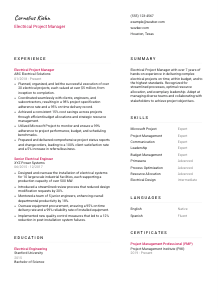
If a certification is current, renewed, or still active, include that detail. Project management methods, compliance expectations, and reporting practices change over time, so an active credential can carry more weight than an expired one. In the example, "2019 - Present" helps show ongoing validity.
Electrical projects change with new standards, delivery models, and software workflows. Keeping project or industry credentials current shows that your methods have kept pace, whether that means stronger schedule control, cleaner reporting, or better cross-functional coordination.
Certifications are most persuasive when they back up the project habits already visible in your experience section. Use them to reinforce planning discipline, communication with stakeholders, and dependable execution.
The best skills sections for this profession read like a project delivery toolkit. They should connect directly to planning, coordination, scheduling, cost control, reporting, and the technical context of electrical work rather than listing broad strengths in isolation.
Start with the language the employer already uses. Here, that includes project management software such as Microsoft Project or Primavera, along with communication, leadership, and budget oversight. If you have those capabilities, name them plainly so they are easy to find in both ATS scans and human review.
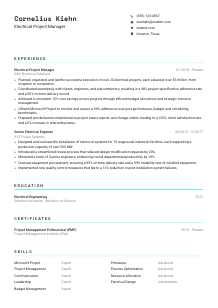
Lead with the skills most tied to day-to-day performance. For an Electrical Project Manager, that often means scheduling software, project management, budget management, resource allocation, stakeholder communication, and leadership. The example skill list works because it places Microsoft Project and core management skills before secondary capabilities.
Avoid turning this section into a master inventory. Choose the skills that support the kind of projects you want to manage. A concise list that combines software, coordination, and electrical domain knowledge is more useful than a long list of generic business terms. If you mention a skill here, make sure your experience section shows where you used it.
A hiring manager should be able to connect this list to the work immediately: planning projects, tracking progress, controlling cost, coordinating people, and delivering electrical scope without surprises.
Language ability matters in project management when it affects meetings, documentation, client updates, and day-to-day coordination across teams. Include it when the posting names a requirement or when additional languages genuinely support the environments you work in.
If the employer specifies English proficiency, list it clearly. This posting does, so showing your English level is not a minor detail. It speaks directly to reporting, client communication, and the ability to handle project status updates and change order discussions without friction.
Order this section by relevance, not preference. If English is essential, lead with it. In the example CV, "English: Native" immediately answers a stated requirement and removes uncertainty.
Additional languages can be valuable when you work with diverse crews, vendors, or clients, especially in commercial or industrial environments. Spanish, for example, may strengthen field communication in some regions, but include extra languages only if you can use them professionally.
Use clear labels such as Native, Fluent, Intermediate, or Basic. Avoid overstating your level. In project work, language gaps show up quickly in meetings, documentation review, and issue resolution.
If language skills improve coordination on site, support client-facing work, or help with multicultural teams, they deserve space. If they do not add practical value for the jobs you are targeting, keep this section brief.
For this role, language skills matter most when they support clearer reporting, smoother coordination, and better communication across the people responsible for delivering the project.
The summary should give a hiring team a fast, accurate picture of your level. For an Electrical Project Manager, that usually means years of experience, project type, delivery strengths, and one or two concrete results that frame the rest of the CV.
Start with your title and years of experience, then anchor that experience in the kind of electrical work you manage. Commercial, industrial, design-build, power, or facility projects all tell the reader something useful. The example summary does this well by leading with more than 7 years of hands-on experience delivering complex electrical projects.
Use the next line or phrase to show what you manage: full project lifecycle, cross-functional coordination, budget control, scheduling, reporting, or client communication. This helps separate true project managers from candidates whose experience is still primarily technical or supervisory.
One well-chosen detail makes the summary more credible. That could be on-time completion, cost savings, large project values, or proficiency with Microsoft Project or Primavera. In the sample CV, references to streamlined processes and resource allocation support the broader claim of consistent project delivery.
Aim for a short paragraph that can be read in seconds. Four lines of precise information will usually outperform a longer paragraph full of soft descriptors. If a sentence does not clarify project scope, technical context, or delivery performance, cut it.
By the time someone finishes this section, they should know what kind of electrical projects you manage, how you operate, and why your background is worth a closer read.
An effective Electrical Project Manager CV shows control over real project variables: scope, schedule, budget, coordination, reporting, and closeout. Once those points are clear in your experience, skills, and summary, the document starts working the way hiring teams need it to.
Use Wozber's free CV builder to organise that information into an ATS-compliant CV, refine wording with role-specific terms, and strengthen ATS optimisation with focused alignment to the job description. The finished CV should make one thing easy to judge: whether you can lead electrical projects from planning through completion with dependable results.




