



Use Wozber and land your dream job
Create CV
No registration required
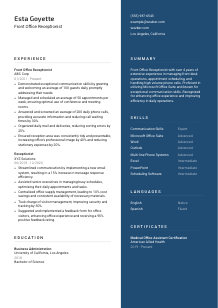
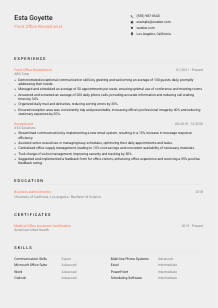
Greeting grins, but your CV lacks reception? Tune into this Front Office Receptionist CV example, created with Wozber free CV builder. Learn how to effortlessly blend your welcoming charm with job doorway details, ensuring your career's first impression is always on point!
Front Office Receptionists set the tone for an office within seconds. Hiring teams look for people who can welcome visitors warmly, keep phones and schedules moving, and stay composed when the front desk gets busy. Your CV should make that operational reliability visible, not just list generic customer service duties.
When front desk experience is tailored clearly, employers can quickly tell whether you have handled the pace, communication load, and coordination work their office depends on. Wozber's free CV builder helps organise that experience into an ATS-compliant CV using the right front office language, so your application shows practical readiness for visitor handling, call management, and scheduling support.
The top of your CV should read like the front desk itself: clear, orderly, and easy to work with. For a Front Office Receptionist, personal details are less about personality and more about making it simple to contact you, place you, and connect you to the role's location and communication expectations.
Use your full name in a clean, slightly larger font so it anchors the page immediately. Front office roles depend on polish and professionalism, and that standard starts with a header that looks structured rather than decorative.
Place "Front Office Receptionist" directly under your name if that is the role you are pursuing. This helps both recruiters and ATS tools connect your CV to the opening without guessing whether your background sits in reception, administrative support, or broader office coordination.
Include a reliable phone number and a professional email address. Since this job revolves around prompt communication, employers will notice whether your contact section feels business-ready. If you regularly use voicemail, make sure your greeting sounds polished as well.
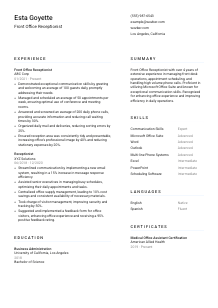
If the employer asks for candidates based in a specific area, include your city and state. Here, listing "Los Angeles, California" helps confirm you meet a stated requirement without forcing the hiring team to search for it elsewhere on the page.
A LinkedIn profile can help if it reflects your front office background, office software knowledge, and customer-facing experience consistently. Unlike roles that rely on portfolios, reception work does not require extra links unless they strengthen your administrative credibility.
This section should confirm the basics fast: who you are, how to reach you, and whether you meet practical requirements such as location. When those details are clean and complete, the rest of the CV can focus on how you run a front desk well.




For Front Office Receptionists, experience carries most of the weight. Employers want to see how you handled the daily traffic of the role: greeting visitors, answering calls, scheduling appointments, managing supplies, and keeping the reception area organised while several things happen at once.
Read the job description closely and build your experience bullets around the recurring work: guest reception, phone screening, appointment scheduling, visitor logs, mail handling, and staying calm under pressure. If your past roles covered these areas, mirror that language naturally so the connection is immediate.
Start with your most recent front desk or receptionist work. That makes it easy to see your current level of responsibility, the pace of the offices you supported, and whether you have the 2+ years of relevant experience the employer requested.
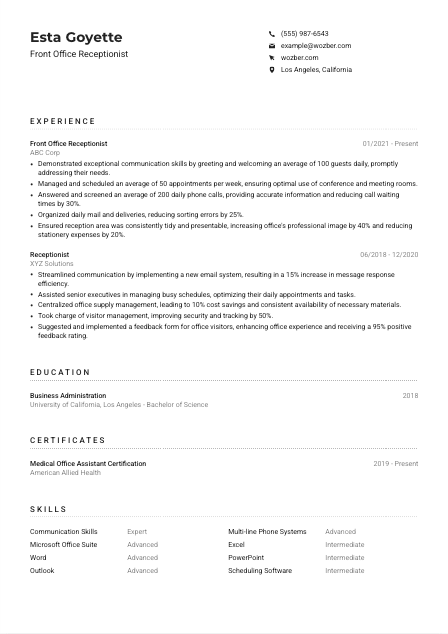
Reception work is often underestimated because many CVs stop at task lists. Go further. Instead of saying you "answered phones" or "scheduled meetings," show volume, speed, and reliability. The sample CV does this well by noting 200 daily phone calls and 50 appointments per week, which gives real scale to the work.
Good metrics for this role include guest volume, call volume, appointment counts, reduced wait times, fewer sorting errors, improved visitor tracking, supply cost savings, or positive feedback from office visitors. A line like reducing call waiting times by 30% says far more than "excellent phone skills."
Keep the spotlight on work that shows you can manage competing demands with professionalism. Experience supporting executives, coordinating meeting rooms, handling deliveries, or maintaining visitor procedures is more relevant here than unrelated duties from older roles. Focus the section on the parts of your background that show dependable front desk coverage.
Your experience section should make it easy to picture you handling the flow of an office day. When your bullets show volume, organisation, and calm execution, employers can see how you would support their reception area from day one.
Education is rarely the main deciding factor for a Front Office Receptionist, but it still helps frame your background. A degree, diploma, or relevant coursework can reinforce your administrative foundation, communication skills, or exposure to business operations.
List your most relevant or highest credential first. Even when the role does not require a specific degree, education in business, administration, hospitality, or healthcare support can strengthen the overall picture of your office readiness.
Include the school name, degree, field of study, and graduation year or completion date. Front desk CVs benefit from orderly formatting, and education should be easy to scan in a few seconds.
If your studies connect to office operations, customer service, communication, or administration, let that link come through. In the example, a Business Administration degree supports the administrative side of reception work without overstating its importance.
Short courses in office software, scheduling systems, customer service, healthcare administration, or records handling can add useful context, especially if your formal education is older or unrelated. These details help show you can work comfortably in a structured office environment.
Academic honors, leadership roles, or service positions are worth mentioning if they show communication, coordination, or responsibility. Keep them brief and role-relevant so they support the CV instead of distracting from your front desk experience.
This section works best when it is concise and relevant. It should confirm your foundation and, where applicable, show that your background supports the communication and organizational demands of reception work.
Certifications can strengthen a Front Office Receptionist CV when they connect directly to the office setting you want to work in. They are especially useful when a posting prefers a specific credential or when you want to show added preparation beyond general front desk experience.
If the job ad prefers a Medical Office Assistant Certification or a similar credential, list it clearly. When a certificate appears in the posting, employers often use it as a quick sorting point, especially in medical or regulated office environments.
Prioritise certificates tied to reception, office administration, medical front office work, customer service, records handling, or scheduling systems. A shorter list of closely related credentials is stronger than a long list of general online courses.
Add the issue date and, if applicable, the active period. That helps employers see whether the training is current. In the sample CV, the certification date makes the qualification feel concrete rather than implied.
If you are building toward more specialised front office roles, certificates can show that progression clearly. They are particularly helpful when your experience is broad administrative support and you want to sharpen your fit for medical, corporate, or client-facing reception work.
A relevant certification can quickly add credibility, especially when it matches the office environment or preference named in the posting. Use this section to underline the training that supports your day-to-day front desk work.
A Front Office Receptionist skills section should reflect the real rhythm of the job. Employers want to see a mix of office software ability, front desk coordination, phone handling, and communication skills that hold up when visitors arrive, calls stack up, and schedules change at once.
Review the description for explicit requirements such as Microsoft Office Suite, English communication, multitasking, and professionalism under pressure. Then look for implied needs like visitor coordination, appointment scheduling, message accuracy, and front desk organisation.
Use the same wording for core requirements when it fits your background. For example, if the posting names Word, Excel, PowerPoint, and Outlook, list those specifically rather than hiding them under a vague "computer skills" label. This improves both ATS alignment and human readability.
Organise your list so front office strengths are easy to scan. You might group communication and visitor-facing skills first, then phone and scheduling tools, then software such as Microsoft Office or scheduling systems. The sample CV handles this well by separating Microsoft Office tools from phone systems and scheduling software.
This section should read like the actual demands of a front desk, not a generic list of strengths. When your skills reflect the tools, pace, and communication standards of reception work, the match becomes much easier to see.
Language skills matter in reception because every conversation shapes the visitor experience. Clear spoken English is often essential, and additional languages can be valuable in offices that serve diverse clients, patients, vendors, or guests.
If the posting calls for strong English communication, list English prominently and use an honest proficiency level. For front office work, spoken fluency matters as much as written ability because calls, greetings, and quick questions happen in real time.
Start with the language most relevant to the role, then list others in descending proficiency. This gives employers a quick read on where you can communicate confidently with visitors or callers without needing clarification.
A second language can be a real advantage in reception, especially in high-traffic offices or diverse cities. In the example CV, Spanish adds practical value because it expands the receptionist's ability to greet and assist a broader range of visitors.
Use labels such as Native, Fluent, Advanced, or Conversational only when they reflect your actual day-to-day ability. Overstating language skill is risky in a front office role, where communication quality is visible immediately.
Mention languages because they improve phone coverage, guest support, or office accessibility, not just because they look impressive. That connection matters more than the number of languages listed.
For reception roles, language proficiency is practical, not decorative. Show the languages you can use confidently in calls, greetings, and day-to-day office interaction, and the value becomes clear on its own.
Your summary should give a hiring manager a quick picture of the kind of front desk support you provide. In a few lines, it should cover your level of experience, the environments you have supported, and the strengths that matter most in reception work, such as communication, scheduling, and composure under pressure.
Before writing, pull out the role's main demands. For this kind of opening, that means relevant years of experience, front office coverage, phone handling, scheduling, Microsoft Office proficiency, and calm communication. Build your summary from those points instead of writing a generic introduction.
Lead with a direct line that identifies you professionally. The sample summary does this effectively with "Front Office Receptionist with over 4 years of extensive experience," which immediately establishes level and relevance.
Choose strengths that connect directly to the front desk, such as managing high call volume, coordinating appointments, maintaining a professional reception area, or improving office efficiency. This keeps the summary grounded in the work rather than soft claims alone.
Aim for 3 to 5 lines. That is enough space to cover your background, a few relevant strengths, and one concrete point of value. Short summaries work best when every phrase points back to front office execution and office support.
When written well, the summary gives an immediate sense of how you communicate, organise, and support the office. It should position you as someone who can step into reception work and handle the pace with confidence.
A Front Office Receptionist CV works when it shows dependable execution in the details employers care about most: visitor experience, phone coverage, scheduling accuracy, office organisation, and calm communication. Keep each section tied to the daily flow of the role so the match feels obvious.
Use Wozber's free CV builder, ATS-friendly CV templates, and ATS optimisation tools to shape your experience around the posting and present it in a clean, ATS-friendly CV format. The final result should make it easy to judge how well you can run the front desk.