



Use Wozber and land your dream job
Create CV
No registration required
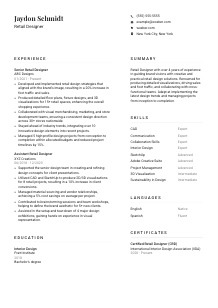
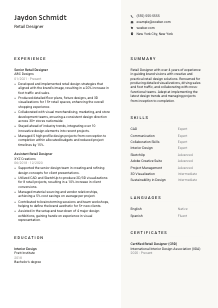
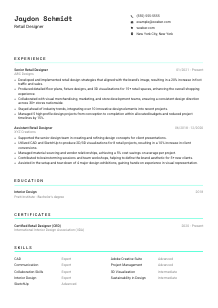
Crafting store layouts, but your CV doesn't grab shopper attention? Check out this Retail Designer CV example, created with Wozber free CV builder. Learn how to match your design finesse with the job's aesthetic, making sure your career stands out just as strikingly as a well-dressed mannequin in a shop window!
Retail design sits at the intersection of brand expression and store performance. Hiring teams want to see how you shape physical environments that support shopper flow, product storytelling, and commercial goals, whether that means fixture planning, spatial layouts, or translating a brand into a repeatable in-store experience.
When that work is tailored well on a CV, the first read becomes much more decisive. Wozber's free CV builder helps you line up your project scope, software, and brand-facing outcomes with the posting in an ATS-friendly CV format, so a hiring manager can quickly see whether you can move from concept boards to build-ready retail spaces.
Retail design is collaborative, deadline-driven work, so your header should read like a clean project cover page. Keep it straightforward and relevant, giving the employer the essential details they need before they get into your portfolio links, store design experience, and software background.
Use your full name in a clear, professional format that is easy to spot at the top of the page. In design fields, polished presentation matters, but this section should stay simple. Save visual flair for your portfolio and let your name lead the document cleanly.
Place "Retail Designer" directly under your name if that matches the role you are pursuing. This immediately frames your background around store environments, floor plans, fixtures, and branded spatial design instead of leaving the reader to guess whether your experience is more residential, hospitality, or general interiors.
List a working phone number and a professional email address, then check them carefully. If a hiring team wants to discuss a portfolio review, store rollout, or interview with cross-functional partners, they need to be able to reach you without friction.
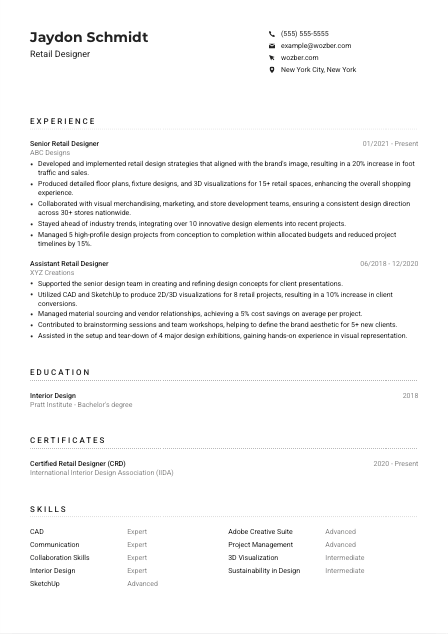
If the posting specifies a city, show that clearly in your header when you meet the requirement. Here, "New York City, New York" answers a stated filter right away. For other roles, only include location when it helps clarify availability for on-site collaboration, site visits, or local store development work.
Retail designers are hired on visuals as much as wording. Include a portfolio, website, or strong LinkedIn profile if it shows store concepts, renderings, fixture details, brand rollouts, or before-and-after project work. Keep the content current and consistent with the experience listed on your CV.
This section should answer the practical basics in seconds: who you are, what role you do, how to contact you, and whether you meet any stated location requirement. After that, the rest of the CV can focus on your design thinking and commercial impact.




This is where retail design CVs separate themselves from general design CVs. Employers are looking for proof that you can turn concepts into physical retail environments, coordinate with merchandising and marketing teams, and deliver layouts or fixture solutions that support both brand standards and business performance.
Start by pulling out the core responsibilities in the job description and matching your bullet points to them. For a retail designer, that usually means design strategy, floor plans, fixture development, 3D visualizations, cross-functional coordination, and project delivery against timeline and budget. If your experience already covers these areas, use similar language so the connection is immediate.
List roles in reverse chronological order, but make the progression visible. Maybe you moved from supporting presentations and sourcing materials to owning store concepts, leading client discussions, or managing multiple openings at once. The sample CV does this well by moving from assistant-level production support into senior-level strategy, rollout consistency, and project ownership.
Retail design work is easier to judge when the result is clear. Instead of saying you "created layouts" or "worked with merchandising," show what changed. A bullet like increasing foot traffic, improving client conversions, or standardising design direction across store locations tells far more than a generic duty statement. Use action verbs tied to design execution such as developed, produced, coordinated, refined, or implemented.
Numbers matter here because they show scale and operational value. Include the number of stores, projects, concepts, fixtures, or visualizations you handled, along with outcomes such as sales lift, timeline reduction, budget adherence, or cost savings. In the example, details like "15+ retail spaces," "30+ stores nationwide," and "reduced project timelines by 15%" make the scope of the work easy to understand.
Keep bullets that strengthen your case for store design, branded environments, visual communication, vendor coordination, and commercial execution. If an older role included unrelated design work, keep only the parts that connect to spatial planning, client presentation, material sourcing, or project coordination. The section should read like a hiring manager can place you into a live retail design workflow right away.
A retail design experience section should show more than creativity. It should show how your layouts, visual concepts, and cross-team execution performed in real stores, with enough scope and detail to suggest you can handle the next project smoothly.
For retail design roles, education usually establishes your technical foundation in space planning, design principles, and presentation tools. It does not need much decoration, but it should clearly confirm that you meet the academic background the employer expects.
If the posting calls for a Bachelor's degree in Interior Design, Architecture, or a related field, make that match obvious. Put the degree, field, school, and graduation year in a clean format. In the example, a Bachelor's degree in Interior Design from Pratt Institute aligns directly with the requirement and needs no extra explanation.
This section works best when it is easy to scan. Use a straightforward structure with degree, field of study, school name, and year. Hiring teams reviewing retail design CVs are often moving quickly between portfolios, software qualifications, and project experience, so clarity matters more than detail here.
Use wording that accurately mirrors your training. If your background is in Interior Design, Architecture, Environmental Design, or a related commercial design discipline, name it clearly. That helps position you within the right design lane, especially if employers are sorting candidates from broader creative backgrounds.
If your degree title is broad or your experience is still growing, you can include a few courses tied to retail environments, materials, CAD drafting, spatial design, or visual merchandising. This is most useful early in your career or when your academic work directly supports the type of store design the role involves.
Add honors, studio projects, exhibitions, or student organisation work only if they strengthen your story as a retail designer. A capstone on branded environments, a student installation, or a competition project involving commercial space planning can add useful context. If you already have several years of strong retail experience, keep this section lean.
This section should quickly establish that you have the formal design training behind your software skills, layouts, and project work. Once that is clear, your experience and portfolio can do the heavier lifting.
Certifications are not always required in retail design, but the right one can strengthen your positioning, especially when it reflects commercial interiors, retail environments, or continued development in design tools and industry practice.
Start with credentials that relate directly to retail or commercial design rather than listing every course you have taken. A certification such as Certified Retail Designer fits naturally because it reinforces specialization in branded physical spaces and store experience.
Only include certifications that add something your experience section does not already prove. Strong options may cover retail design, interior design, sustainability, software proficiency, or project management if those areas matter in the roles you target. A short, relevant list is stronger than a long catalogue of loosely connected learning.
Include the year earned, and if the certification is current, note that clearly. Dates help employers understand whether the credential reflects recent development. In design fields where materials, tools, and build approaches evolve, recency adds useful context.
Retail environments change with shopper behaviour, omnichannel expectations, fixture systems, and material trends. Ongoing learning in visualization tools, sustainable materials, accessibility, or branded experience design can keep your profile current and make future certifications worth adding.
A well-chosen certificate can reinforce your specialization without taking over the CV. Include the credentials that make your retail design background look more current, more focused, or more technically complete.
Retail designers need a mix of design software, presentation ability, and coordination skills that hold up in real projects. Your skills section should mirror the tools and working style behind store layouts, visual concepts, and rollout execution, not read like a generic creative profile.
Review the job description for explicit tools and capabilities, then mirror the ones you genuinely use. Here, CAD, SketchUp, Adobe Creative Suite, communication, collaboration, and knowledge of brand identity all matter. Those are stronger anchors than broad labels like "creative" or "detail-oriented."
Order the list around what the employer is likely to screen for early. In retail design, software proficiency, 3D visualization, project coordination, and brand-aligned design thinking usually belong near the top. The sample CV handles this well by foregrounding CAD, communication, collaboration, interior design, and key supporting tools.
Retail design work rarely happens in isolation. Alongside software and visualization skills, include the people-facing abilities that matter in client reviews, store development meetings, and coordination with visual merchandising or marketing teams. The combination should show that you can both produce the work and move it through approval and execution.
This section should make it easy to picture how you work. A hiring manager should be able to see the software you use, the kind of design output you can produce, and how you operate with the teams that bring retail concepts to life.
Language ability matters in design roles when it affects presentations, stakeholder meetings, written communication, or work across regional teams. For a retail designer, list languages only when they add practical value and describe your level honestly.
If the posting names a language requirement, include it clearly and use an accurate proficiency level. In this case, English is specifically requested, so it should appear first if that is the language you use professionally in presentations, meetings, and design documentation.
List additional languages when they could support client communication, vendor coordination, or work across diverse markets. Spanish, for example, can be useful in some retail environments, but it should remain a supporting strength unless the role explicitly requires it.
Stick to standard descriptions such as Native, Fluent, Intermediate, or Basic. That gives hiring teams a practical read on whether you can lead presentations, handle day-to-day communication, or participate at a lighter level.
Some retail brands operate across regions, tourist-heavy locations, or international teams, where language range can support smoother communication. Include multilingual ability when it strengthens your ability to collaborate, present, or work with broader store development partners.
Treat languages as a practical communication asset, not filler. If a language helps you present concepts, coordinate with teams, or work with clients and vendors more effectively, it belongs here. If not, keep the section concise.
For retail design roles, language skills matter most when they support collaboration and presentation. Keep the section accurate and relevant so it adds context rather than distraction.
Your summary should quickly establish the kind of retail designer you are. Focus on the blend that matters most in this field: branded spatial thinking, technical design execution, and commercial outcomes that make store environments work better for both the customer and the business.
Read the posting closely and identify the two or three themes at the centre of the job. For this one, that includes retail design strategy, detailed visual and spatial output, cross-functional collaboration, and project delivery. Use those themes to decide what belongs in the opening lines of your summary.
Start with your title and years of relevant experience. A line such as "Retail Designer with 4+ years of experience in commercial and brand-led environments" gives immediate context. Keep it specific enough to place you in retail, not just in general interiors or design support.
Follow with two or three strengths backed by real retail relevance. Mention store concepts, floor plans, fixture design, 3D visualization, brand consistency across locations, or measurable results such as foot traffic, sales lift, or delivery against budget and schedule. The example summary works because it ties practical design work to sales impact and project ownership.
Aim for a compact paragraph of about 3 to 5 lines. That is enough space to establish experience level, core specialization, and one or two business-relevant outcomes without repeating the bullet points that appear later in the CV.
A strong retail designer summary tells the reader what kind of environments you design, how you work, and what your work improves. That gives the rest of the CV a clear frame from the start.
A well-tailored Retail Designer CV should show how your design decisions support brand consistency, customer experience, and real store performance. When your experience, tools, and project outcomes are clearly aligned with the role, hiring teams can quickly picture you contributing to live retail projects from concept through rollout.
Use Wozber's free CV builder to organise that story in an ATS-compliant CV, then refine it with ATS optimisation support such as keyword alignment, section targeting, and an ATS CV scanner. The finished CV should make one thing easy to judge: whether you can design retail spaces that work commercially as well as visually.




