



Use Wozber and land your dream job
Create CV
No registration required
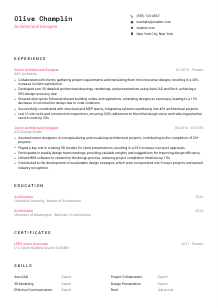
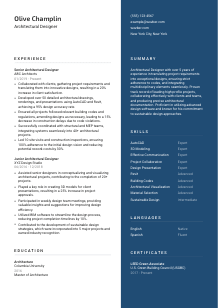
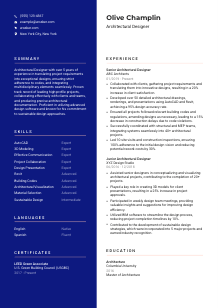
Blueprints to success, but your CV doesn't stand out? Get a closer look at this Architectural Designer CV example, created with Wozber free CV builder. It shows how to shape your design acumen to match job specifics, ensuring your career rises as stunningly as your structures.
Architectural design work gets judged in the details long before a project reaches permit or construction. Hiring teams want to see whether you can move from client requirements to clear drawings, coordinated systems, and code-aware revisions without losing the design intent. Your CV should make that process visible, especially where your work touched documentation, visualization, consultant coordination, or site follow-through.
CV tailoring changes how quickly a firm can place you in the right part of its workflow. When your headings, project bullets, and software terms reflect the language of the job description, Wozber's free CV builder helps you shape an ATS-compliant CV that surfaces experience in Revit, AutoCAD, code coordination, and client-facing design work. That gives reviewers a faster read on whether you can contribute to real project delivery, not just concept sketches.
Architectural firms usually see your contact block before they see your drawings, software stack, or project history. Keep it clean, professional, and aligned with the basics the employer needs to confirm, especially title, contact access, and location when the posting specifies it.
Place your name first, then use the target title directly beneath it. For this opening, "Architectural Designer" is the right choice because it matches the role and sets expectations around design development, documentation, consultant coordination, and presentation work.
Use a current phone number and a professional email address that would look at home on a client presentation or drawing transmittal. Double-check every character. A missed digit or outdated inbox can cost you an interview even when your portfolio and CV are otherwise well aligned.
If an employer asks for someone based in a specific city, put your city and state in this section. Here, listing "New York City, New York" immediately addresses a stated requirement and removes uncertainty around relocation or local availability for site visits, meetings, and inspections.
For architectural roles, a portfolio link often matters more than a generic personal website. Include it if it shows drawings, renderings, built work, concept development, or BIM-based coordination that matches the level of the jobs you are targeting. Keep your LinkedIn and portfolio project names, dates, and titles consistent with the CV.
Do not add age, marital status, headshot, or other personal information unrelated to architectural practice. Save the space for project-relevant material and keep the opening of your CV focused on professional identity and accessibility.
This section should answer the practical opening questions quickly: who you are, what role you do, how to reach you, and whether you meet any location requirement. Make those basics easy to confirm so the reader can move straight into your design and project experience.




For Architectural Designers, experience is where hiring managers look for proof of how you contribute across design stages. They want to see more than job titles. They look for work with drawings, BIM or CAD tools, consultants, codes, client presentations, and the kinds of project outcomes that affect approvals, accuracy, rework, or delivery.
Before rewriting your bullets, identify the workflows the role depends on. In this posting, those include translating client requirements into design solutions, producing drawings and renderings, working within building codes, coordinating with structural and MEP teams, and joining site visits or inspections. Those are the themes your experience section should reflect.
List positions in reverse chronological order with title, firm name, and dates. For this profession, progression matters. A move from junior design support into independent drawing production, consultant coordination, or client-facing presentation work tells a stronger story than title changes alone.
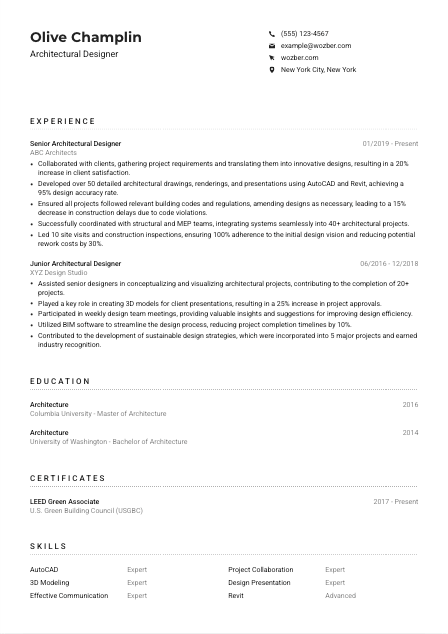
Write bullets around what you produced and what improved because of your work. The sample CV handles this well by moving beyond general statements into specifics such as developing more than 50 drawings and renderings, coordinating 40+ projects with structural and MEP teams, and reducing delays tied to code violations. That kind of wording helps firms picture where you can plug into their delivery process.
Quantify the scale or result of your work when the numbers are real and relevant. Useful measures include drawing volume, number of projects, design accuracy, permit or code-related revisions, client approval rates, reduced rework, timeline improvement, or inspection outcomes. Metrics like a 25% increase in project approvals or a 30% reduction in potential rework costs feel credible here because they connect directly to design communication and construction execution.
You do not need to document every task from every studio job. Keep the bullets that prove architectural design value: BIM or CAD output, coordination across disciplines, code compliance, client communication, sustainable design input, and site-based follow-through. If a bullet would not help a firm trust you with drawings, reviews, or coordination meetings, remove it.
A well-built experience section lets a reviewer see how you think, document, coordinate, and respond to project constraints. If your bullets show design output and delivery impact in the same line, the section is doing its job.
Architecture hiring still pays close attention to education because it anchors technical training, studio development, and your familiarity with design process. For many Architectural Designer roles, the degree is a baseline requirement, especially when firms want candidates who can contribute to documentation, coordination, and code-aware design work from the start.
If the posting asks for a Bachelor's or Master's degree in Architecture or a related field, list that credential clearly and without abbreviation confusion. In the example, both the Master of Architecture and Bachelor of Architecture line up cleanly with what the employer asked for, which removes any doubt on qualification.
Present each entry with degree, field, school, and graduation year. Keep the structure consistent so the reader can scan it quickly. Architectural hiring teams usually do not need extra formatting here. They need to confirm the credential and move on to your design work.
If your academic work included sustainable design, urban systems, fabrication, parametric modeling, preservation, or another area that connects to the role, mention it briefly when it adds context. Use this selectively. The degree itself comes first, then any focus area that strengthens your relevance.
Honors, thesis topics, juried studio work, or standout coursework can be useful if you are earlier in your career or if the content directly supports the target role. For example, a thesis tied to adaptive reuse, building systems integration, or code-responsive housing could add weight for a design-focused firm.
Leadership in design-build teams, architecture organizations, competition work, or collaborative studio projects can help if they show coordination, presentation, or technical discipline. Keep these additions concise and tied to how architects actually work, not as a general student activity list.
This section should quickly establish that you meet the academic standard and, where relevant, hint at the design or technical focus you built during school. Once that baseline is clear, your experience and portfolio can carry the heavier proof.
Certifications are not mandatory in every Architectural Designer search, but the right one can sharpen your profile. They work best when they connect to real project concerns such as sustainability, building performance, materials, or professional development that firms increasingly value in design teams.
Choose certifications that connect to the kind of work you want to do. A LEED Green Associate, for example, supports roles where sustainable design strategies, material selection, and environmental performance matter. It adds more value than a general credential with no clear link to architectural practice.
Only include certifications that strengthen your case for the position. One relevant credential is better than a crowded list of loosely related courses. In the example, the LEED credential works because it complements the sustainable design experience already mentioned in the CV.
List the certification name, issuing organisation, and date or active period. This makes it easy for a recruiter or hiring manager to understand what the credential covers and whether it is current. Clear presentation matters here just as much as it does in a drawing set.
As your career grows, this section can evolve with it. Add credentials that reflect the direction of your work, whether that is sustainability, BIM specialization, code-related expertise, or other technical areas that affect project delivery and team value.
Used well, this section shows professional momentum and added capability. Keep it short, current, and connected to real architectural responsibilities rather than collecting credentials for their own sake.
Architectural Designers are rarely hired for software alone. Firms want a mix of drafting and modeling tools, building knowledge, coordination ability, and client communication. Your skills section should group those capabilities in a way that reflects how projects actually move from concept to construction.
Start with the posting and identify both stated and implied skills. Here, the obvious ones are AutoCAD, Revit, 3D modeling, building materials, codes, construction methods, communication, and collaboration. The implied skills include presentation development, consultant coordination, and design revision through project phases.
Lead with the tools and knowledge areas that let you contribute immediately. Software such as AutoCAD and Revit belongs near the top for this role, followed by code knowledge, architectural visualization, material selection, and cross-disciplinary collaboration. The example CV does this well by balancing technical tools with practice-based abilities like design presentation and project collaboration.
Do not leave the section as a random inventory. Group skills by function, such as design software, technical knowledge, and communication or coordination. That structure makes it easier for both ATS systems and human reviewers to connect your skills to drawing production, consultant integration, and client-facing design work.
A focused skills section should tell a firm where you can contribute on day one, whether that is BIM production, code-aware documentation, consultant coordination, or presentation support. Keep it current and tied to the work you want to be trusted with.
Architecture is collaborative work. Drawings, markups, presentations, consultant meetings, and site conversations all depend on clear communication. If a posting names language ability, treat that as an operational requirement, especially when the role involves client interaction and coordination across multiple stakeholders.
When English fluency is specifically requested, list English at the top with an honest proficiency level. For a role that includes presenting design concepts, coordinating with engineers, and participating in site visits, that requirement is directly tied to daily performance, not just general communication.
Additional languages can strengthen your profile when they support client communication, community-facing work, or collaboration in diverse project teams. In the example, Spanish adds useful range without distracting from the primary requirement for fluent English.
Stick to straightforward ratings such as Native, Fluent, Intermediate, or Basic. Avoid vague wording. Hiring teams need a realistic sense of how comfortably you can discuss design intent, review comments, and construction issues in each language.
Language ability carries more weight in firms serving multilingual clients, public-sector projects, or internationally connected teams. Even when not required, it can support your candidacy if communication is a visible part of the role.
Only claim a level you can use in real working situations, including presentations, meetings, and written coordination. In architecture, overstatement gets exposed quickly when the conversation moves from general ideas to technical details.
This section should help a firm understand how you communicate in the settings that matter most: client meetings, team reviews, and project coordination. Accuracy matters more than volume.
The summary sits at the top of the CV, so it should quickly establish what kind of Architectural Designer you are. Keep it grounded in experience, design scope, software fluency, and project contribution. This is where you frame your professional profile before the reader gets into the individual roles.
Read the posting closely and pull out the few themes that define success in the role. For this one, that means architectural design experience, AutoCAD and Revit fluency, code awareness, consultant coordination, and communication with clients and team members. Those ideas should shape the summary more than generic claims about creativity or passion.
Start with a direct line that names your profession and years of relevant work. The sample summary uses "Architectural Designer with over 5 years of experience," which works because it immediately gives the reader both role identity and professional range.
Your summary should mention the tools and responsibilities that define your value, then connect them to results. For example, note experience producing precise architectural documentation, integrating multidisciplinary systems, or improving design accuracy and reducing rework through coordinated drawings and code-compliant revisions.
Aim for 3 to 5 lines with no filler. Every sentence should earn its place by clarifying your design focus, software fluency, project scope, or delivery impact. If a line could apply just as easily to another profession, rewrite it until it sounds clearly architectural.
By the time a hiring manager finishes this section, they should already understand your level, your design tools, and the kind of project contribution you bring. That makes the rest of the CV easier to read in the right context.
A strong Architectural Designer CV shows more than design interest. It shows how you turn requirements into drawings, coordinate with consultants, work within codes, and support projects through review and execution. When each section reflects that reality, the document reads like a useful project profile rather than a generic career summary.
Use Wozber to tighten that alignment across structure, wording, and ATS optimisation. Its free CV builder, ATS-friendly CV templates, and ATS CV scanner can help you match the language of the job description, surface missing requirements, and present your experience in a format firms can scan quickly. The final read should make one thing clear: you are ready to contribute to design work that has to be buildable, coordinated, and client-ready.