




Use Wozber and land your dream job
Create CV
No registration required
Shaping narratives, but your CV reads like fine print? Edit that intro with this Editorial Director CV example, created with Wozber free CV builder. Learn how to clearly articulate your editorial vision so it matches the job narrative, and put your career at the helm of captivating stories!
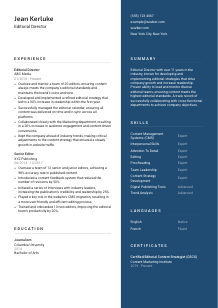
Editorial Director hiring usually turns on one question fast: have you led content operations at a level where quality, consistency, and deadlines all hold together at once? A CV for this role needs to make that visible through real editorial scope, such as team leadership, brand voice stewardship, publishing cadence, and the business results of your content strategy.
When that story is tailored well, the hiring team can quickly separate a senior editor with strong copy instincts from a director who can run an editorial function. Wozber's free CV builder helps you shape that distinction in an ATS-compliant CV by aligning your language with the posting, organising leadership outcomes clearly, and making it easy to see how you manage standards, strategy, and cross-functional execution.
For an Editorial Director, the header should read like clean front matter: accurate, relevant, and easy to scan. This section is short, but it still does important work by confirming role alignment, professional presence, and any stated logistical requirement such as location.
Use your full name as the most prominent text in the header. Keep the formatting clean and editorially restrained. For a senior content leader, decorative styling works against you. Clear hierarchy and polished presentation already suggest the judgment expected from someone who sets publishing standards.
Place "Editorial Director" directly under your name if that matches the role you are pursuing and the level of work you have done. Matching the target title helps frame the rest of the CV around leadership, editorial strategy, and team oversight instead of leaving you looking like a general content candidate.
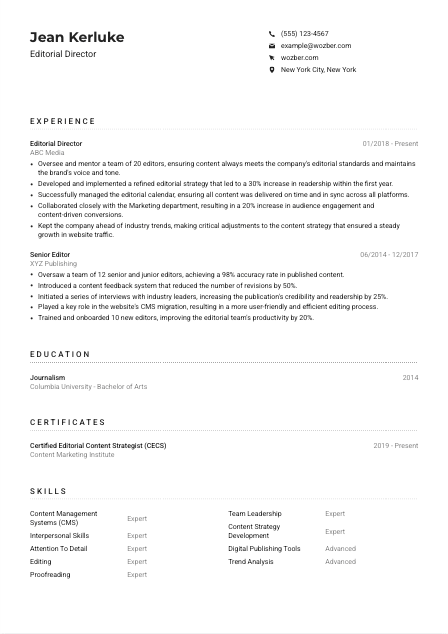
Include a reliable phone number and a professional email address. Add your city and state when location matters. Here, "New York City, New York" is worth listing because the posting specifically requires the candidate to be based there. That kind of detail removes friction early in the review process.
A LinkedIn profile, portfolio site, or professional website can help if it shows published work, leadership scope, speaking, or thought leadership in content strategy. Make sure it is current and consistent with your CV. For an Editorial Director, a weak or outdated link can undercut the polish your CV is trying to convey.
Do not include age, marital status, photo, or other personal identifiers unless a local norm explicitly requires them. Editorial hiring should stay focused on the substance of your leadership, the quality of your execution, and the scale of the content operation you have run.
Your personal details should confirm that you are easy to contact, aligned with the target role, and responsive to any stated requirement such as location. Keep it tight and accurate, and let the rest of the CV carry your editorial leadership story.




This is the section hiring teams read most closely for Editorial Director roles. They want to see whether you have managed editors, shaped content strategy, maintained standards across channels, and kept publishing on schedule while supporting broader business goals.
Prioritise positions where you directed editorial output, managed people, owned a content roadmap, or influenced brand voice across platforms. If your background includes both writing and leadership, give more space to the roles where you set standards and made decisions, not just produced copy. In the example CV, the move from Senior Editor to Editorial Director makes that progression easy to follow.
Start with your current or most recent position and work backward. For each entry, include title, employer, and dates. That structure helps hiring managers understand how your remit expanded over time, whether from editing into team management, or from publication oversight into full editorial strategy.
Write bullet points that show what changed because of your work. For this level, that means outcomes tied to readership growth, engagement, on-time delivery, editorial accuracy, team performance, or content-driven business impact. A bullet like "developed and implemented an editorial strategy that increased readership by 30%" works because it connects strategic ownership to a measurable audience result.
Numbers help define the size of the operation you led. Include team size, publishing volume, engagement lift, conversion impact, accuracy rates, reduced revision cycles, or traffic growth when those metrics reflect your actual work. The sample CV does this well by noting a team of 20 editors, a 20% increase in audience engagement, and a 98% accuracy rate in published content.
Keep the section focused on work that proves you can lead an editorial function. Routine copyediting tasks, generic writing duties, or older experience without strategic relevance can be trimmed back. Space is better used on editorial calendar ownership, stakeholder collaboration, CMS initiatives, brand stewardship, and the outcomes of your leadership.
A strong experience section makes it easy to see the scale you have managed, the standards you have upheld, and the results your editorial decisions produced. That is the core proof behind an Editorial Director application.
Education will not carry the application on its own at this level, but it still needs to confirm that you meet the stated academic requirement. For senior editorial roles, this section works best when it is clean, direct, and aligned with the field expectations in the posting.
Start by checking the posting for the required degree and field. Here, a bachelor's degree in English, Journalism, Communications, or a related field is requested. If your degree fits, present it clearly. The example CV does this directly with a Bachelor of Arts in Journalism.
List the degree, field of study, school name, and graduation year or date. Keep the structure simple. For Editorial Director roles, this section should support the application without competing with the experience section for attention.
If your degree is especially relevant, such as Journalism, English, or Communications, name the field exactly rather than relying on abbreviations or partial wording. That direct alignment helps both ATS screening and human review, especially when the employer has set a specific education baseline.
Most senior editorial candidates do not need to list coursework, but it can help if your degree title is broad or if a concentration connects directly to digital publishing, media, communications, or content strategy. Keep it selective and useful.
Honors, editorial positions in student publications, or standout academic work can be worth mentioning if they reinforce your long-term editorial track. For most experienced candidates, though, professional results matter far more, so keep education concise.
At the director level, education mainly confirms that you meet the formal requirement and have a relevant academic foundation. Present it plainly, then let your leadership record do the heavier lifting.
Certifications are usually a supporting section for Editorial Director CVs, not a deciding one. They help when they reinforce areas such as content strategy, digital publishing, audience development, or leadership in modern editorial environments.
Start with credentials that strengthen your case for running a content function. A certificate in content strategy, digital publishing, or editorial operations is more relevant here than a broad unrelated course. The example's "Certified Editorial Content Strategist" works because it supports the strategic side of the role.
One or two strong certifications are better than a crowded section of loosely connected programs. Hiring teams will care more about whether a credential sharpens your profile in strategy, audience growth, workflow management, or leadership than about the total number listed.
Include the year earned or active period, especially when the credential is recent or ongoing. For editorial work shaped by changing distribution channels, CMS workflows, and digital audience behaviour, recency can help show that your knowledge has stayed current.
A well-chosen certification suggests that you stay engaged with changes in content strategy, publishing tools, and market trends. That matters for an Editorial Director who is expected to refine strategy, respond to competitive shifts, and guide a team through evolving formats and channels.
Relevant certifications can add weight to your profile, especially when they reinforce editorial strategy or digital publishing expertise. Keep the section focused and make every credential support the level of role you want.
Editorial Director CVs need a skills section that goes beyond generic communication strengths. The right mix should show how you run editorial systems, maintain quality, lead people, and connect content output to audience or business performance.
Review the job description for the operational and leadership capabilities it emphasizes. For this role, that includes CMS proficiency, digital publishing tools, editing, proofreading, interpersonal strength, team leadership, and strategy development. Only include skills you can support elsewhere in the CV.
A director-level list should show both execution standards and organizational leadership. Pair skills like editing, proofreading, brand voice, and CMS fluency with team leadership, editorial planning, stakeholder collaboration, and trend analysis. That balance helps distinguish a content leader from an individual contributor.
Do not turn the skills section into a keyword dump. Prioritise the abilities most likely to matter in hiring for this role, and use wording that matches the posting naturally. The example CV is strongest where it combines core editorial abilities with strategic ones, such as CMS, content strategy development, digital publishing tools, and leadership.
The best skills lists confirm how you work: leading editors, managing publishing workflows, maintaining standards, and shaping strategy. Keep it focused enough that every skill points back to the job you want.
Language ability is not always central to Editorial Director hiring, but it can add context when it supports audience reach, team collaboration, or market understanding. Include this section if it reflects a real advantage, not just to fill space.
Start with the posting. If no additional language is required, treat this section as optional support rather than a core qualification. For editorial leadership, extra languages can still be useful when publications serve multilingual audiences, cover international markets, or work with global contributors.
Begin with your strongest language and label your level honestly, such as Native, Fluent, or Conversational. Clear proficiency labels matter more than an impressive list, especially if language ability could affect interviews, stakeholder communication, or content review.
If another language helps you oversee region-specific content, work across international teams, or understand a broader audience, that is worth noting. In the example CV, fluent French adds range, though it remains secondary to the candidate's editorial leadership record.
Use realistic labels and avoid overstating your fluency. Editorial roles rely heavily on precision, so inflated language claims can hurt trust quickly if they come up in conversation or collaboration.
Additional languages can round out your profile, but they should not distract from the main hiring criteria for an Editorial Director: strategic judgment, content quality, team leadership, and delivery across channels.
If language skills broaden your audience understanding or collaboration range, they can strengthen the CV. Just keep them in proportion to the leadership and strategic work that will drive the hiring decision.
The summary is where you set the editorial and leadership frame for the rest of the CV. For an Editorial Director, it should quickly show seniority, scope, and the kind of outcomes you have delivered, without slipping into generic statements about being passionate or results-driven.
Before writing the summary, identify the few themes the employer is hiring for most aggressively. In this case, those are editorial leadership, content quality, strategic direction, deadline management, and cross-functional collaboration. Build your opening around that mix instead of trying to summarise your entire career.
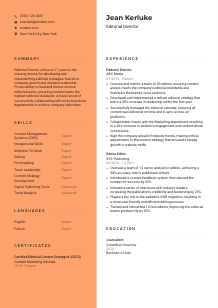
State your title or leadership identity, followed by your years of experience if they strengthen your candidacy. A line such as "Editorial Director with 11+ years in publishing and content leadership" immediately establishes seniority and relevance.
Use short, concrete phrases that show the kind of results you produce. That could mean readership growth, stronger editorial standards, better on-time delivery, improved engagement, or successful collaboration with marketing and other stakeholders. The sample summary works because it ties strategy and team leadership to company growth.
Aim for three to five lines with language that matches the job posting naturally. A concise summary is especially important in editorial hiring, where clarity, pacing, and word choice are part of the impression you create. Every sentence should earn its place.
Your summary should quickly establish that you can direct content, lead teams, and shape strategy in a way that supports the brand and the business. Once that frame is clear, the rest of the CV has a stronger job to do.
An Editorial Director CV should leave little doubt about three things: the scale of editorial work you have led, the standards you have maintained, and the results your strategy produced. When those points come through clearly, hiring teams can picture you running the calendar, guiding editors, and protecting the brand voice from day one.
Wozber helps you turn that experience into a polished ATS-friendly CV with stronger ATS optimisation, clearer role alignment, and language tailored to the posting. Use it to sharpen each section, then apply with a CV that makes your editorial judgment and leadership easy to recognize.




