



Use Wozber and land your dream job
Create CV
No registration required
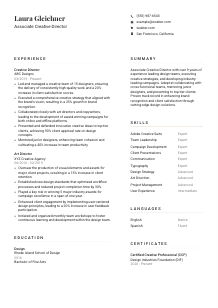
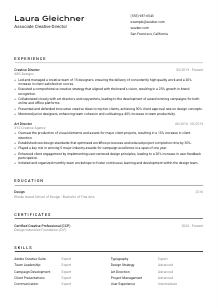
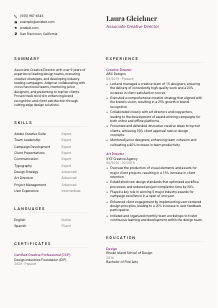
Molding cutting-edge campaigns, but your CV seems conventional? Check out this Associate Creative Director CV example, created with Wozber free CV builder. Learn how to artfully position your leadership and creative flair to match job expectations, painting a career portrait as bold as your boldest brushstrokes!
Associate Creative Directors sit in the middle of concept, craft, and team leadership. Hiring teams want to see more than visual taste. They look for proof that you can steer campaigns, sharpen ideas with art directors and copywriters, protect brand standards, and keep creative output strong across channels without slowing the team down.
CV tailoring changes how quickly that leadership becomes visible. When your wording mirrors the brief, your team scope, campaign work, presentation experience, and software fluency are easier to surface in an ATS-compliant CV. Wozber's free CV builder helps organise that language clearly so both the ATS and the hiring team can quickly recognize whether you can lead creative work from concept through delivery.
The header does a simple but important job. For an Associate Creative Director, it should immediately establish professional identity and remove friction around contact, portfolio access, and basic eligibility.
Use your full name in a clean, prominent format so it anchors the page right away. In creative leadership hiring, flashy formatting rarely helps here. Clear hierarchy does.
Place "Associate Creative Director" directly beneath your name if that is the role you are pursuing. Matching the target title helps frame your experience around creative leadership rather than leaving the reader to infer whether you are aiming for senior design, art direction, or broader brand leadership.
List a phone number and professional email address that you check regularly. This role often involves interviews with recruiters, creative leaders, and cross-functional stakeholders, so missed outreach can slow things down. A simple format such as firstname.lastname@email.com keeps the section polished.
If the posting asks for San Francisco, CA, show that you are already based there or make relocation clear. That is a posting-specific requirement, not a universal rule for every Associate Creative Director job, but when it appears in the brief, it belongs in your header so the employer does not have to guess.
For creative leadership roles, a LinkedIn profile or portfolio site is often just as important as the CV itself. Make sure the work shown there supports what your CV says about campaign direction, brand systems, integrated work, and client presentations. If your CV mentions award-winning campaigns or omni-channel assets, your portfolio should show that level of work.
This section should confirm who you are, what role you are targeting, how to reach you, and where to see your work. Once that is clear, the hiring team can focus on your creative leadership record.




This is the section most likely to determine whether you move forward. For an Associate Creative Director, employers look for the mix of concept development, team guidance, brand stewardship, stakeholder management, and measurable campaign results that shows you can lead work rather than simply contribute to it.
Read the posting closely and identify the responsibilities that define success in the role. Here, the central themes are leading a creative team, collaborating with art directors and copywriters, developing visual campaigns across online and offline channels, presenting ideas, and mentoring talent. Those themes should shape which bullets you keep and how you phrase them.
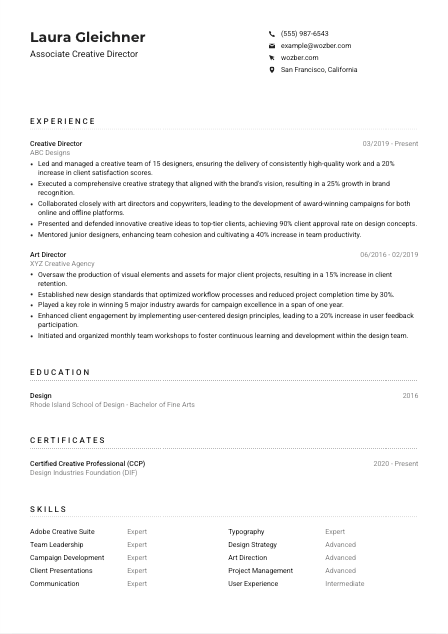
List positions in reverse chronological order and make the path to creative leadership obvious. Titles such as Art Director, Senior Designer, Design Lead, or Creative Director can all support an Associate Creative Director application if the bullets show expanding ownership over concepts, team direction, and client-facing work. In the example CV, the move from Art Director to Creative Director makes that progression easy to follow.
Your bullets should show what changed because of your direction. Results such as stronger brand recognition, higher client approval rates, faster campaign delivery, improved retention, or better team productivity carry more weight than generic statements about managing projects. The sample CV does this well with metrics like a 20% rise in client satisfaction and a 25% increase in brand recognition.
Associate Creative Directors are often judged on how well they turn ideas into campaigns with partners in copy, design, marketing, and account teams. Make that collaboration concrete. Mention cross-functional concept development, creative reviews, stakeholder presentations, campaign launches, or feedback loops that improved the final work. A bullet about working closely with art directors and copywriters is stronger when it also shows what that collaboration produced.
Use numbers where they reflect how creative work is evaluated. Team size, approval rate, delivery speed, campaign performance, client retention, award recognition, and productivity gains all help. The sample CV pairs leadership and impact effectively by noting management of 15 designers alongside gains in satisfaction and productivity. That combination tells a fuller story than metrics on campaign work alone.
Your experience section should leave no doubt about the level of creative judgment, team leadership, and campaign responsibility you already handle. When the bullets show results, collaboration, and scope, the leap to Associate Creative Director feels credible.
Education carries less weight than your portfolio and experience at this level, but it still matters when the job description asks for a degree. Present it clearly and use it to confirm the formal design or fine arts background the employer is expecting.
If the posting asks for a bachelor's degree in Design, Fine Arts, or a related field, make sure your education section reflects that language accurately. A Bachelor of Fine Arts in Design, like the example CV shows, lines up neatly with the requirement and removes unnecessary ambiguity.
List degree, field of study, school, and graduation year in a clean order. At the Associate Creative Director level, clarity matters more than detail unless your coursework or academic project work has direct relevance to branding, campaign development, or visual communication.
Spell out the discipline rather than relying on a vague degree label. "Design," "Graphic Design," "Visual Communication," or "Fine Arts" gives the reader a clearer picture of your formal training and helps reinforce alignment with the posting.
Honors, thesis work, capstone projects, or design leadership activities can be worth adding if they still connect to the kind of work you do now. For example, a branding thesis or a senior campaign project may still be relevant if it supports your current focus on creative strategy and concept execution.
If you are several years into your career, keep this section concise. Let education confirm qualifications, then let experience and portfolio carry the argument. Save space for academic distinctions only when they add something your professional record does not already show.
For this role, education should validate your background without pulling attention away from your campaign work and leadership record. Keep it accurate, relevant, and brief.
Certifications are usually secondary for Associate Creative Director hiring, but they can strengthen your profile when they reflect ongoing development in creative leadership, branding, design systems, or adjacent strategy work. Include them when they add professional depth, not just volume.
The strongest certifications are the ones that connect to how Associate Creative Directors operate, whether in creative strategy, brand development, leadership, UX, or advanced design practice. The example's "Certified Creative Professional" works because it supports the broader story of senior creative capability.
A short list of meaningful credentials is more persuasive than a long list of loosely related courses. If a certification does not strengthen your case for leading campaigns, mentoring creatives, or directing brand work, it can usually be left off.
Dates help the reader understand whether a certification is current, recently earned, or maintained over time. That matters more when the credential reflects an evolving area such as digital experience, creative technology, or leadership development.
Creative leadership changes with platforms, audience behaviour, and production workflows. Certifications can show that you continue to sharpen your practice beyond your day job, especially if they support newer channels, integrated campaign thinking, or team leadership.
When certifications appear on this CV, they should support your credibility as a creative lead who keeps developing craft, strategy, or management skills in a changing market.
An Associate Creative Director skill list should capture both creative execution and leadership range. Hiring teams expect design fluency, but they also want to see whether you can direct campaigns, communicate ideas, guide teams, and work across functions.
Start with the tools and capabilities the employer has already named. In this case, that includes Adobe Creative Suite, leadership, communication, collaboration, and team management. Matching those terms helps with ATS optimisation and shows that your background aligns with the actual brief.
Do not make this section read like a mid-level designer's profile. Pair technical strengths such as Adobe Creative Suite, typography, art direction, or campaign development with leadership skills like mentoring, client presentations, creative strategy, and cross-functional collaboration. That combination reflects the real operating range of the role.
Choose skills you can support in your experience bullets and portfolio. A concise list of relevant capabilities is stronger than an oversized inventory. In the example CV, skills such as Campaign Development, Client Presentations, and Team Leadership directly reinforce the achievements described in the experience section.
Every skill listed here should be backed by work you have led, presentations you have handled, teams you have managed, or campaigns you have shipped. That is what makes the section convincing.
Language fluency matters differently across creative roles. For an Associate Creative Director, the baseline requirement is usually clear communication with clients, internal stakeholders, and the creative team. Additional languages can help, especially in global brand, multicultural, or international agency work.
If the job description states that English is essential, list your English proficiency clearly. That requirement is straightforward, and your CV should answer it just as directly.
Extra languages can strengthen your profile when the brand, client base, or agency footprint is international. They are particularly useful if you have worked on multilingual campaigns, regional brand adaptations, or client relationships that benefited from that fluency.
Be clear about whether you are Native, Fluent, Advanced, or Intermediate. Overstating language ability becomes obvious quickly in interviews and client-facing roles, where communication quality is part of the job.
If you speak more than one language, it can point to stronger cross-cultural communication and a broader perspective on audience nuance. That is useful in creative work, especially when campaigns need to resonate across markets rather than simply be translated.
Languages are a supporting detail unless the role specifically depends on them. Include them cleanly, then keep the main emphasis on concept quality, team leadership, and campaign execution.
This section should confirm communication capability and, where relevant, broaden your appeal for multicultural or international creative work. It should not compete with the core story of your leadership and creative direction.
Your summary should read like an informed snapshot of the level you operate at. For an Associate Creative Director, that means combining senior creative experience with the ability to lead teams, shape campaigns, and represent ideas persuasively to stakeholders.
Start with a direct statement that establishes seniority. A line such as "Associate Creative Director with 9+ years of experience" immediately frames the rest of the CV and helps distinguish you from candidates coming from purely execution-focused design roles.
Use the next sentence to cover the work that matters most at this level. Mention leading design teams, guiding creative strategy, developing campaigns, collaborating across disciplines, or presenting concepts to clients and stakeholders. The example summary does this well by tying leadership, strategy, and cross-functional collaboration together.
Aim for a short paragraph that includes your strongest role-defining themes and one or two meaningful outcomes. Brand recognition growth, client satisfaction gains, award-winning work, or team development can all fit here if they are native to your experience. Avoid vague claims that could belong to any senior creative.
Revisit the job description before finalizing the summary. If the role emphasizes mentoring, stakeholder presentations, multi-channel campaigns, or agency background, reflect those priorities in your wording when they match your experience. This is one of the fastest ways to make the CV feel tailored rather than generic.
A well-shaped summary should make the rest of the CV easier to read. It sets expectations around your leadership range, creative judgment, and campaign experience before the hiring team gets into the details.
An Associate Creative Director CV needs to make three things easy to see: the quality of work you have led, the teams and stakeholders you can manage, and the business or brand results tied to your creative decisions. When each section supports those points, the document reads with much more authority.
Use Wozber to tighten that alignment through structured writing, ATS optimisation, and clear section planning. With Wozber's AI CV builder and ATS CV scanner, you can match your language to the job description, surface missing requirements, and shape an ATS-friendly CV format that shows you are ready to lead creative work at this level.