



Use Wozber and land your dream job
Create CV
No registration required
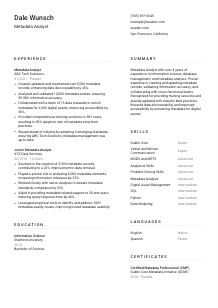
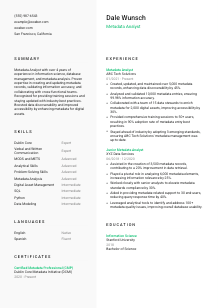
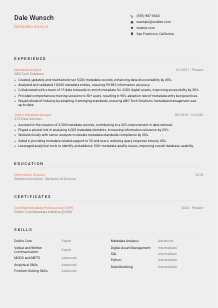
Cataloging facts, but your CV feels hidden in the stacks? Check out this Metadata Analyst CV example, created with Wozber free CV builder. It shows how to showcase your information organisation skills to match job specifics, setting your career data to be as discoverable as can be!
Metadata work gets judged in the details. Hiring teams want to see whether you can keep records accurate, apply standards consistently, and make digital assets easier to find and use across real systems and teams. Your CV should make that operational value visible, not just say you are organised or analytical.
When metadata CVs are tailored well, the first scan quickly shows the standards, record volumes, quality work, and collaboration scope behind your experience. Wozber's free CV builder helps you shape that into an ATS-compliant CV with language that matches the posting, so reviewers can immediately see whether you can support discoverability, metadata quality, and cross-functional workflows.
This section is simple, but it still carries practical screening value. For a Metadata Analyst, it should confirm role alignment, make contact easy, and address any location or communication requirement stated in the posting.
Use your full name in a slightly larger font than the body text so it is easy to spot at the top of the page. Clean presentation matters here because metadata roles are tied to precision, consistency, and attention to detail, and your CV should reflect that from the first line.
Place your professional title directly under your name and keep it aligned with the role you are targeting. If "Metadata Analyst" accurately reflects your background, use it. That makes your focus clear immediately and helps both recruiters and ATS tools connect your CV to the position without extra interpretation.
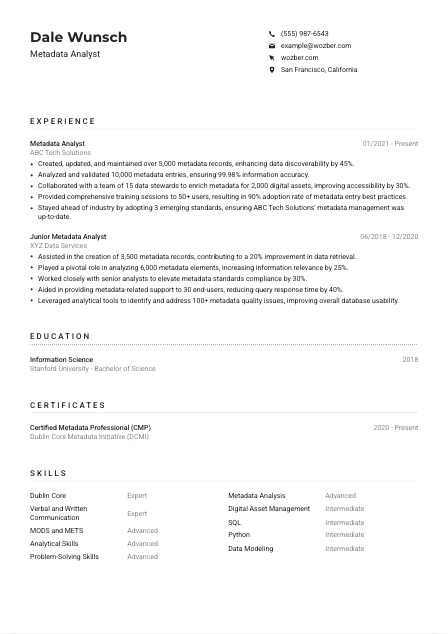
If a job requires you to be in a specific city or open to relocation, show that clearly in your header. In this example, listing "San Francisco, California" directly supports a stated requirement and removes an avoidable question before the CV even reaches the experience section.
Include LinkedIn or a professional site if it adds context to your metadata work, such as taxonomy projects, digital asset initiatives, data governance work, or technical tools you use. Keep the content aligned with the CV so your job titles, dates, and scope of work tell one consistent story.
Your personal details should remove friction, not create it. A clear title, accurate contact information, and any required location detail help reviewers move straight to your metadata experience. Wozber's ATS-friendly CV template keeps this section clean and easy to parse.




For Metadata Analyst roles, the experience section carries most of the hiring weight. This is where you show how you handled metadata records, quality checks, standards compliance, digital asset enrichment, and user support in working environments rather than in abstract terms.
Before editing bullets, mark the responsibilities and requirements that define the role. Here, that includes creating and maintaining metadata records, validating quality, using standards like Dublin Core, MODS, or METS, collaborating with data stewards, and training users. Those themes should appear naturally across your recent roles if they reflect your actual work.
Move past generic statements like "responsible for metadata maintenance." Show what changed because of your work. Strong bullets mention outputs and results, such as record volume, discoverability gains, accuracy rates, adoption of metadata standards, or turnaround improvements. The sample CV does this well by tying metadata maintenance to a 45% improvement in discoverability and validation work to 99.98% accuracy.
Metadata work is measurable, so use numbers wherever they are real and relevant. Counts of records maintained, assets enriched, users trained, quality issues resolved, or percentage improvements in retrieval and accessibility help hiring teams understand your operating scale. Numbers like 5,000 records, 10,000 validated entries, or 50+ trained users immediately make the work more concrete.
Trim bullets that centre on unrelated administrative work unless they directly supported metadata operations, digital collections, cataloging quality, or data discoverability. Each line should strengthen your case for work involving metadata standards, validation, analysis, stakeholder collaboration, or user guidance. Relevance matters more than volume.
By the end of your experience section, a reviewer should understand the scale of your metadata work, the standards or workflows you supported, and the outcomes you improved. Wozber's ATS CV scanner can help you align those bullets with the terms and priorities used in the target posting.
Education matters here because many Metadata Analyst openings ask for a degree tied to information science, computer science, or a related discipline. The key is to present your academic background in a way that clearly supports the technical and organizational demands of metadata work.
If the posting asks for a bachelor's degree in Information Science, Computer Science, or a related field, make that easy to confirm. Lead with your most relevant completed degree and use the full degree and field name. In the sample, "Bachelor of Science in Information Science" lines up cleanly with the requirement.
List degree, field of study, school, and graduation date in a consistent order. A simple structure keeps attention on the qualification itself and helps ATS systems parse the section accurately.
When your degree has a direct connection to metadata analysis, information architecture, library and information science, database systems, or digital asset management, let that relevance speak clearly. You do not need extra explanation if the field already maps well to the role.
If you are earlier in your career, relevant coursework can help fill in context. Courses in metadata standards, database design, digital libraries, information retrieval, taxonomy, or data modeling can reinforce your foundation when professional experience is still developing.
Honors, research, capstone work, or relevant student projects are worth adding when they connect to structured information, digital collections, search, or data quality. If you already have several years of strong metadata experience, keep these details brief so the CV stays weighted toward professional impact.
Your education section should confirm that you meet the academic baseline and that your background supports metadata analysis work. Wozber helps present it in a clean ATS-friendly CV format that keeps the qualification easy to find.
Certifications are not always required for Metadata Analyst roles, but the right ones can strengthen your profile, especially when they reflect current metadata standards, digital asset practices, or specialised information management knowledge.
Prioritise certificates that reinforce the exact kind of work the role requires. Credentials tied to metadata standards, cataloging, taxonomy, digital collections, information governance, or data management carry more weight here than broad generic training. A certification such as Certified Metadata Professional fits naturally because it points back to the standards-based side of the work.
Only include certifications that help explain why you can manage metadata quality, apply standards, or support information discoverability. A short, relevant list is stronger than a long inventory that pulls attention away from your core specialization.
Metadata standards and information management practices evolve, so dates can be useful. Showing when a certification was earned or whether it is still active helps demonstrate that your knowledge is current enough for present-day metadata workflows.
If you continue to learn through certifications or formal training, that supports the part of the role that requires staying current with emerging standards and best practices. Use this section to show continued engagement with the field, especially if the role involves evolving schemas, digital asset platforms, or governance frameworks.
A well-chosen certification section adds weight to your technical credibility without taking over the CV. Wozber's free CV builder makes it easy to keep these credentials visible and neatly structured in an ATS-compliant CV.
A Metadata Analyst skills section should read like a practical map of how you do the work. Focus on standards, analysis capabilities, supporting tools, and communication strengths that matter in metadata environments.
Start with the language used in the job description. Here, that includes metadata standards such as Dublin Core, MODS, and METS, along with analytical problem-solving and cross-functional communication. Those are not filler keywords. They describe the daily work and should be represented when they match your experience.
Put the most relevant capabilities first. For this kind of role, metadata standards, metadata analysis, quality validation, digital asset management, and communication with data stewards or subject matter experts usually deserve higher placement than general technical skills. The sample CV handles this well by placing Dublin Core, MODS, METS, and metadata analysis near the top.
Do not overload the section with every software platform or transferable skill you have ever used. Choose the skills that support the role most directly, then let the experience section prove them. A concise list helps both ATS parsing and human review, especially when the terms reflect real metadata workflows instead of generic buzzwords.
This section should tell a reviewer, in a few seconds, whether you understand metadata standards, can analyse quality issues, and can work effectively with the people who maintain and use structured information. Wozber's ATS CV scanner can help you tighten the match between your skills list and the posting.
Language matters in metadata work because the role often involves writing clear descriptions, applying controlled vocabularies consistently, and explaining metadata practices to colleagues who are not specialists. When a posting names an English communication requirement, address it directly.
If the job states that you must communicate well in English, list English prominently and include an accurate proficiency level. This is especially relevant for roles that involve training users, documenting metadata rules, or working across teams that depend on precise terminology.
Use common labels such as Native, Fluent, Intermediate, or Basic. Clear proficiency wording helps hiring teams assess whether you can handle documentation, meetings, and support tasks without making assumptions.
Additional languages can be useful in organizations with international collections, multilingual metadata, or cross-border collaboration. They are usually secondary to the required language, but they can still add value when they are presented honestly and briefly.
Do not overstate fluency. Metadata roles rely on precision, and your language section should reflect that same standard. If you can read documentation but not lead training sessions in a language, choose the level that matches your actual ability.
Not every Metadata Analyst role needs multiple languages, but some do. If the organisation manages global digital assets, multilingual records, or international user groups, listing additional language capability can reinforce your ability to support broader metadata access and usability.
Your language section should quickly confirm that you can communicate clearly in the working language of the role and, if relevant, support multilingual metadata environments. Wozber helps keep that information clean and easy to read in an ATS-friendly CV format.
Your summary should give a compact, job-relevant picture of your metadata background before the reader reaches the detailed bullets below. For this profession, that means stating your level, your core area of work, and a few outcomes or specialties that match the posting.
Review the posting and pick the themes that define the role. For a Metadata Analyst, that often means metadata management, standards knowledge, data quality, discoverability, and collaboration with subject matter experts or data stewards. Those ideas should shape the summary instead of generic claims about being hardworking or detail-oriented.
Start with a direct line that names your profession and years of experience, such as "Metadata Analyst with 4+ years of experience in information science and metadata analysis." That gives immediate context and helps frame the rest of the CV.
Use the middle of the summary to highlight specialties and outcomes that match the role, such as maintaining metadata records, validating accuracy, improving discoverability, supporting digital assets, or training users on metadata entry practices. The sample summary is effective because it combines role-specific responsibilities with measurable improvements in discoverability and accessibility.
Aim for 3 to 5 sentences. That is enough space to show your metadata focus, standards familiarity, and a few meaningful results without repeating the entire experience section. A concise summary works best when each sentence adds a new piece of role-relevant information.
A well-written summary tells the reader, within a few lines, what kind of metadata work you have handled and what kind of results you can bring. Wozber can help you refine the wording for stronger ATS alignment and a clearer opening read on your CV. Make those first lines easy to trust.
You now have a clear structure for presenting metadata experience in a way that hiring teams can evaluate quickly. Focus on standards, record scale, quality improvements, collaboration, and training where those reflect your real background.
Use Wozber to build and refine an ATS-friendly CV template, check alignment with an ATS CV scanner, and tailor your language to each posting without losing accuracy. The finished CV should make one thing clear fast: you can manage metadata in a way that improves discoverability, usability, and confidence in the underlying information.




