



Use Wozber and land your dream job
Create CV
No registration required
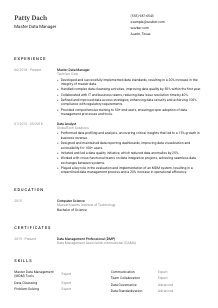
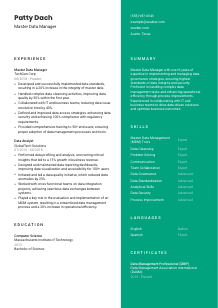
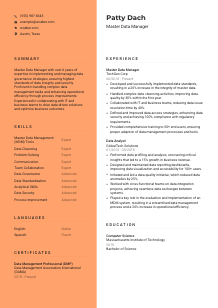
Unraveling data mysteries, but your CV feels like an unsolved case? Check out this Master Data Manager CV example, created with Wozber free CV builder. Learn how to present your data governance expertise in line with job requirements, putting your career on course and your data in sync!
Master data work gets judged by the condition of the data itself. When product, customer, supplier, or reference records are inconsistent, duplicated, or poorly governed, downstream reporting, integrations, compliance, and operational decisions all suffer. A Master Data Manager CV needs to show that you do more than maintain records. It should show how you set standards, improve data quality, and keep governance practices working across business and IT teams.
CV tailoring changes how quickly hiring teams can place you on the MDM side of data management rather than a general analyst or reporting profile. Using Wozber's free CV builder helps you line up your language with the posting and present it in an ATS-friendly CV format, so terms like data governance, data cleansing, access controls, and end-user training are easy to read and match. That makes your scope in data quality, stewardship, and process improvement much clearer from the first scan.
Master Data Managers are trusted with accuracy, structure, and governance, so even the top of the CV should feel controlled and precise. This section is simple, but it still carries practical screening value. Hiring teams should be able to confirm who you are, what role you are targeting, and whether any stated logistics, such as location, are already covered.
Display your name clearly in a larger font than the rest of the header. Keep it clean and professional. For a role centered on data quality and standards, small formatting choices matter because they reinforce the kind of detail-oriented working style expected in MDM.
Place "Master Data Manager" directly below your name if that reflects your current or target role. Matching the posting's title helps both recruiters and ATS tools connect your background to the position quickly, especially when employers are filtering between data analysts, data stewards, governance leads, and MDM managers.
Include your phone number, professional email address, and, if relevant, a LinkedIn profile or portfolio URL. Check every character. In a profession where duplicate records, broken ownership, and inconsistent fields create real business problems, even basic contact information should model accuracy and consistency.
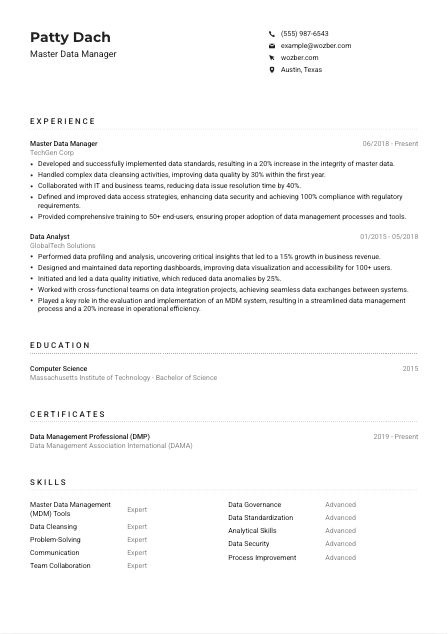
If a role includes a location requirement, make that easy to confirm in your header. In the example, listing Austin, Texas directly supports the employer's stated requirement and removes an avoidable question during early screening. If you are relocating, state that clearly instead of leaving the employer to guess.
A LinkedIn profile, professional site, or project page can help if it reflects your CV and adds useful context, such as data governance initiatives, system implementation work, or cross-functional leadership. Keep titles, dates, and role descriptions aligned so there is no confusion between platforms.
Your header should confirm the basics without friction. When the role is tied to governance, data integrity, and process discipline, a precise Personal Details section quietly supports the story told in the rest of the CV.




This section carries the most weight for a Master Data Manager. Hiring teams want to see how you improved record quality, enforced standards, worked across functions, and supported secure access to trusted data. Job titles matter, but the real differentiator is whether your bullets show governance outcomes, process ownership, and measurable change.
Start by identifying the operating themes in the job description, not just isolated keywords. For this role, the priorities include data standards, cleansing and enrichment, governance policy alignment, access management, regulatory compliance, issue resolution, and user training. Those themes should shape which accomplishments you select and how you phrase them.
List your recent positions first and give the most detail to work that touches MDM, data governance, stewardship, or enterprise data quality. If your earlier experience was in analytics or reporting, frame it around the pieces that connect to master data, such as profiling, anomaly reduction, source integration, or MDM system support. The example does this well by moving from Data Analyst work into direct Master Data Manager ownership.
Generic lines like "responsible for data management" do not tell anyone how well you performed. Use bullets that show what changed because of your work, such as improved data integrity, faster issue resolution, reduced anomalies, stronger compliance, or better adoption of governance processes. The sample CV uses metrics effectively with a 20% increase in data integrity, 30% better data quality, and 40% faster issue resolution, which are the kinds of outcomes that feel native to MDM work.
Master Data Managers rarely work in isolation. Your experience should show how you coordinated with IT, business owners, data stewards, analysts, or compliance teams to define standards, manage access, and resolve data issues across systems. If you improved permissions, supported regulatory controls, or introduced new source data into an MDM environment, spell that out so the employer can see both operational and governance depth.
Bring in the posting's terminology where it matches your real work. Phrases such as "data governance," "data cleansing," "standardization," "data integrity," "roles and permissions," and "process improvement" help your experience section read clearly in an ATS while also sounding familiar to hiring managers. Wozber's AI CV builder can help surface missing terms and tighten the phrasing so your bullets stay specific rather than stuffed with keywords.
By the end of this section, a hiring team should be able to see the systems you influenced, the quality problems you solved, and the governance structure you helped enforce. That is what separates MDM leadership from broader data support work.
For Master Data Manager roles, education usually works as a qualification checkpoint rather than the main selling point. Still, it helps establish your foundation in business systems, computer science, information management, or related analytical disciplines. Present it cleanly and make any directly relevant degree easy to spot.
If the job asks for a bachelor's degree in Business Administration, Computer Science, or a related field, list that information clearly. In the example, a Bachelor of Science in Computer Science aligns directly with the stated requirement and supports the technical side of MDM work, including systems understanding and structured data handling.
Include the degree, field of study, school name, and graduation year or date. Avoid overloading this section with unnecessary detail if you already have more than 5 years of relevant experience. For an experienced Master Data Manager, hiring attention will stay on governance results, data quality outcomes, and cross-functional delivery.
When your degree strongly supports the role, make that easy to scan by leading with the credential and field rather than burying them in extra text. A clear line such as "Bachelor of Science, Computer Science" immediately connects to roles that involve MDM platforms, data structures, workflow design, and standards management.
If you are early in your career, selected coursework, capstone projects, or academic research can help bridge the gap to professional MDM work. Focus on subjects such as databases, information systems, data governance, systems analysis, or process design. If you already have substantial experience, those details can usually stay out unless they are unusually relevant.
Formal education does not need to carry the whole section. If you have taken later coursework in governance, data quality, compliance, or enterprise data architecture, that can reinforce that your knowledge is current. This is especially useful when the role touches changing governance policies, toolsets, or regulatory expectations.
Education should confirm that you meet the baseline and understand the technical or business context behind master data work. Keep it straightforward, relevant, and easy to verify.
Certifications can add weight in Master Data Manager hiring because they point to formal grounding in governance frameworks, data quality practices, and professional standards. They are most useful when they reinforce the kind of work already shown in your experience, especially around stewardship, controls, and enterprise data management.
Prioritise credentials that support MDM, governance, data quality, or related enterprise data disciplines. The example's Data Management Professional credential is a strong fit because it complements hands-on work in standards, cleansing, access controls, and governance processes.
A short list of relevant certifications usually lands better than a long inventory of loosely connected courses. Choose certifications that strengthen your CV's central story, whether that story is governance leadership, MDM operations, compliance support, or process improvement across business systems.
Certification dates help show whether your knowledge is active and current. This matters in data management because governance practices, regulatory requirements, and platform capabilities evolve over time. If a credential is ongoing or maintained through continuing requirements, show that clearly.
If you are working toward a relevant certification or recently completed training in areas like data governance, data security, or MDM tooling, include it when it adds useful context. That can be particularly helpful when you want to show growth from analyst or stewardship work into broader master data ownership.
Certifications work best when they reinforce your practical MDM record. Used selectively, they show that your approach to data governance and quality is grounded in recognized standards, not just ad hoc experience.
A Master Data Manager skills section should read like an operating toolkit, not a generic list of strengths. Employers are looking for a mix of governance knowledge, data quality capability, systems fluency, and cross-functional communication. Prioritise the skills that support how master data is actually managed, secured, and improved.
Start with the skills the employer explicitly asks for, then match them to your own experience. For this role, that includes data governance best practices, MDM tools and systems, analytical problem-solving, communication, and cross-functional collaboration. If you have done data cleansing, standardization, enrichment, access management, or process improvement, those deserve space as well.
Master data work sits between systems and people. Your skills should reflect both sides of that equation, including MDM platforms, data quality workflows, governance controls, and security awareness alongside communication, training, and collaboration with business and IT teams. The sample list handles this well by combining MDM tools and data cleansing with communication and team collaboration.
Put the highest-value MDM skills near the top rather than alphabetizing everything. If the job emphasizes governance and data integrity, lead with those. If it stresses access controls, compliance, or end-user support, make room for those too. Wozber's ATS CV scanner can help you compare your skills language against the posting and spot gaps before you apply.
This section should reinforce the kind of master data environment you can manage. When the skill mix reflects governance, quality control, system knowledge, and business collaboration, the CV reads as genuinely MDM-focused.
Language skills will not drive every Master Data Manager hire, but they can matter when the role involves global business units, regional data owners, or distributed support teams. Even when only one language is required, this section helps confirm communication capability for training, policy rollout, and issue resolution.
If the posting explicitly requires English, list it first and state your level clearly. In this case, strong English matters because the role includes cross-functional collaboration, governance documentation, and end-user training, all of which depend on precise communication.
Extra languages can support work with international suppliers, regional master data teams, or multilingual user groups. They are especially worth listing if your data environment spans geographies or if part of your role has involved stakeholder support across regions.
Use clear levels such as Native, Fluent, Intermediate, or Basic. Avoid vague claims. For data governance and training work, employers need a realistic sense of whether you can lead workshops, write process guidance, or support business users in that language.
Not every Master Data Manager role is global, so do not overstate the value of additional languages where they are not relevant. Include them when they strengthen your ability to support shared master data processes, cross-border operations, or multi-region stakeholder communication.
For this profession, language ability is most meaningful when it improves adoption of standards, user training, and issue resolution across teams. If you speak another language fluently, it can support smoother handoffs and clearer governance communication in complex organizations.
When listed honestly and kept relevant, languages can add useful context about the teams and users you can support. For MDM work, that matters most when communication quality affects governance adoption and data consistency.
The summary should quickly establish that you belong in Master Data Management, not in a broader data title without governance depth. In a few lines, identify your level, your core focus, and the outcomes you have delivered in data quality, standards, compliance, or process improvement. That opening framing helps the rest of the CV land faster.
Use the posting to decide what belongs in your opening lines. Here, the emphasis falls on governance practices, MDM experience, data integrity, analytical problem-solving, cross-functional collaboration, and training support. Those are better anchors for your summary than broad claims about being results-driven or detail-oriented.
Open with your title or a close equivalent and your years of relevant experience. For example, "Master Data Manager with 6+ years of experience in data governance and data quality improvement" is much stronger than a generic introduction because it immediately places you in the right lane.
Choose highlights that reflect how Master Data Managers create value, such as improving data integrity, reducing issue resolution time, supporting compliance, or implementing standards across systems and teams. The example summary works because it points to governance strategy, data integrity, security, and process improvement rather than describing the candidate in broad terms.
Aim for a short paragraph of 3 to 5 lines. Every phrase should earn its place by clarifying your MDM scope, business impact, or technical grounding. Wozber can help tighten this section so your opening matches the job description and stays readable in an ATS-compliant CV without sounding copied from the posting.
A well-built summary should tell the reader, within seconds, that you can manage master data with discipline, improve quality at scale, and work across teams to keep governance practices effective. That is the standard your opening should set for the rest of the CV.
A Master Data Manager CV should leave very little for the reader to infer. It should show the standards you built, the data quality issues you fixed, the controls you supported, and the business teams you worked with to keep master data usable and trusted.
Use Wozber's free CV builder, ATS-friendly CV templates, and ATS CV scanner to align your wording with the job description, tighten weak sections, and present your background in a format that supports ATS optimisation. The finished CV should make your governance experience, MDM scope, and data quality results easy to judge.




