



Use Wozber and land your dream job
Create CV
No registration required
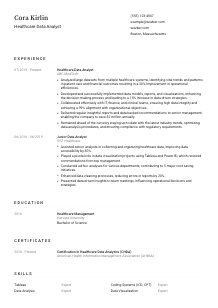
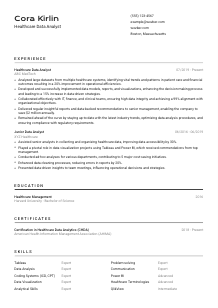
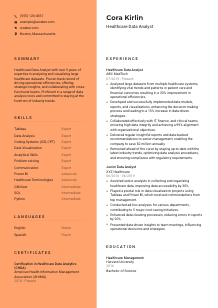
Decoding patient records, but your CV doesn't tally? Check out this Healthcare Data Analyst CV example, created with Wozber free CV builder. Learn how to mesh your insights into health trends with job specifics, bringing your career prognosis as clear as an EKG line!
Healthcare data analysis sits at the point where patient care, operations, and financial performance meet. Hiring teams want to see more than general reporting ability. Your CV needs to show that you can work with healthcare datasets, understand coding systems such as ICD and CPT, and turn messy source data into decisions clinicians, finance leaders, and executives can actually use.
A tailored CV changes how quickly that picture comes through, especially when an ATS is scanning for healthcare-specific tools, terminology, and industry experience. Wozber's free CV builder helps you line up your wording, structure, and ATS optimisation with the job description so the hiring team can immediately see whether you can analyse healthcare data with enough accuracy, context, and business judgment for the role.
For a Healthcare Data Analyst, the top of the CV should establish straightforward professional alignment. This section is brief, but it still carries practical weight because it confirms role focus, location fit when required, and the contact details a hiring team needs to move quickly.
Use your full name as the clear heading of the document in a slightly larger font than the rest of the page. Keep it simple and professional. In data-focused roles, clean presentation matters because it hints at the same clarity you bring to dashboards, reports, and stakeholder communication.
Place "Healthcare Data Analyst" directly under your name if that is the role you are targeting. This immediately connects your profile to the opening and helps frame the rest of the CV around healthcare analytics rather than broader BI or general analyst work.
Include a phone number and professional email address that you check regularly. If you also have a LinkedIn profile or portfolio with dashboard samples, SQL projects, or analytics work, add it only if it supports your candidacy and is up to date. A healthcare employer should be able to contact you and quickly review relevant work without hunting for it.
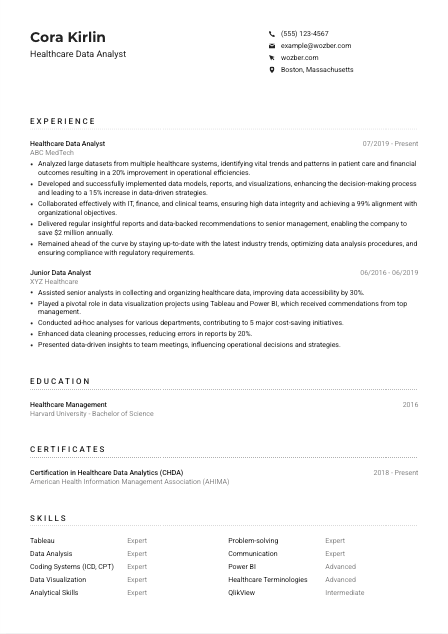
Some Healthcare Data Analyst jobs are flexible, but this one specifies Boston, Massachusetts. Listing Boston, Massachusetts in your header immediately removes a possible screening concern. Treat location this way whenever a posting names an on-site or location-based requirement.
A LinkedIn profile, personal site, or analytics portfolio can reinforce your experience if it includes healthcare reporting work, visualization examples, or project context. Keep it relevant. A link is useful when it extends your CV with material such as Tableau dashboards, Power BI samples, or a concise overview of your healthcare analytics background.
Your header should confirm three things at a glance: who you are, which role you are pursuing, and whether basic logistics line up. Once that is clear, the rest of the CV can focus on your analysis work.




This section carries most of the hiring weight for a Healthcare Data Analyst. Employers want to see how you handled healthcare datasets, what decisions your analysis supported, which tools you used, and whether your work improved care operations, reporting quality, or financial outcomes.
Start by isolating the responsibilities that define the role. Here, that includes analysing large healthcare datasets, building reports and visualizations, partnering with IT, finance, and clinical teams, and presenting recommendations to senior management. Those points tell you what your experience bullets should emphasize first.
Show your most recent position first, followed by earlier roles. For each entry, include job title, employer, and dates. If your background includes both healthcare and non-healthcare analytics work, make the healthcare experience easiest to scan because that industry context matters when employers are dealing with EMR, claims, coding, and regulatory reporting.
Each bullet should show what you analysed, what you built, and what changed because of your work. Strong Healthcare Data Analyst bullets often include patient care trends, operational efficiency, revenue cycle insights, quality reporting, or executive decision support. The sample CV does this well by tying analysis work to operational gains, improved decision-making, and annual savings.
Numbers are especially persuasive when they reflect real business or clinical impact. Include measures such as reduced reporting errors, faster reporting cycles, improved operational efficiency, better data integrity, cost savings, or adoption of dashboards by stakeholders. For example, a bullet showing a 20% efficiency improvement or $2 million in annual savings gives the analysis clear organizational value.
Prioritise experience that reflects the posting's language and demands. If the employer emphasizes cross-functional collaboration, healthcare systems data, and senior-level reporting, those elements should appear prominently in your bullets. Cut or compress tasks that do not strengthen your case for healthcare analytics work, even if they mattered in a previous job.
Your experience should show that you can move from raw healthcare data to usable recommendations. When the bullets connect source data, analysis methods, stakeholder collaboration, and measurable outcomes, the hiring team can picture you doing the job.
Education matters here because the posting asks for a bachelor's degree in a relevant analytical or healthcare-related field. This section should confirm that foundation quickly and, when useful, reinforce your connection to healthcare data work.
List the degree that best aligns with the posting, especially if it is in Healthcare Management, Business Analytics, Computer Science, Information Systems, or a related field. When your degree is an obvious match, it removes friction early in the review.
Include degree, field of study, school name, and graduation year. Keep formatting consistent with the rest of the CV. In most Healthcare Data Analyst applications, that is enough to confirm academic preparation without distracting from experience and technical capability.
If your degree title closely matches the requirement, let that work for you. The sample CV's Bachelor of Science in Healthcare Management is a direct fit for a healthcare analytics opening. If your field is related but less obvious, use the exact formal title and let your experience and skills reinforce the connection.
Most mid-career candidates can keep this section lean. If you are earlier in your career, a few relevant details can help, such as coursework in health informatics, statistics, database systems, healthcare finance, or data visualization. Include projects only if they show practical analysis work tied to healthcare data or reporting.
Honors, scholarships, research work, or leadership in analytics-related programs are worth adding when they strengthen your profile, especially for newer candidates. Keep the additions relevant to analytical rigor, healthcare context, or technical training rather than listing every campus activity.
This section should confirm that you have the educational base for healthcare analytics and move the reader back to your professional work. If the degree lines up cleanly with the posting, let it do that job efficiently.
Certifications carry extra weight in healthcare analytics because they show formal engagement with the industry's data, systems, and standards. When a posting names CHDA or CPHIMS, relevant credentials become a direct tailoring opportunity rather than a nice extra.
Review the posting for preferred or required certifications and place matching ones first. In this case, CHDA and CPHIMS are specifically named, so candidates who hold either should make them prominent and easy to spot.
Do not crowd this section with unrelated certificates. A short list of healthcare analytics, health information management, BI, or data governance credentials is more useful than a long catalogue of general training. Relevance matters more than quantity.
List the certification name, issuing organisation, and date earned or active status when applicable. That gives the credential context and helps show whether your certification is current. In regulated, data-sensitive environments, up-to-date credentials add credibility.
Healthcare reporting standards, reimbursement models, interoperability efforts, and analytics tools continue to evolve. Ongoing certification or continuing education can strengthen your profile, particularly if your recent experience does not fully show your work with newer data practices or healthcare systems.
Well-chosen certifications tell the employer that you understand healthcare data work beyond general analytics. If the posting names a credential you have, make sure it is impossible to miss.
The skills section should read like a practical inventory of how you do the job. For Healthcare Data Analyst roles, that means balancing analytics tools, healthcare domain knowledge, and communication skills used to explain findings to non-technical stakeholders.
Read the posting closely and separate tool requirements from industry knowledge. Here, the technical side includes Tableau, Power BI, QlikView, and general data analysis. The domain side includes healthcare terminology, ICD and CPT coding systems, and experience with EMR or claims data. Both matter.
Add the skills you genuinely use and that directly support the target position. A focused list helps more than a long one. The sample CV gets the balance right by combining visualization tools, data analysis, healthcare coding knowledge, and supporting skills such as SQL and Python.
Group your skills in a way that mirrors how the work is done. For example, you might separate Data Visualization Tools, Query and Analysis Tools, Healthcare Data Knowledge, and Communication or Stakeholder Skills. This makes it easier for both ATS systems and hiring managers to find the capabilities they expect.
A hiring team should be able to scan this section and understand the systems, data language, and reporting tools you can bring into a healthcare environment. Keep it specific, honest, and tied to real use.
Healthcare analytics work often involves presenting findings to operational, financial, and clinical stakeholders, so language ability matters when it affects communication quality. This section is usually short, but it still deserves deliberate tailoring when the posting specifies a required language.
If the job description asks for language proficiency, include that language clearly in this section. Here, English proficiency is required, so English should appear first with an accurate level listed.
Order matters. Lead with English in this case because it is directly tied to the role's communication needs, from written reporting to meetings with cross-functional teams and senior stakeholders.
Additional languages can strengthen your profile, especially in healthcare organizations serving multilingual patient populations or diverse internal teams. They are secondary to the required language, but still worth listing when proficiency is solid and relevant.
Choose straightforward labels such as Native, Fluent, Intermediate, or Basic. Hiring teams need a realistic picture of how comfortably you can write, present, and discuss data findings, not a vague claim.
Many Healthcare Data Analyst roles rely more on precise written reporting and stakeholder communication than on multilingual ability. Treat extra languages as an added asset, not a substitute for strong healthcare analytics content elsewhere on the CV.
List languages clearly and honestly, with the required one first. Then let your experience and summary show how you communicate complex healthcare findings in practice.
The summary sets the frame for everything that follows. For a Healthcare Data Analyst, it should quickly combine years of experience, healthcare domain familiarity, technical strength, and the type of decisions your analysis supports.
Before writing, identify the few points the employer needs to understand first. In this posting, that means healthcare industry analysis experience, visualization capability, familiarity with healthcare data and coding systems, and the ability to support business decisions through reporting and recommendations.
Lead with your title and level of experience. A line such as "Healthcare Data Analyst with 5+ years of experience in healthcare reporting and visualization" is much more useful than a broad personal statement because it establishes your lane immediately.
Use the next lines to highlight the kind of work you handle well. Mention healthcare datasets, dashboard or reporting tools, cross-functional collaboration, and business impact where possible. The sample summary works because it combines years of experience, analytics scope, and concrete value such as operational efficiency and strategic insight.
Aim for 3 to 5 lines. Every phrase should help answer a hiring question, such as whether you know healthcare data, whether you can communicate findings, and whether your work influences decisions. Skip broad adjectives and focus on scope, tools, and outcomes.
When this section is tailored well, the hiring team starts the CV already expecting to see relevant healthcare data work, credible tool knowledge, and useful reporting outcomes. That is exactly the frame you want.
A Healthcare Data Analyst CV needs to show that you can work with healthcare source data, translate analysis into reporting that leaders can act on, and communicate comfortably across clinical, financial, and technical teams.
Use Wozber's ATS CV scanner and ATS-friendly CV template to tighten wording, align healthcare terminology with the posting, and build an ATS-compliant CV that surfaces the experience most likely to matter in review.
When the CV is tailored well, a hiring team can quickly judge whether you can step into the reporting environment, handle healthcare data responsibly, and produce insights the organisation can trust.




