



Use Wozber and land your dream job
Create CV
No registration required
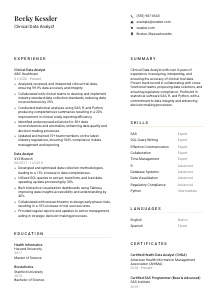
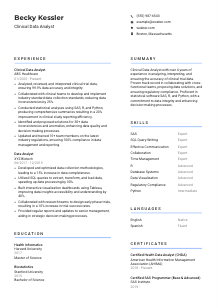
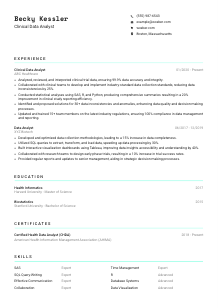
Unraveling medical mysteries with data, but your CV feels like a puzzling diagnosis? Check out this Clinical Data Analyst CV example, created with Wozber free CV builder. Learn how to match your analytical acumen to job demands, making your career prognosis as accurate as a clinical trial outcome!
Clinical Data Analysts sit close to the point where research quality can either hold up or break down. Hiring teams want to see whether your work has actually improved data accuracy, cleaned inconsistencies, supported statistical analysis, and helped clinical teams trust the numbers going into reports, submissions, and study decisions.
CV tailoring changes which parts of your background get noticed first. For this kind of role, the clearest CVs surface clinical trial work, statistical tools, SQL use, and compliance-minded data handling early enough for both hiring reviewers and an ATS to read them correctly. Wozber's free CV builder helps organise that language into an ATS-friendly CV format so your experience reads clearly as clinical data analysis, not generic analytics.
This section does quiet but important work in a Clinical Data Analyst CV. It should confirm who you are, what role you target, and whether practical requirements like location and communication details are already covered before anyone gets into your trial data or reporting experience.
Use your full name in a clear, easy-to-read format at the top of the page. Clinical data roles do not need decorative branding here. They need a professional header that makes the document easy to file, search, and revisit during a multi-step hiring process.
Place "Clinical Data Analyst" directly under your name when that is the role you are applying for. This helps frame your background correctly from the first line and supports ATS matching, especially if your earlier titles were broader, such as Data Analyst or Research Analyst.
Include a current phone number and a professional email address. Accuracy matters more than style. If a hiring team wants to move you into a screening call to discuss SAS work, SQL querying, or clinical study reporting, your contact details should never be the reason that process stalls.
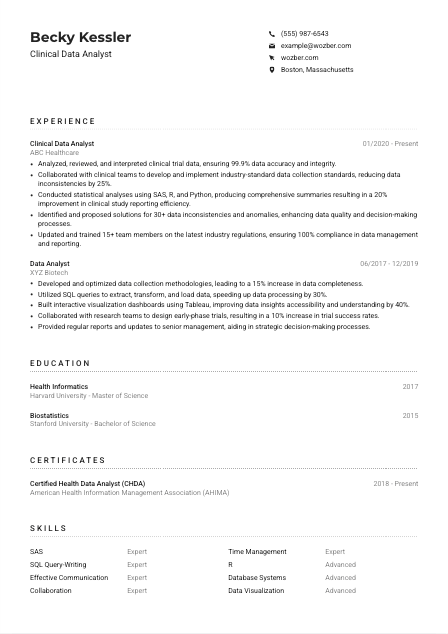
If the employer requires candidates to be based in a specific city, show that clearly in your header. In this example, listing Boston, Massachusetts removes a predictable point of friction right away. Only do this when it reflects your actual location or the application instructions you are following.
A LinkedIn profile, professional website, or portfolio can help if it adds substance, such as publications, research support work, dashboard samples, or a fuller project history. Keep it current and consistent with the CV, especially around job titles, dates, and technical tools.
When your header is clean, accurate, and aligned to the posting, reviewers can move straight to your clinical data experience instead of chasing missing details. That is exactly what this section should accomplish.




For Clinical Data Analysts, experience is where employers look for operating proof. They want to see how you handled trial data, improved integrity, used statistical tools, worked with clinical teams, and responded when inconsistencies or reporting issues showed up.
Prioritise experience that involves clinical trials, healthcare data, study reporting, protocol-driven data collection, or regulated environments. If part of your background sits outside formal clinical analysis, rewrite those bullets to emphasize overlapping work such as data quality checks, SQL extraction, reporting workflows, or collaboration with research teams.
Use reverse-chronological order with job title, employer, and dates clearly listed. That helps reviewers quickly map your progression from general analytics into clinical data work, and it helps ATS parsing keep your experience structured correctly.
Each bullet should show a concrete action and a meaningful result. For this profession, that often means analysing clinical trial data, improving data integrity, producing study summaries, resolving anomalies, or refining collection standards. The sample CV does this well with bullets such as "ensuring 99.9% data accuracy and integrity" and reducing inconsistencies by 25%.
Quantify the outcome when the number reflects how the work is actually measured. Useful examples include accuracy rate, reduction in inconsistencies, reporting turnaround, query resolution volume, compliance rate, or gains in data completeness. A bullet like a "20% improvement in clinical study reporting efficiency" tells a hiring manager far more than a vague claim about improving processes.
Keep bullets that reinforce your ability to analyse datasets, use tools like SAS, R, Python, or SQL, partner with cross-functional teams, and maintain compliant reporting practices. Remove generic responsibilities that could belong to any analyst unless they are tied to healthcare, research operations, or measurable delivery.
Your experience section should leave no doubt that you can move from raw study data to accurate analysis and usable reporting. Wozber's ATS-friendly CV format helps keep those details easy to scan, but the real advantage comes from bullets that show clinical scope, tool use, and measurable outcomes.
Clinical Data Analyst roles often use education as an early screening point, especially when the posting asks for a degree in health informatics, biostatistics, or a related field. Your education section should confirm that foundation quickly and without clutter.
If the role asks for a bachelor's degree in Health Informatics, Biostatistics, or a related discipline, list the qualifying degree clearly. A higher degree can appear first when it strengthens your fit, as long as the underlying required academic background is still easy to identify.
List degree, field of study, school, and graduation year in a consistent structure. Clinical and research employers often review many applications quickly, so straightforward formatting helps them confirm your academic background without digging.
Use the formal field name that matches your transcript and also aligns with the posting. If your degree is in Biostatistics, Health Informatics, Epidemiology, Public Health, or another related area, write it clearly rather than replacing it with broader labels. In the example, both Health Informatics and Biostatistics map neatly to the requirement.
Relevant coursework can help early-career candidates or applicants whose degree title is broader than the work they are targeting. Include courses such as biostatistics, clinical research methods, database systems, epidemiology, or data management only if they sharpen your connection to clinical analysis.
Honors, scholarships, thesis work, or research projects are worth adding when they relate to healthcare data, statistical analysis, or study methodology. If you already have several years of direct clinical data experience, keep these details brief so the section stays supportive rather than dominant.
This section should confirm that you meet the educational bar and have relevant analytical training. Once that is clear, the hiring focus moves back to your clinical datasets, tools, and reporting work.
Certifications are not always required for Clinical Data Analyst jobs, but they can add weight when they reinforce the tools, standards, or domain knowledge the role depends on. In regulated data work, relevant credentials can show that your skills are current and applied with discipline.
Prioritise credentials tied to clinical data, health information, statistical programming, or regulated reporting. Certifications such as CHDA or SAS programming credentials make immediate sense because they connect to analysis quality, data handling, and the software environment many employers use.
A short list of directly relevant certifications is usually stronger than a long list of general learning badges. Hiring teams are looking for proof that supports data analysis, database work, compliance awareness, or healthcare information management, not every course you have completed.
Include issue dates or active date ranges when they help demonstrate that your knowledge is current. This is especially useful for software certifications or credentials tied to standards that evolve over time.
Clinical data work changes with reporting standards, data management practices, and analysis tooling. Updating certifications or adding new ones over time shows that you keep pace with the field, whether that means better SAS fluency, stronger programming depth, or broader health data governance knowledge.
A well-chosen certification section adds technical and domain credibility around the work already shown in your experience. Keep it relevant, current, and clearly tied to the kind of clinical data analysis the job requires.
A Clinical Data Analyst skills section should read like the toolkit behind your day-to-day work. Employers expect a mix of statistical analysis, database querying, data quality management, and collaboration with clinical or research stakeholders.
Start with the skills the employer named directly. Here, that includes SAS, R or Python, SQL query-writing, database systems, communication, and collaboration. Those terms belong in your CV only when they reflect real experience, because interview questions will usually go straight to how you used them.
Order your skills so the most job-relevant items appear first. For a Clinical Data Analyst, statistical software, SQL, database knowledge, data integrity work, and regulatory awareness typically deserve more prominence than broad workplace traits. The sample CV handles this well by leading with SAS and SQL query-writing.
Group or prioritise skills so reviewers can quickly understand your working range. Technical tools, analytical methods, and professional skills can all appear, but avoid overloading the section with generic items that do not advance your case. Every skill should help explain how you manage, analyse, validate, or communicate clinical data.
The best skill lists preview what the experience bullets later prove. If your CV says SAS, SQL, database systems, collaboration, and regulatory compliance here, your work history should show exactly where those capabilities produced better data quality or stronger reporting.
Language skills matter in Clinical Data Analyst hiring when communication is explicitly required or when the role involves cross-functional coordination across research, operations, and reporting teams. This section should stay practical and truthful.
If the posting specifies English proficiency, list English clearly with an honest level. In many clinical environments, that requirement connects directly to documentation quality, cross-team communication, and the ability to explain findings in reports or meetings.
Order languages by role relevance, not by personal preference. When English is required, it should appear first so recruiters do not have to search for it.
Additional languages can be worth listing if they support collaboration in multilingual teams, patient-facing research settings, or international study environments. They are helpful secondary information, not a substitute for the technical and analytical requirements of the role.
Choose straightforward ratings such as Native, Fluent, Advanced, or Intermediate and use them consistently. Clear language levels reduce ambiguity and set accurate expectations for interviews, documentation, and stakeholder communication.
If the role supports global studies, diverse site teams, or international reporting workflows, extra language ability may be more relevant. If not, keep this section brief and let your clinical data experience remain the main story.
For most Clinical Data Analyst CVs, this section confirms communication readiness rather than carrying the application. State required language ability clearly, then let your analysis, data integrity, and reporting work do the heavier lifting.
The summary sets the reading direction for the entire CV. In Clinical Data Analyst applications, it should quickly establish your level of experience, your clinical data focus, and the analytical tools or outcomes that make your background relevant to the role.
Write the summary around your real scope, such as clinical trial data analysis, data integrity review, statistical reporting, or collaboration with clinical teams on collection standards. Avoid broad analyst language that could describe finance, marketing, or operations roles just as easily.
Open with your title and experience level in a direct way, such as "Clinical Data Analyst with 4+ years of experience." That immediately positions you in the right hiring lane and helps separate you from candidates whose work has been more general.
Use one or two details that mirror the posting closely, such as experience with SAS, R, Python, SQL, clinical trial datasets, anomaly resolution, or compliance-focused reporting. The sample summary works because it combines years of experience, tool proficiency, collaboration, and data accuracy in a compact space.
Aim for a short paragraph that can be read in seconds. Three to five lines is usually enough to establish your domain, technical strengths, and a notable result or two. Save fuller detail for the experience section, where metrics and project context can do more work.
When this section is sharp, the reader already knows you belong in a Clinical Data Analyst conversation before reaching your first job entry. Build it with the same discipline you bring to data review: precise wording, relevant tools, and outcomes that matter. Wozber's AI CV builder can help tighten that language and strengthen ATS optimisation so your summary leads naturally into the evidence below.
A Clinical Data Analyst CV needs to show more than general analytical ability. It should connect your background to clinical trial data, statistical tools, SQL work, data quality, reporting, and collaboration with clinical teams in language that holds up in both ATS screening and human review.
Use Wozber to build and refine an ATS-compliant CV that reflects the actual work you do, from data integrity checks to study reporting support. When the sections align, hiring teams can quickly see that you are prepared to step into regulated, detail-sensitive clinical data analysis work.