



Use Wozber and land your dream job
Create CV
No registration required
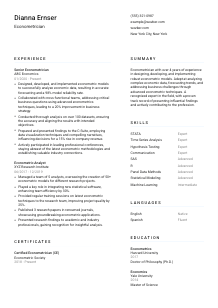
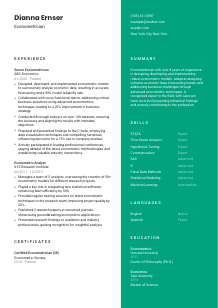
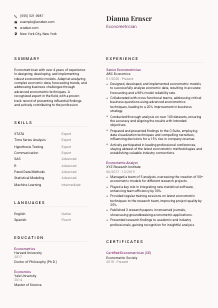
Decoding data, but your CV seems cryptic? Check out this Econometrician CV example, created with Wozber free CV builder. It shows how to blend your economic insights and statistical prowess to match your job goals, making your career growth as robust as your regression models!
Econometrician hiring usually turns on one practical question fast: can this person build models that stand up under scrutiny and answer real business or policy questions. CVs often miss that standard by leaning too hard on theory, coursework, or software lists without showing how the candidate handled forecasting, model validation, or interpretation for decision-makers.
The first screen often comes down to whether your CV connects econometric methods to usable outcomes, especially in an ATS-compliant CV. Wozber's free CV builder helps you align job-specific terminology, structure, and keywords so hiring teams can quickly see your command of time series work, panel data analysis, hypothesis testing, and executive-facing communication.
For an Econometrician, the header needs to do one simple job well: confirm who you are, what role you are targeting, and whether you meet any immediate screening requirements. Keep it clean, accurate, and easy to scan so the reader can move straight to your modeling experience.
Use your full name in a slightly larger font than the rest of the header. In quantitative hiring, presentation still matters, and a clear header signals precision before anyone reads your regression work or forecasting results.
Place "Econometrician" directly below your name when that is the role you are pursuing. Mirroring the job title helps with ATS matching and immediately frames your background around econometric modeling rather than adjacent profiles such as data analyst, economist, or research associate.
List one phone number and one professional email address you check regularly. Small mistakes in the header create avoidable friction, and for a role built on statistical rigor and careful reporting, accuracy in basic details matters more than people think.
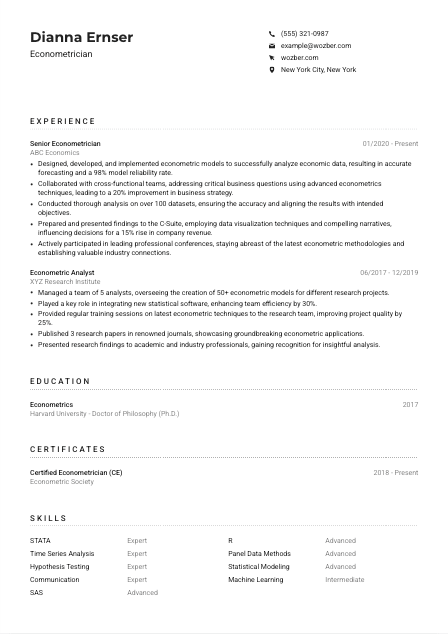
If the employer asks for a candidate in a specific city, include it plainly. In the example, "New York City, New York" removes uncertainty about location early, which is useful when the posting names that requirement directly. If your target role does not mention geography, city and state are usually enough.
Include LinkedIn, a personal site, or a research profile only if it strengthens your candidacy. For an econometrician, that could mean publications, conference activity, working papers, project summaries, or presentations that show applied modeling work. Make sure the content matches the claims on your CV.
This section is short, but it clears the first screening hurdles quickly. When your title, contact details, and any location requirement are handled cleanly, the reader can focus on your econometric work instead of missing basics.




Experience is where employers look for signs that you can move from methodology to decisions. They want to see the models you built, the data you handled, how you tested reliability, and whether your analysis changed a forecast, recommendation, or business strategy.
Start by identifying the operating verbs in the job description and reflect them in your bullets where they match your real experience. For this role, that means designing and implementing econometric models, analysing economic data, forecasting trends, validating results, and presenting findings clearly. When those actions already appear in your work history, use the same language naturally.
List your most recent role first, then work backward. For each position, include your job title, employer, and dates. That format lets hiring teams quickly track progression from analyst-level work into larger ownership, such as leading model development, supervising research staff, or briefing senior leadership on forecast implications.
Econometric CVs get stronger when bullets connect methodology to results. Instead of saying you "performed analysis," show what the analysis improved. The example does this well by linking model design to a 98% reliability rate, cross-functional econometric work to a 20% business strategy improvement, and executive presentations to revenue impact. Use metrics that fit your context, such as forecast accuracy, model stability, processing speed, project volume, or policy influence.
Prioritise bullets that show modeling depth, statistical judgment, and business or research relevance. Time series work, panel data methods, hypothesis testing, model validation, software implementation, and economic forecasting all belong here. Less relevant achievements can be trimmed unless they support the kind of analytical scope the role calls for.
Econometricians rarely work in isolation. Your experience should show how you partnered with business leaders, researchers, product teams, or policy stakeholders to frame questions and explain model outputs. The sample CV's C-suite presentations are a useful illustration. Hiring teams want to know you can translate coefficients, assumptions, and uncertainty into actions non-technical stakeholders can use.
A strong experience section shows more than statistical competence. It shows that your models were built for real decisions, validated carefully, and communicated well. Wozber's ATS optimisation can help keep those accomplishments aligned with the language the employer is screening for.
Econometrician roles often set a clear academic threshold because the work depends on advanced quantitative training. Your education section should confirm that foundation quickly, then move out of the way so your applied modeling experience can carry the rest of the CV.
If the posting asks for a Master's or Ph.D. in Economics, Econometrics, or a related quantitative field, make sure that qualification is easy to find. Relevant graduate training often acts as an early filter for econometric roles, especially when the work involves formal modeling, inference, and forecast design.
List degree, field of study, school, and graduation year. That is usually enough. For a technical profession like econometrics, clarity beats decoration, and hiring teams mainly want to confirm subject relevance and level of study without digging for it.
When your background aligns closely with the posting, let that alignment work for you. In the example, a Ph.D. in Econometrics is an obvious match for an employer asking for advanced quantitative training. If your degree is in economics, statistics, public policy, or another related field, use the exact field name and let your experience show the econometric depth.
Early-career candidates can benefit from listing selected coursework or research areas such as time series analysis, panel data econometrics, causal inference, or advanced statistical computing. If you already have several years of professional modeling work, those details usually matter less than your project results.
Honors, thesis topics, dissertations, research assistantships, or econometrics-focused publications can help if they strengthen your case for the specific role. Keep them when they add useful context, such as a dissertation on forecasting methods or panel estimation. Leave them out if they distract from stronger professional experience.
This section should quickly establish that you meet the role's academic expectations and have the quantitative grounding to handle rigorous modeling work. Wozber can help present those credentials in an ATS-friendly CV format without burying the degree details recruiters need to find fast.
Certifications are rarely the main hiring criterion for an Econometrician, but they can reinforce specialization and continued development. They work best when they support your modeling profile rather than pad the page.
If the job posting does not require a certification, include only those that strengthen your technical or professional positioning. Relevant credentials might reflect advanced econometric practice, quantitative finance, analytics, causal inference, or software depth, depending on the kind of role you are targeting.
A focused certification carries more weight than a long list of broad online courses. In the example, "Certified Econometrician (CE)" supports the candidate's niche directly. That kind of credential works because it reinforces the same story already told by the degree and experience sections.
List the award date or validity period when relevant. In a field shaped by evolving methods, software updates, and new approaches to forecasting or causal analysis, dates can show that your training is recent enough to matter.
Econometric methods do not stand still. If you have recent training in advanced forecasting, Bayesian methods, panel data extensions, or applied machine learning for economic data, this section can show that you keep your toolkit current and relevant to modern analytical work.
A well-chosen certification adds depth when it points to current econometric knowledge or relevant specialization. In an ATS-friendly CV template, that extra signal is easy to surface without distracting from the modeling work that carries the most weight.
This section should read like the toolkit of someone who can build, test, and explain econometric models. Group the skills that matter most to the role and keep them grounded in methods, software, and communication strengths you can support elsewhere in the CV.
Start with the software, methods, and communication requirements named in the posting. Here, that includes STATA, SAS, or R, along with time series analysis, panel data methods, hypothesis testing, and strong presentation skills. Those terms belong in your skills section if they reflect your actual background.
An econometrician's skill set is not just software proficiency. Include the modeling techniques you use, the statistical packages you work in, and the communication abilities that help you explain results to leadership, clients, or cross-functional teams. That balance matches how the work is done in practice.
Order the most relevant skills first and avoid turning the section into a giant keyword dump. A clean list that leads with econometric methods and core software is easier for an ATS CV scanner to parse and easier for a hiring manager to review in seconds. If you use Wozber, you can quickly align this section with the language in the posting while keeping it natural.
Your skills section should echo the methods and tools already proven in your experience, not introduce a separate story. When the list is targeted and easy to scan, hiring teams can connect your econometric toolkit to the work they need done.
Language skills matter here mainly because econometric work often ends in discussion, presentation, and written interpretation. If a role specifically asks for business English, your language section should confirm that quickly and clearly.
When the posting asks for English for business communication, list English prominently with an honest proficiency level. For an econometrician, that means being able to explain findings in meetings, write concise summaries, and present model implications without losing accuracy.
Additional languages can be useful if the role touches international markets, multilingual stakeholders, or cross-border research. In the example, Spanish adds breadth, but it should remain a supporting detail unless the target role specifically requires multilingual communication.
Terms such as "Native," "Fluent," "Intermediate," and "Basic" are enough. They set expectations cleanly and avoid vague claims, which is especially important in roles where communication precision affects how findings are understood.
If another language has helped you present research, review foreign-language economic sources, or collaborate across regions, it can be worth including. Keep the benefit practical and tied to analysis, reporting, or stakeholder communication rather than treating languages as decoration.
If you are actively improving a language that matters to your target market or sector, include it only when you can describe your level honestly. The section should broaden your profile, not overstate your ability to work in client-facing or executive-facing settings.
For this profession, language proficiency matters most when it supports reporting, presentations, and collaboration. State it clearly, keep it honest, and let it strengthen the communication side of your econometric profile.
Your summary should sound like an econometrician who has already solved consequential problems, not like a textbook definition of the profession. In a few lines, show your level, your technical focus, and the kind of decisions your analysis has informed.
Start from the main work the employer needs done. For this kind of opening, that usually means econometric modeling, economic data analysis, forecasting, model validation, and translating findings for stakeholders. Build the summary around the parts of that work you do best and most often.
Open with your title, your experience level, and two or three strengths that define your profile. The example summary uses more than 4 years of experience and highlights model design, forecasting, and business problem-solving. That is effective because it establishes both seniority and specialization quickly.
Add a concise outcome that gives your claims weight. That might be stronger forecast accuracy, better model reliability, successful executive recommendations, research output, or measurable business impact. Keep it brief, but make sure the reader can see that your econometric work produced usable results.
Aim for a short paragraph that a hiring manager can absorb in one pass. Skip broad traits and focus on methods, software, analysis scope, and decision impact. For an econometrician, a summary should read more like a precise abstract than a generic professional statement.
When the summary is tailored well, it frames the rest of the CV around the right strengths from the start. Wozber's free CV builder can help you refine that opening, align it with ATS-friendly CV templates, and surface the econometric language that makes your background easier to shortlist.
An effective Econometrician CV makes one thing easy to judge: whether your modeling work holds up, answers real questions, and can be explained clearly to decision-makers. Every section should support that standard, from your graduate training to your software stack to the outcomes tied to your analysis.
Use Wozber to sharpen wording, improve ATS optimisation, and organise your experience in an ATS-friendly CV format that reflects the role you are targeting. The finished CV should make your econometric range, technical credibility, and communication strength clear within a few seconds of review.




