



Use Wozber and land your dream job
Create CV
No registration required
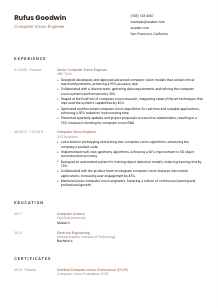
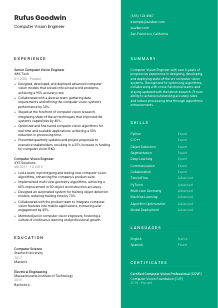
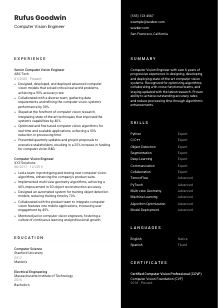
Analysing images, but your CV looks pixelated? Focus in on this Computer Vision Engineer CV example, created with Wozber free CV builder. Learn how to align your algorithmic acumen with job requisites, making sure your career path is always in high definition!
Computer vision hiring moves quickly past broad claims and into execution. Teams want to see whether you have actually built models that perform under real constraints, whether that means object detection accuracy, segmentation quality, multi-view reconstruction, inference speed, or deployment in production settings. Your CV should make that technical range visible without reading like a research abstract or a generic machine learning profile.
Screening often starts with one practical question: can this candidate handle the exact mix of modeling, optimisation, and collaboration the role requires? Tailoring your CV around the job's language helps answer that early, especially in an ATS-compliant CV. Wozber's free CV builder helps you align section wording, highlight job-relevant terms, and keep the structure clean enough for both ATS parsing and human review, so hiring teams can quickly see your computer vision depth.
Contact details look simple, but they set the tone for the rest of the CV. In engineering hiring, a clean header also helps reviewers move straight to your technical background, portfolio links, and location status when those details affect interview logistics.
Place your name at the top in a clear, readable format. Keep styling simple and professional. For technical roles, the header should feel clean and organised, much like well-structured documentation or a readable project README.
Add "Computer Vision Engineer" directly beneath your name when that is the role you are pursuing. Matching the title used in the posting helps frame the rest of your experience correctly, especially when your past titles vary between machine learning, perception, imaging, or research engineering.
List a current phone number and a professional email address, then verify both. If you have a GitHub profile, portfolio, Google Scholar page, or LinkedIn profile with relevant projects, publications, model demos, or deployed systems, include it. For computer vision roles, that extra link can show code quality, datasets, papers, or visual results that a one-page CV cannot fully capture.
If the employer specifies a location or work authorization requirement, reflect that clearly in your header. In the example, listing San Francisco, California supports alignment with a location-specific requirement and reduces uncertainty around availability or relocation.
Only include a website if it strengthens your candidacy. A portfolio that shows detection pipelines, segmentation outputs, 3D vision work, model benchmarks, or deployment case studies is useful. A sparse or outdated site is not. Every link should add technical credibility.
Keep personal details clean, accurate, and relevant to the hiring process. The best version removes friction and points reviewers toward the technical work that supports your candidacy.




This section carries the most weight for most computer vision roles. Hiring teams look for proof that you can move from data and models to measurable results, and that you understand the tradeoffs between accuracy, latency, scale, and deployment.
Read the job description closely and identify the actual work being hired for. For this role, that includes designing and deploying computer vision models, improving performance, working across teams, and using tools such as Python, C/C++, TensorFlow, or PyTorch. Those priorities should shape the language of your bullets so the CV reflects the employer's workflow, not just your internal job history.
List your experience in reverse chronological order and lead with positions where computer vision was central to the job. If a role blended perception, machine learning, robotics, imaging, or applied research, write bullets that foreground the vision work itself. The sample CV does this well by centering model development, multi-view geometry, and deployment-related optimisation rather than generic software duties.
Each bullet should show what you built, improved, or deployed. Use verbs tied to the field, such as trained, optimised, segmented, detected, reconstructed, deployed, benchmarked, or fine-tuned. Then connect that work to an outcome, whether it was higher accuracy, faster inference, better reconstruction quality, stronger product adoption, or more reliable real-time performance.
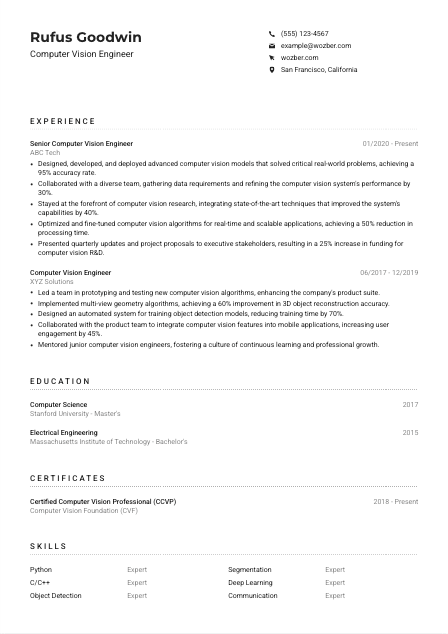
Quantification matters most when it reflects how computer vision systems are actually evaluated. Accuracy, IoU, precision and recall, processing time, latency, throughput, annotation reduction, training time, and system performance gains all carry weight. In the example, a 50% reduction in processing time and a 60% improvement in 3D reconstruction accuracy give reviewers a much clearer read on engineering impact than vague claims ever could.
Remove bullets that do not support the target role. If a point does not show computer vision methods, model performance, deployment work, tooling, cross-functional collaboration, or business impact, it likely belongs elsewhere or should be rewritten. Space is limited, and your strongest material should keep the focus on relevant engineering execution.
Your experience should show a clear record of building and improving computer vision systems in production or near-production settings. When the bullets connect methods, tools, and measurable results, your value becomes much easier to understand.
Education matters more in computer vision than in many adjacent software roles because the work often draws on linear algebra, geometry, optimisation, deep learning, and research-heavy problem solving. Present your academic background in a way that quickly confirms you meet the role's baseline requirements.
If the position asks for a Master's degree in Computer Science, Electrical Engineering, or a related field, place that degree first and state it clearly. This role does exactly that, so a Master's in Computer Science should be easy to find at a glance.
Use a simple format: school, degree, field, graduation year. That is enough for most engineering CVs. Clean formatting also improves ATS readability and helps reviewers confirm your background without digging through extra text.
When your degree aligns directly with the job posting, use the formal field name rather than a broad shorthand. "Computer Science" and "Electrical Engineering" carry more value here than a vague label because they map directly to the stated requirement and reinforce technical fit.
If you completed advanced coursework, thesis work, or research tied to computer vision, deep learning, image processing, 3D reconstruction, or related topics, include it when it strengthens your case. This is especially helpful for earlier-career candidates whose academic work is more substantive than their industry history.
Honors, scholarships, strong GPAs, or notable lab affiliations can be worth listing if they add context. For experienced candidates, keep this brief. Once you have several years of industry work, your shipped systems and measurable results should remain the main focus.
Show the degree, field, and institution clearly, then add only the academic details that strengthen your computer vision profile. The section should confirm the technical foundation without crowding out professional work.
Certifications are rarely the deciding factor in computer vision hiring, but they can support your profile when they point to current technical depth, continuing education, or a niche area of specialization.
List certifications that connect directly to computer vision, machine learning, deep learning frameworks, model deployment, or related engineering domains. A credential such as a computer vision certification can reinforce your specialization even when it is not explicitly required in the posting.
A short list of meaningful certifications is more convincing than a long inventory of loosely related courses. Prioritise credentials that support the kind of work the role involves, such as perception systems, deep learning workflows, or production ML engineering.
Add the completion or validity date where possible. In a field shaped by fast-moving frameworks and research, timing matters. A recent certification can show that your knowledge has stayed current with evolving tools and methods.
Computer vision changes quickly, from backbone architectures to deployment tooling and real-time optimisation techniques. Updating this section over time helps show that you stay engaged with the field rather than relying only on older academic training or past project experience.
Use certifications to reinforce specialised knowledge and continued learning, not to fill space. The right credential adds credibility when it supports the actual work you want to be hired to do.
The skills section should read like a focused snapshot of your working toolkit. For computer vision roles, that means showing both the engineering stack and the domain methods you can apply with confidence.
Start with the posting and extract the concrete skills it names. Here, that includes Python, C/C++, TensorFlow or PyTorch, object detection, segmentation, multi-view geometry, machine learning, and communication. Those terms belong in your skills section when they reflect real experience, because they matter for both ATS matching and technical screening.
Group or order skills so the most relevant ones appear first. For a computer vision engineer, frameworks, programming languages, core methods, and deployment-related capabilities usually deserve priority. Soft skills belong here too, but they should support the technical story rather than dominate it.
Avoid turning this section into a catalogue of every library or concept you have touched once. A tighter list is stronger. The example CV works because it stays close to the role's requirements, combining core programming languages, deep learning frameworks, vision techniques, and collaboration skills without drifting into unrelated tooling.
Your skills list should make it easy to see whether your toolkit matches the modeling, engineering, and collaboration demands of the role. Focus on the stack and methods you can discuss in detail during an interview.
Language skills matter when the job involves cross-functional communication, documentation, stakeholder presentations, or global collaboration. For engineering roles, this section is usually brief, but it should still reflect the communication requirements in the posting.
If the role calls for strong or superior English, place English first and state your proficiency clearly. This matters for explaining model behaviour, documenting experiments, discussing tradeoffs with product or leadership teams, and presenting results to non-technical stakeholders.
Terms like Native, Fluent, Professional, or Intermediate work well when used honestly. Choose labels that reflect how you actually communicate in meetings, technical writing, and presentations rather than how comfortable you feel reading casually.
Extra languages are not usually core hiring criteria for a computer vision engineer, but they can help in international teams, research collaboration, or customer-facing technical work. Keep them listed after the primary required language.
Do not inflate proficiency. If an interview includes technical discussion, presentation, or documentation review, your stated level should hold up comfortably under real use.
If languages are not central to the role, keep this section concise. In this example, English matters because the job explicitly asks for it, while another language such as Spanish remains a useful secondary detail rather than a deciding qualification.
List language ability clearly and honestly, with the required language first. For this kind of role, the section should support your ability to collaborate, present findings, and work across technical and non-technical audiences.
Your summary should quickly tell reviewers what kind of computer vision engineer you are, how much relevant experience you bring, and where your strongest value shows up. Keep it compact, technical, and specific enough to distinguish you from a general machine learning candidate.
Read the posting closely before writing the summary. If the role asks for 3+ years of industry experience, deep learning framework proficiency, and expertise in areas like object detection or segmentation, those should shape the first lines of your summary.
State your title and years of relevant experience early. For example, a summary that opens with "Computer Vision Engineer with 6+ years of experience" immediately establishes role alignment and seniority in a way that recruiters and technical leads can process fast.
Choose strengths tied to the work itself, such as building production vision systems, optimising real-time inference, improving model accuracy, or collaborating across engineering and product teams. The sample summary works because it combines system design, algorithm optimisation, and measurable outcomes instead of relying on broad claims about passion or innovation.
Aim for a short paragraph of three to five lines. Use language that mirrors the target role where accurate, and leave detailed metrics for the experience section. The summary should create a focused technical frame, not repeat the entire CV.
A well-written summary makes your computer vision specialty clear within seconds. When it names your experience level, core methods, and strongest outcomes, the rest of the CV lands with much more context.
A Computer Vision Engineer CV works best when it shows applied modeling skill, engineering range, and measurable system improvement in language that matches the target role. Before sending it out, review every section for relevance to the actual work, from deep learning frameworks and vision methods to deployment, optimisation, and cross-functional communication.
Wozber can help you bring that together with ATS-friendly CV templates, an ATS CV scanner, and AI-assisted tailoring that maps job requirements to the right sections of your CV. The final result should make one thing easy to judge: you can build, improve, and communicate computer vision systems that perform in the real world.




