




Use Wozber and land your dream job
Create CV
No registration required
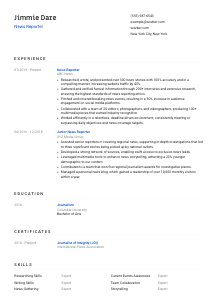
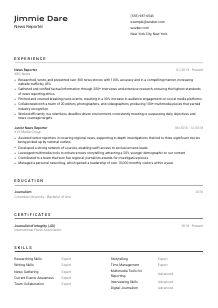
Delivering headlines, but your CV isn't breaking through? Tune in to this News Reporter CV example, created with Wozber free CV builder. Learn how to succinctly present your news-slinging skills to match newsroom demands, ensuring your career narrative keeps pace with current events!
News reporting CVs are reviewed with the same standard applied to published work: accuracy, speed, judgment, and the ability to turn raw information into a clear story under deadline. A hiring editor wants to see more than a love of journalism. Your CV should quickly show the kind of reporting you handle, how you verify facts, what formats you work in, and the audience or newsroom impact your work has produced.
When that experience is tailored to the posting, the distinction between a general content writer and a newsroom-ready reporter becomes much easier to read. Wozber's free CV builder helps you shape that experience into an ATS-compliant CV by aligning your wording with the reporting, multimedia, and deadline-driven language in the job ad, so the first scan already points to your newsroom value.
In reporting, small errors can undermine an otherwise solid story. The same applies here. Your personal details section should give an editor or recruiter clean, dependable contact information and immediately place you in the professional context of the role.
Your name should be the clearest line on the page. Use a professional font and slightly larger size so it reads like a byline, not a footnote. In a field built on published credit and professional reputation, this simple formatting choice helps establish presence right away.
Place "News Reporter" directly under your name if that is the role you are pursuing. Matching the title used in the posting keeps your positioning clear for both editors and ATS filters, especially when employers are sorting applicants across adjacent roles such as producer, correspondent, or content writer.
List a phone number you answer and a professional email address without nicknames or outdated domains. Accuracy matters in journalism, and a typo in your contact section sends the wrong message before anyone reads your clips, reporting metrics, or beat experience.
If the employer asks for a local candidate, include your city and state. Here, New York City is specifically requested, so stating "New York City, New York" immediately removes a point of uncertainty. Use location this way when it is a stated requirement, not as filler in every application.
A link to your portfolio, personal reporting site, or professional profile gives hiring teams direct access to published articles, video packages, or multimedia work. For a News Reporter, that is often more persuasive than any single bullet point because it shows your writing voice, story range, sourcing depth, and format versatility in real output.
This section should read like the top of a polished submission: accurate, relevant, and ready for immediate follow-up. Make it easy to see who you are, what role you cover, and whether you meet any practical requirements such as location.




Editors look to the experience section for proof of newsroom performance. They want to know what you covered, how you gathered information, what deadlines you handled, and whether your work moved an audience, advanced a story, or strengthened the outlet's coverage.
Start by identifying the language that defines the role. In this posting, that includes researching, interviewing, writing accurate stories, staying current on news trends, collaborating on multimedia pieces, and working in a fast-paced environment. Those points should guide which accomplishments you feature and which verbs you use in your bullets.
Begin with your most recent newsroom or reporting-related position. Include employer, title, and dates without clutter. For journalism roles, that structure helps reviewers quickly understand career progression, whether you moved from junior reporting into independent coverage, or expanded from regional news into broader or higher-pressure assignments.
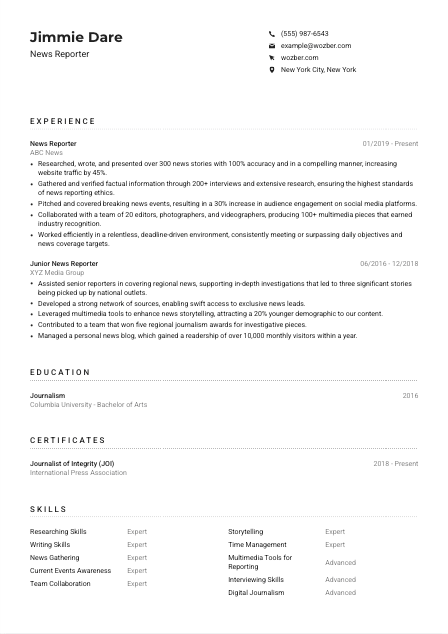
Use accomplishment bullets that show what you produced and what changed because of it. Strong examples include number of stories filed, interviews conducted, traffic growth, engagement gains, investigative pickups, or multimedia output. The sample CV does this well with metrics such as 300+ stories, 200+ interviews, and a 45% traffic increase, which gives real newsroom scale to the candidate's work.
Not every media task deserves equal space. If the role centers on reporting, verification, and story pitching, lead with those responsibilities before broader marketing or general content work. Coverage that shows beat development, breaking news response, source cultivation, or ethical fact-checking will usually carry more weight than unrelated digital tasks.
Use terms from the posting where they reflect your real work, such as "interviews," "factual verification," "multimedia content," or "current events." That improves ATS optimisation while also helping editors quickly recognize relevant experience. Wozber's AI CV builder can help surface those terms and align them to the right bullet points without making the writing sound stuffed or generic.
A reporting CV earns attention when the experience section shows published output, verification discipline, deadline pace, and collaboration across the newsroom. If an editor can picture you filing stories from these bullets, the section is doing its job.
For reporting roles, education usually serves as baseline qualification rather than the main selling point. Still, when a posting asks for a journalism or communications degree, this section should confirm that requirement cleanly and, where useful, reinforce the kind of reporting foundation you bring.
If the role asks for a bachelor's degree in Journalism, Communications, or a related field, present your degree in that exact context when it applies. A Bachelor of Arts in Journalism, as shown in the sample, directly supports the requirement and removes any ambiguity during the first review.
List degree, school, field of study, and graduation year. This section should be easy to scan in seconds. Hiring teams are usually confirming credentials here, not looking for a long narrative, so clean structure matters more than extra wording.
If your program included work in reporting, media law, ethics, investigative journalism, broadcast writing, or multimedia storytelling, those details can support your candidacy when you are early in your career or when the role emphasizes a particular reporting style. Add them briefly only if they sharpen your newsroom profile.
Student newspaper work, campus broadcasting, investigative projects, or editorial leadership can add value if they demonstrate real reporting practice, deadline work, or published output. For early-career applicants, those experiences often help bridge the gap between classroom training and professional newsroom work.
Journalism changes with audience behaviour and platform demands. If you have completed workshops or courses in mobile reporting, video editing, data journalism, verification methods, or digital audience strategy, include the ones that support the kind of reporting the employer wants now.
Keep this section factual, relevant, and connected to the reporting work you want to do. It should show that you meet the academic requirement and, when helpful, that your training covered the tools and standards modern newsrooms rely on.
Certifications are rarely the core reason a reporter gets hired, but the right one can reinforce professional standards, technical range, or subject-matter depth. In journalism, they are most useful when they support how you report, verify, produce, or present stories.
Start with credentials tied to reporting practice, media ethics, investigative methods, digital storytelling, video production, public records research, or specialised beats. The sample certificate in journalistic integrity works because it supports a core expectation of the profession: accurate, ethical reporting.
Only include certifications that add something your experience section does not already make obvious. A short list of strong, relevant credentials reads better than a long catalogue of unrelated courses, especially in a role where writing quality, verification habits, and published work matter most.
Publication standards, verification practices, and multimedia tools evolve. Showing when a certificate was earned, or whether it remains active, helps hiring teams understand how current your training is, particularly for digital journalism or newsroom technology.
If you move into investigative reporting, video-first storytelling, court reporting, or another specialised area, your certifications should evolve with that direction. This section works best when it reflects the reporting methods and standards you actively use, not just past coursework.
The right certificate can support your case as a reporter who takes standards seriously and keeps up with the craft. Keep the focus on credentials that strengthen ethical reporting, technical versatility, or beat-specific expertise.
A News Reporter skills section should look like a newsroom toolkit, not a generic list of traits. The strongest version combines reporting fundamentals, production capabilities, and the working habits that matter when stories move fast and facts still need to hold up.
Use the job description to identify the skills that matter most for the role. Here, that includes writing, research, interviewing, multimedia tools, and the ability to operate in a deadline-driven newsroom. Those are the skills that deserve priority because they map directly to daily reporting work.
Include both editorial and technical abilities. A hiring team may want to see interviewing, source development, fact-checking, AP style, or beat reporting alongside video capture, audio editing, CMS publishing, or social distribution, depending on the newsroom. The sample CV handles this balance well by combining storytelling and news gathering with multimedia and digital journalism.
Do not overload this section with every transferable skill you have. Choose the ones that support the actual work of reporting and story production. A tighter list helps both ATS parsing and human review, especially when each skill clearly connects to the responsibilities in the posting.
Your skills section should quickly show that you can report, verify, write, and adapt stories across formats. If the list reflects the pace and production demands of the target newsroom, it is doing real work for your application.
Language ability can matter a great deal in reporting, especially when it affects access to sources, community coverage, or international context. Even when only English is required, this section can add useful depth if you present proficiency clearly and honestly.
If the posting specifies English fluency, list English first and state your level clearly as "Native" or "Fluent," whichever is accurate. That quick confirmation matters because strong writing, interviewing, and on-the-record communication depend on it.
Other languages can strengthen your profile when they help you interview more sources, cover multilingual communities, or follow international developments. In a diverse market, a language like Spanish can be especially useful, but include additional languages as assets, not as padded extras.
Stick to direct terms such as "Native," "Fluent," "Intermediate," or "Basic." Editors and recruiters need a realistic sense of whether you can conduct interviews, review documents, or navigate community conversations in that language.
If a role covers a specific region, audience, or beat, highlight languages that make you more effective in that reporting context. That could mean community reporting, immigration coverage, international affairs, or local politics involving multilingual constituencies.
The value of language skills lies in better access, better sourcing, and better storytelling. Present them that way. A second language can widen your source network and deepen coverage, which is far more meaningful than simply appearing well-rounded.
This section works best when it tells a practical story about access and communication. Lead with required fluency, then add other languages that genuinely strengthen the kind of journalism you can produce.
A reporter's summary should read like a strong opening graf: quick, specific, and grounded in real work. It needs to establish your reporting identity, your range, and the kind of newsroom contribution you can make without repeating your entire experience section.
Start with your title and experience level in a direct line, such as a News Reporter with 5+ years covering breaking news, enterprise stories, or multimedia features. This gives immediate context and helps separate you from adjacent candidates in content, communications, or broader media roles.
Work in the most relevant strengths from the posting, especially writing, research, interviewing, fact verification, and deadline performance. The sample summary does this effectively by naming news reporting, research, compelling storytelling, and comfort in fast-paced environments.
Aim for a few lines, not a full biography. Editors move fast, and your summary should deliver your value in one quick read. Focus on your reporting scope, professional strengths, and one or two concrete distinctions rather than broad career commentary.
Adjust the summary for the job you are targeting. If the employer wants multimedia storytelling and collaboration with photographers or videographers, mention that. If the role leans heavily on breaking news, investigations, or audience-facing presentation, bring that into the summary so the opening lines already match the assignment.
Your summary should make your newsroom identity clear within seconds. When it captures your reporting strengths, pace, and format range in plain language, the rest of the CV has a strong opening to build on.
A well-tailored News Reporter CV should show published output, factual discipline, deadline performance, and the ability to work across modern storytelling formats. When those strengths are easy to find, hiring teams can quickly picture you covering the next story, not just applying for the job.
Wozber's free CV builder, ATS-friendly CV template, and ATS CV scanner can help you organise that experience, align it with the posting, and strengthen ATS optimisation without losing your reporting voice. The final result should make one thing clear: you can step into the newsroom and deliver accurate, compelling coverage from day one.




