



Use Wozber and land your dream job
Create CV
No registration required
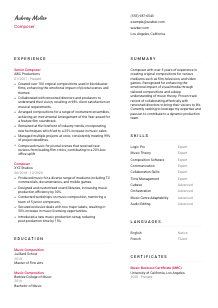
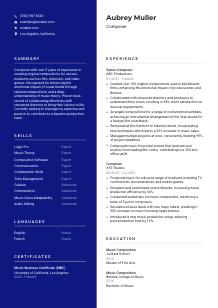
Harmonizing melodies, but your CV sounds off-key? Check out this Composer CV example, created with Wozber free CV builder. It shows how to score your musical spirit to hit all the right job notes, ensuring your career is always in perfect pitch!
Composers are hired on their ability to shape emotion to picture, direction, and deadline. A CV for this field needs to show more than musical talent. It should make clear that you can write original material for visual media, adapt your style to a project's tone, arrange for the right ensemble, and keep creative work moving when directors, producers, and delivery schedules are in play.
When that story is tailored well, hiring teams can quickly distinguish a composer with production-ready credits from someone with only broad music experience. Wozber's free CV builder helps you line up your wording with the posting, keep an ATS-friendly CV format, and surface role-specific terms like orchestration, scoring for visual media, and collaboration with directors so your background reads as relevant from the first scan.
This section is straightforward, but it still affects how quickly a production team can place you. For a Composer opening, your header should confirm who you are, what role you do, and whether you meet practical requirements such as location and professional contact access.
Use your full name as the clearest element at the top of the page. Keep the formatting clean and readable so it looks professional in both digital review and ATS parsing.
Use the target title directly below your name when it fits your background. Here, "Composer" is the right choice because it aligns with the posting and immediately frames the rest of the CV around scoring, arranging, and production collaboration.
List a working phone number and a professional email address you check regularly. In project-based creative work, missed calls or bounced emails can cost you follow-up conversations about briefs, revisions, or interviews.
If a role includes a location requirement, state your city and state clearly. In this example, listing Los Angeles, California directly addresses the employer's request and removes doubt about availability for local collaboration.
A personal website, portfolio, or well-maintained LinkedIn profile can strengthen this section, especially for composers with credits in film, television, games, trailers, or branded content. Link to a page that reflects your current work and makes it easy to hear cues, view credits, or understand your scoring range.
Keep this section clean, accurate, and aligned with the posting. It should confirm basic logistics fast so the reader can move straight to your credits and musical work.




Experience carries the most weight on a Composer CV because it shows how your music performed in real productions. Hiring teams want to see the mediums you have worked in, the scale of your output, the collaborators you supported, and the results your compositions helped drive.
Read the posting closely and pull out the working requirements behind the wording. For this role, the key themes are original composition for visual media, collaboration with directors and producers, arranging for different ensembles, staying current with technique, and meeting deadlines. Those should shape which bullets you keep and how you phrase them.
Start with your current or most recent position, then work backward. Include company, title, and dates clearly. If you have progressed from Composer to Senior Composer, as in the example, that progression helps show increasing trust, creative scope, and responsibility.
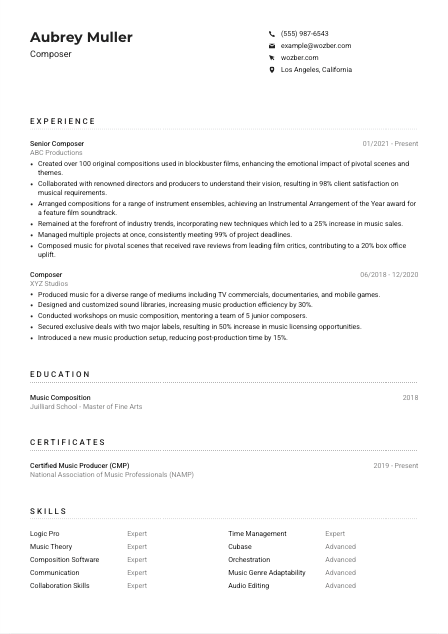
Your bullets should show what you composed, for which medium, and what happened because of that work. Strong examples include writing music for films, television, commercials, documentaries, or games, tailoring cues to scene tone, and shaping arrangements for specific instrument groups. The sample CV does this well by tying composition work to emotional impact, director collaboration, and soundtrack recognition.
Numbers make creative achievements easier to judge when they reflect real industry outcomes. Useful measures include number of original compositions delivered, client satisfaction, licensing growth, production efficiency, post-production time saved, deadline consistency, awards, review response, or commercial results tied to a scored project. Metrics like "over 100 original compositions," "98% client satisfaction," and "99% of project deadlines met" give the work real professional scale.
Cut background that does not strengthen your case for composing in professional media environments. Space is better spent on cue writing, orchestration, DAW-based production, revision cycles, collaboration with filmmakers, or managing multiple projects than on unrelated performance or general music interests. Relevance is what turns experience into a convincing shortlist profile.
The best experience sections read like a record of delivered projects, trusted creative partnerships, and reliable execution. Make it easy to see that you can write strong music and move it through real production timelines.
Education matters here because the posting asks for a bachelor's degree in music composition or a related field. Present it clearly, then use any added academic depth to reinforce training in composition, theory, orchestration, and professional musicianship.
If the role asks for a bachelor's in music composition or a related field, list that information plainly. Degree, field, school, and graduation year should be visible at a glance so there is no ambiguity about meeting the requirement.
Put your most advanced degree first, then work backward. For a composer, this can show both formal grounding and advanced specialization. In the sample, the Master of Fine Arts in Music Composition strengthens an already relevant bachelor's degree.
Use the same format for each entry so the section reads quickly. School name, degree, field, and year are usually enough. That keeps attention on the substance of your training instead of cluttering the layout.
Extra academic detail is worth including when it supports the kind of work you want next. Coursework or concentration areas like orchestration, film scoring, interactive music, conducting, or advanced harmony can help if you are earlier in your career or targeting a specialised composition path.
Awards, fellowships, competition placements, or distinction in composition can add value, especially if your professional credits are still growing. Keep them selective and relevant to writing, arranging, or music production rather than listing every academic recognition.
This section should show that your training supports the work on the page. For composing roles, that usually means a clear degree match plus any focused study that strengthens your command of theory, orchestration, and scoring practice.
Certifications are not always required for composers, but they can support your profile when they reflect current production knowledge, business awareness, or specialised technical skills. Keep this section selective and relevant to the kind of projects you want to score.
Look for credentials that add something useful to your application, such as music production, scoring technology, audio tools, or industry business knowledge. The example's music production and music business certificates work because they complement composition work without replacing the importance of actual credits.
List the certification title clearly, followed by the issuing organisation. That makes the credential easier to understand and gives it more weight than a vague abbreviation on its own.
Dates help a hiring team see whether your training is current, active, or recently completed. In software-driven creative work, recency matters because production tools and workflows evolve.
If you complete training in new DAWs, sample library workflows, audio post-production, or sync and licensing topics, refresh the section. Ongoing learning is especially useful when it connects directly to how you compose, produce, and deliver music today.
A short, relevant certifications section can reinforce current technical range and industry engagement. Keep it tied to composition work, production tools, or the business side of media music.
The skills section should translate your musicianship into hiring language the employer recognizes fast. For composers, that means balancing creative craft with production tools and the collaboration skills needed to turn notes into finished cues under direction.
Start with the skills the employer actually names. Here, that includes composition software, music production tools such as Logic Pro or Cubase, music theory, orchestration, genre range, communication, collaboration, and time management. Using those terms naturally supports ATS optimisation and keeps your CV closely aligned with the role.
Show both the artistic and technical sides of the job. A useful list might include orchestration, thematic writing, cue development, music theory, DAWs, audio editing, MIDI programming, mockup production, and collaboration with directors or producers. The sample skills section works because it combines software proficiency with core composition strengths.
Do not overload this section with every music-related ability you have. Prioritise the skills most relevant to professional scoring work, and group them logically if needed. A concise list is easier to scan and does a better job of reinforcing your experience bullets.
A useful skills section should reflect how you really compose and deliver work. Choose the tools, musical disciplines, and collaboration strengths that match the productions you want to join.
Language skills matter when the role calls for clear communication with directors, producers, editors, and other collaborators. For a Composer, this section is usually brief, but it should still cover required communication ability cleanly.
If the posting specifies English communication, list English clearly with an accurate proficiency level. That answers the requirement directly and avoids leaving the reader to infer it from the rest of the CV.
Place English first when it is required for the role, marked as "Native" or "Fluent" if that is accurate. The sample CV handles this well by making English immediately visible.
Additional languages can help if you work on international productions, multilingual teams, or global licensing and client relationships. They are a supporting advantage, not a substitute for core composition experience.
Use straightforward labels such as Native, Fluent, Intermediate, or Basic. Overstating language ability can create problems quickly in meetings, revision calls, or written project communication.
For most composing roles, language ability is a secondary factor unless the production context makes it central. Include what is useful, but keep the focus of the CV on scoring credits, tools, and delivered work.
This section only needs to do a clear job. Confirm communication ability where required and let your composition experience remain the main story.
The summary should frame you as a working composer, not simply a musician with broad interests. In a few lines, connect your years of experience, main media formats, creative strengths, and production habits to the kind of projects you are targeting now.
Start with your title and level of experience in terms that match the work you do. For example, mention 3+ years or 5+ years composing for film, television, games, or other media if that reflects your background. This immediately sets the range of your professional practice.
Choose two or three priorities from the posting and build them into the paragraph naturally. For this position, that could include creating original compositions for visual media, collaborating with directors and producers, and drawing on strong music theory and orchestration skills.
A summary becomes more credible when it includes selective proof. You might reference the scale of your output, a notable result, or the breadth of media you have scored. The sample summary is strongest where it connects years of experience with tailored compositions and collaboration history.
End by pointing toward the contribution you are ready to make, such as supporting a production team with emotionally precise scoring, dependable delivery, or stylistic versatility across genres. Keep it specific and concise rather than overly dramatic.
A good summary gives the reader a fast read on your credits, creative strengths, and production reliability. Finish by refining the wording in Wozber's AI CV builder and checking it with an ATS CV scanner so your ATS-compliant CV makes your scoring experience, collaboration style, and readiness for the role easy to recognize.
A Composer CV works when each section supports the same conclusion: you can write original music for picture, collaborate well, and deliver on deadline with the tools the production environment expects.
Use Wozber to tighten wording, align your CV with the posting, and present it in an ATS-friendly CV template that keeps your credits, software, and results easy to scan.
When the editing is done, your CV should make one thing clear immediately. You are ready to contribute music that serves the project, the team, and the production schedule.