



Use Wozber and land your dream job
Create CV
No registration required
Reporting live, but your CV feels pre-taped? Check out this Broadcast Journalist CV example, created with Wozber free CV builder. Learn how to seamlessly weave your on-air charisma into job specifics, scripting a career that's always ready for prime time!
Broadcast journalism gets judged in real time. Producers and news directors look for people who can report accurately under deadline, write to pictures, stay composed on camera, and move from editorial meeting to field interview without losing the thread of the story. Your CV needs to show that kind of newsroom range clearly, with proof that you can deliver coverage people can trust.
A tailored CV makes one early distinction much easier in this field: whether you are a general media candidate or someone who can step into a newsroom workflow and contribute fast. Using Wozber's free CV builder helps you shape an ATS-compliant CV around the posting's language, so experience with field reporting, story production, newsroom systems, and live coverage is immediately visible to both the system and the hiring team.
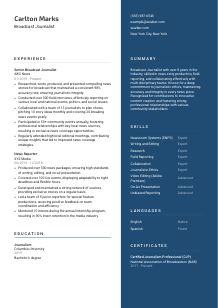
In broadcast journalism, the top of the CV should read like a clean station ID. It needs to establish who you are, what role you are targeting, and whether a newsroom can contact and place you quickly. Keep this section direct and useful.
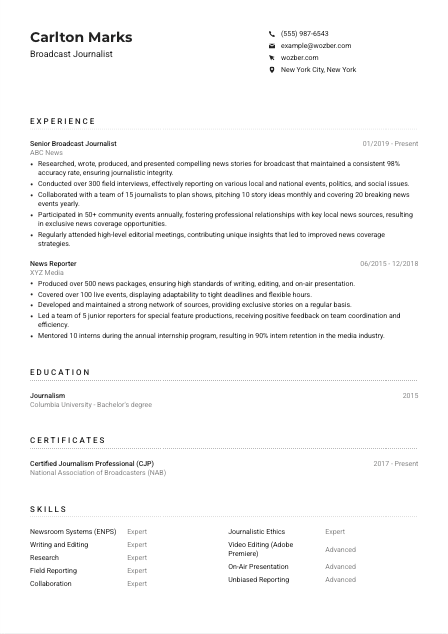
Your name should be the most visible text on the page, just as a byline or on-air identifier would be. Use a clear font and enough spacing so it stands out immediately in an ATS-friendly CV format.
Place "Broadcast Journalist" directly under your name if that is the role you are pursuing. This helps frame the rest of the CV around reporting, producing, and on-air work instead of leaving your profile open to broader media interpretations.
List a reliable phone number and a professional email address you check often. News hiring can move quickly, especially around staffing changes or expanding coverage needs, so accuracy matters here more than style.
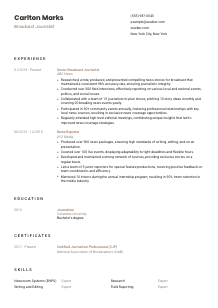
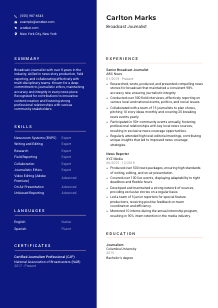
If the employer specifies a city, reflect that clearly. In the example, "New York City, New York" answers a stated requirement and removes uncertainty about local availability for field reporting, editorial meetings, and community events.
A LinkedIn profile, personal website, or digital portfolio can support your CV with clips, reels, or published work. Make sure it matches the reporting focus, accomplishments, and credits you list on the CV so the hiring team sees a consistent professional record.
This section should confirm your professional identity and basic logistics without slowing the reader down. If a station or newsroom can immediately see your role target, contact details, and required location, they can move straight to your reporting track record.




Newsroom experience is where broadcast journalist CVs either become credible fast or stay vague. Hiring teams want to see what you covered, how you worked, what kind of output you handled, and whether your reporting held up under real deadline pressure. Focus on published work, live coverage, editorial contribution, and measurable newsroom results.
Start with positions that clearly connect to broadcast reporting, news production, or field journalism. A title like "Senior Broadcast Journalist" or "News Reporter" immediately places your background in the right lane and helps the reader understand your level of newsroom responsibility.
Do not stop at listing routine tasks. Show what your work produced. The example bullet about researching, writing, producing, and presenting stories with a 98% accuracy rate works because it connects core newsroom duties to a performance standard that matters in journalism.
Broadcast journalism is often evaluated by output and range. Numbers such as 300 field interviews, 500 news packages, or 20 breaking news events per year give hiring teams a practical sense of your reporting volume, field experience, and deadline stamina.
Move bullets about writing, editing, field interviews, live events, editorial meetings, source development, and community engagement to the top of each role when those are central to the opening. If the employer mentions politics, social issues, or local coverage, highlight reporting that shows you have already worked in those lanes.
Career growth in journalism often shows up through bigger assignments, more visible on-air work, special coverage, or influence in editorial planning. Advancing from a reporting role into a senior broadcast position, as in the example, tells the employer that previous newsrooms trusted you with greater responsibility and judgment.
Your experience section should read like proof of newsroom performance. When it shows story production, reporting range, audience-facing presentation, collaboration with producers and editors, and measurable output, the employer can picture how you would contribute on day one.
For broadcast journalists, education usually serves as baseline qualification rather than the main selling point. It still matters because many postings ask for a journalism, broadcasting, or related degree, and that requirement should be easy to find in seconds.
When a posting asks for a bachelor's degree in Journalism, Broadcasting, or a related field, list that qualification exactly and make it easy to scan. The sample's "Bachelor's degree, Journalism" aligns cleanly with the requirement and avoids ambiguity.
Present degree, field of study, school, and graduation year in a consistent order. That structure works well for ATS parsing and lets hiring teams confirm your academic background without digging through extra detail.
If your degree is directly connected to journalism, say so. "Journalism" carries more value here than a broad label because it ties your education to reporting, ethics, media law, writing, and newsroom practice.
Early-career candidates can use relevant coursework to strengthen the section, especially if they have limited professional clips or reporting history. Courses in broadcast writing, media production, political reporting, or video journalism can add context, but experienced journalists usually do not need that extra layer.
Honors, student media leadership, investigative projects, or campus broadcasting work can be worth adding if they demonstrate reporting initiative or on-air experience. Keep them only if they reinforce your journalism profile rather than distract from professional newsroom work.
This section should confirm that you meet the academic baseline and, when relevant, add a little context about your journalism training. For experienced broadcast candidates, clarity matters more than detail.
Certifications are rarely the deciding factor for broadcast journalist roles, but they can strengthen your profile when they reflect professional development in journalism, media production, or related standards. Use this section to support your newsroom credibility, not to pad the CV.
List certifications that connect to reporting, broadcasting, editing, media ethics, or professional journalism standards. A credential such as the example's "Certified Journalism Professional (CJP)" adds weight because it reinforces commitment to the field rather than introducing an unrelated qualification.
A short, relevant certificate list works better than a long inventory of loosely connected courses. Prioritise credentials that sharpen your profile as a broadcast reporter, producer, or on-air journalist.
Dates help employers see whether a certification is current, recent, or long held. Listing "2017 - Present" in the example gives a clear sense of continuity and ongoing professional standing.
Broadcast journalism changes with new production tools, newsroom workflows, audience habits, and editorial standards. Recent learning in video editing, digital reporting, or media law can show that your practice is current and adaptable.
Relevant certifications can reinforce your credibility, especially when they echo the reporting, production, or editorial strengths the job calls for. Keep the section focused and tied to the actual work of the newsroom.
The skills section should reflect how broadcast journalism actually gets done. Hiring teams look for a mix of editorial judgment, reporting ability, on-air communication, production tools, and collaboration inside a fast-moving newsroom. Keep the list sharp and tied to the posting.
Start with the terms the employer already uses. If the job asks for writing, editing, on-air presentation, video editing software, and familiarity with newsroom systems, those categories belong near the top of your list.
Be specific when you can. Instead of a generic "video editing," listing "Adobe Premiere" gives the reader a clearer picture of your production ability. The same applies to newsroom platforms such as ENPS when that experience is real and relevant.
Prioritise skills tied to core broadcast work, such as research, field reporting, interview preparation, script writing, fact-checking, on-air delivery, and journalistic ethics. These tell a stronger story than broad descriptors that could belong to any communications role.
Your skills section should quickly show that you can report, write, edit, and work inside a newsroom system without a long ramp-up. Relevance matters more than volume, so keep the focus on the capabilities that support broadcast coverage.
Language ability can matter a great deal in journalism, especially when it expands your access to sources, communities, and audience segments. For broadcast roles, this section should first address any required speaking standard, then add other languages that broaden your reporting reach.
If the posting says you must articulate clearly in English, make that visible. Listing English with an honest proficiency level, such as "Native," directly addresses an explicit requirement for on-air and interview communication.
A second language can be valuable when it helps with source development, community reporting, or multilingual interviews. In the example, fluent Spanish would be a practical asset in many markets because it can widen both reporting access and audience connection.
Use clear levels such as Native, Fluent, Advanced, or Conversational. In journalism, overstating language ability can create real problems in interviews, live reporting, and source relationships, so accuracy matters.
Extra languages are most persuasive when the employer can imagine how they help the coverage. That might mean reporting in multilingual communities, handling field interviews more directly, or building trust with sources who are more comfortable speaking in another language.
Not every language belongs on every CV. Include the ones that realistically support the beat, market, or audience you want to cover. For a local news role, a widely spoken community language may matter more than a language you rarely use professionally.
Handled well, the languages section shows more than personal background. It shows whether you can communicate clearly on air, work more effectively with sources, and report stories that reach beyond a narrow audience base.
The summary should sound like an experienced journalist introducing their reporting profile, not like generic branding copy. In a few lines, show your level, your editorial strengths, and the kind of newsroom contribution you are ready to make.
Read the posting closely, then write a summary that reflects the actual work involved. For a broadcast journalist, that usually means some combination of reporting experience, story production, live or on-air presentation, accuracy, and collaboration with the newsroom team.
A direct first line works best. "Broadcast Journalist with 8+ years of experience" immediately gives the employer a frame for your seniority and keeps the section grounded in the profession.
Choose strengths that map to the role, such as field reporting, writing to deadline, editorial integrity, live presentation, or source development. The sample summary works well because it combines production, reporting, and ethics rather than relying on broad self-description.
Aim for a compact paragraph with real substance. A summary should be brief enough to scan quickly, but specific enough that a news director or recruiter can understand your coverage background and professional standard right away.
Your summary should quickly establish what kind of broadcast journalist you are and what newsroom strengths you bring. When it names your experience, reporting focus, and editorial standards clearly, the rest of the CV lands with much more force.
A broadcast journalist CV should make three things easy to see: you can report accurately, work fast under deadline, and contribute inside a real newsroom operation. If each section reinforces those points with relevant roles, measurable reporting work, and tools that match the posting, you are presenting the right kind of profile.
Use Wozber's free CV builder, ATS-friendly CV templates, and ATS CV scanner to sharpen wording, align your experience with the job description, and present everything in an ATS-friendly CV format. The final version should make it easy for a hiring team to judge your reporting range, editorial judgment, and readiness for the next broadcast assignment.