



Use Wozber and land your dream job
Create CV
No registration required
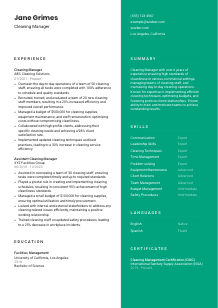
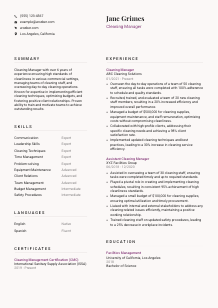
Keeping spaces spotless, but your CV feels a bit messy? Check out this Cleaning Manager CV example, built with Wozber free CV builder. Learn how to tidy up your leadership and sanitation skills to match job expectations, making your career shine as brightly as a freshly polished surface!
Cleaning Managers are trusted with work that becomes obvious the moment it slips. A hiring team wants to see that you can run daily cleaning operations, keep standards consistent across shifts or sites, handle staff issues quickly, and maintain safe use of chemicals and equipment. Your CV should make that operating control visible, not just list cleaning duties.
When the CV mirrors the language of the job ad, it becomes much easier to separate hands-on cleaners from candidates who have actually managed schedules, budgets, training, and client expectations. Wozber's free CV builder helps you shape that experience into an ATS-compliant CV that surfaces the right terms and priorities early, so employers can quickly see your management scope and service standards.
For a Cleaning Manager, the header needs to do one practical job well: confirm who you are, what role you are targeting, and whether basic requirements such as location and contact access are already covered. Keep it clean, direct, and professional.
Use your full name in a clear, easy-to-read format at the top of the page. This is not a design exercise. It is a professional identifier tied to your supervisory record, client-facing work, and management history, so make it easy to find.
Place "Cleaning Manager" directly under your name when that is the role you are applying for. Matching the posted title helps frame your background correctly from the first line and supports ATS alignment, especially when your past titles include close variations such as Assistant Cleaning Manager or Facilities Supervisor.
Include a working phone number and a professional email address you check regularly. Cleaning management hiring often moves quickly when employers need someone who can step into staffing gaps, client escalations, or site coverage issues, so your contact details should support fast follow-up.
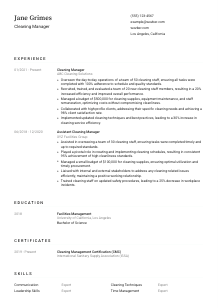
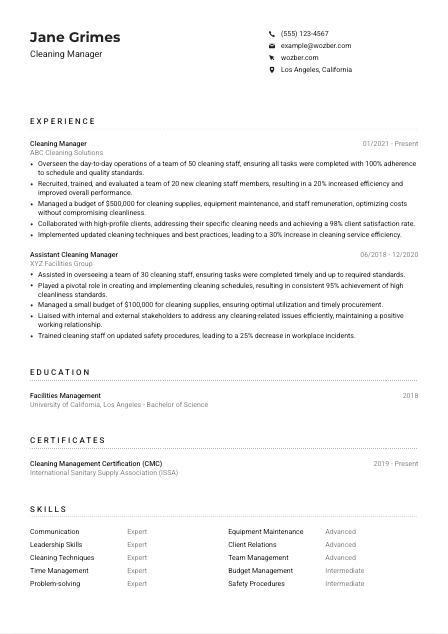
If the employer specifies a local requirement, include your city and state. In the example, listing Los Angeles, California directly addresses the posting's location filter and removes an avoidable question about relocation or availability.
Add LinkedIn or a professional website only if it supports your CV with relevant management experience, certifications, or facilities-related work. Make sure the content matches your CV titles, dates, and scope of responsibility so your application reads consistently across every touchpoint.
This section should confirm the basics quickly and cleanly. When your title, contact details, and location are aligned with the role, the reader can move straight to your management experience.




In cleaning management, experience is where employers look for proof that you can keep standards high while coordinating people, schedules, supplies, and client needs. Focus less on routine tasks and more on the scale, control, and outcomes of the operations you managed.
Start by marking the responsibilities and requirements that define the role. Here, the posting emphasizes staff oversight, cleaning schedules, quality standards, client communication, budgeting, and knowledge of cleaning methods and equipment maintenance. Those points should shape which achievements you select and how you phrase them.
List your most recent role first, then work backward. For each position, include job title, employer, and dates so the reader can track your move from frontline support into supervision or full operational management. That progression matters in a role where leadership credibility is built over time.
Each bullet should show what you managed, improved, resolved, or delivered. The example does this well with details such as overseeing 50 staff, managing a $500,000 budget, and recruiting and training new team members. Those statements show managerial scope in a way that "responsible for cleaning operations" never will.
Use numbers that reflect how cleaning work is actually measured: team size, site count, budget, audit scores, schedule adherence, client satisfaction, incident reduction, supply savings, or efficiency gains. A line such as "improved service efficiency by 30%" gives employers a concrete view of your impact on workflow and service delivery.
Prioritise experience that shows staff leadership, quality control, training, health and safety practices, equipment oversight, and client coordination. If you have broader facilities experience, keep the bullets that connect directly to cleaning operations and service standards. The goal is to show that you can run a cleaning team, not simply participate in one.
Your experience section should show operational control. When the bullets cover team leadership, service quality, scheduling, budgeting, and measurable improvements, your management background becomes easy to trust.
Cleaning Manager roles are usually won on operational experience, but education still adds useful context. It can show formal grounding in facilities management, safety, supervision, or business operations, especially when the job ad asks for related training or credentials.
Review the education and training language before you format this section. In this case, the employer mentions a relevant certification or license in cleaning management or a similar field, so your degree and any field-related study should be presented in a way that supports that expectation.
Include the degree, school, field of study, and graduation year or date. Keep the layout clean so the reader can scan it quickly alongside your work history. For management roles, over-formatting adds no value. Clear presentation does.
If your degree connects to facilities, operations, environmental services, business, or workplace safety, make that connection obvious. The example's Bachelor of Science in Facilities Management works well because it complements hands-on cleaning leadership with formal operational knowledge.
You do not need to list classes unless they reinforce the role. If you studied sanitation systems, occupational safety, maintenance operations, or staff management, those details can help when your work history is lighter or when the employer values technical understanding of cleaning environments.
Academic honors, projects, or related organizations are useful only when they support your professional direction. Early-career candidates may benefit from them more. For experienced Cleaning Managers, keep the emphasis on education that strengthens your credibility in operations, compliance, or facilities oversight.
Education should support the story your experience already tells. Keep the focus on study that connects to cleaning operations, supervision, safety, or facilities management.
Certifications carry weight in cleaning management because they show current knowledge of industry practices, safety expectations, and supervisory discipline. They are especially useful when the employer mentions preferred credentials or when your role involves training staff and maintaining compliance standards.
Return to the posting and note any credential language. This job does not name a required certification, but it does mention a relevant certification or license in cleaning management or a similar field. That makes industry-recognized credentials worth highlighting rather than treating them as optional extras.
Choose certificates tied to cleaning management, sanitation standards, safety procedures, chemical handling, equipment care, or facilities operations. The example's Cleaning Management Certification from ISSA works because it supports both supervisory credibility and technical knowledge of the field.
Show when the certification was earned and whether it is current. Dates matter in areas such as safety procedures, compliance expectations, and equipment practices, where employers want confidence that your training is still current enough to guide staff properly.
If you are still growing into larger management roles, pursue certifications that strengthen the exact areas employers ask for most often: team supervision, cleaning systems, workplace safety, infection control, or facilities operations. Each credential should make your CV more relevant to the work you want next.
A well-chosen certification section shows professional upkeep. For a Cleaning Manager, that means current standards, safe practices, and a clear commitment to running services responsibly.
A Cleaning Manager's skills section should read like the toolkit behind daily operations. Include the abilities that keep teams productive, sites compliant, clients informed, and service quality consistent, then order them around the needs of the job you are targeting.
Pull both technical and people-management skills from the job ad. Here, that includes communication, leadership, cleaning techniques, equipment maintenance, schedule planning, and client coordination. Those terms are more useful than generic claims because they match the work the employer needs covered.
Lead with the skills most central to the role. For many Cleaning Manager positions, that means team leadership, cleaning operations, quality control, training, scheduling, and client communication before broader strengths like time management. Prioritization helps the reader understand your management profile quickly.
Do not overload this area with every skill you have ever used. Select the mix that best supports the role, including both hard skills and supervisory strengths. In the example, cleaning techniques, equipment maintenance, safety procedures, team management, and client relations work together because they reflect the day-to-day realities of running cleaning services.
Choose skills that describe how you lead cleaning operations in practice. A tighter, role-specific list tells a much clearer story than a long catalogue of generic strengths.
Language skills matter in cleaning management when the role involves directing teams, explaining procedures, handling client requests, and resolving service issues on the spot. Include languages that genuinely support the work environment, and present your proficiency levels honestly.
If the job states English proficiency as a necessity, list English clearly and give your true level. For a Cleaning Manager, this matters in staff instruction, schedule communication, reporting, and client interactions, not just casual workplace conversation.
Place the most relevant language first, then add others that strengthen your ability to supervise teams or communicate with clients. In the example, English appears first and Spanish adds useful value in a large, diverse labour market. That will not be universal for every opening, but it can be a strong advantage where it matches the workforce or customer base.
Additional languages can help with team training, conflict resolution, and clearer task delegation across multilingual crews. Include them when they are real working skills, especially if your background includes client-facing sites or large teams with varied language needs.
Stick to plain terms such as Native, Fluent, Advanced, Intermediate, or Basic. Avoid inflated wording. A Cleaning Manager may need to give safety instructions, explain chemical procedures, or respond to complaints, so your stated level should reflect what you can actually handle on the job.
Think about who you manage and who you serve. In some cleaning environments, extra language ability helps with shift handovers, onboarding, and client communication across multiple sites. Include it when it adds operational value, not simply because it looks impressive.
List languages that improve real communication on the job. In a management role, that means clearer instructions, smoother client contact, and fewer misunderstandings across the team.
The summary is where you frame your value in a few lines before the reader reaches your job history. For a Cleaning Manager, it should quickly establish years of experience, team leadership, operational strengths, and the kind of results you have delivered across cleaning services.
Base your opening lines on the priorities in the posting. For this role, that means management experience, knowledge of cleaning methods, scheduling, staff oversight, client communication, and quality standards. Your summary should preview those strengths in a concise way.
Start with your years of experience and the environments you manage, such as commercial buildings, facilities services, or multi-site operations. A line like the example's "over 6 years of experience" works because it immediately establishes professional maturity in cleaning leadership.
Add achievements or strengths that show how you operate as a manager. Good examples include improving efficiency, training teams, controlling budgets, maintaining high cleanliness scores, or building strong client relationships. These details make the summary feel earned rather than generic.
Aim for a short paragraph with substance. Four to five lines is usually enough. If every sentence refers to real management scope, operational outcomes, or cleaning expertise, the summary will do its job without sounding inflated.
Your summary should quickly establish that you can lead cleaning operations, maintain standards, and manage people effectively. When those points are clear upfront, the rest of the CV has a strong foundation.
A Cleaning Manager CV works best when every section supports the same message: you can run cleaning operations reliably, lead staff well, and maintain standards clients notice. That means showing team size, schedule control, training, safety awareness, supply or budget oversight, and measurable service results wherever your experience allows.
Use Wozber's free CV builder and ATS CV scanner to align your wording with the job description, strengthen ATS optimisation, and present your background in an ATS-friendly CV format. The final result should make one thing easy to judge at a glance: you are ready to manage cleaning services with consistency, accountability, and professional control.