




Use Wozber and land your dream job
Create CV
No registration required
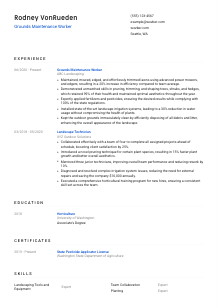
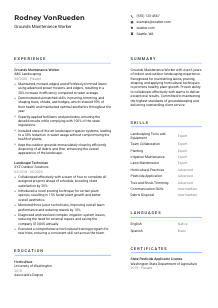
Tending to turf, but your CV isn't in full bloom? Check out this Grounds Maintenance Worker CV example, created with Wozber free CV builder. It shows how to put your green thumb to work in line with job expectations, setting your career path as well-manicured as the lawns you care for!
Grounds maintenance is judged in the field long before anyone talks about aesthetics. Hiring teams want to see that you can keep sites safe, healthy, and presentable through routine mowing, pruning, irrigation upkeep, debris removal, and chemical application that follows schedule and regulation. Your CV should make that day-to-day reliability visible, not just say you
When that experience is tailored well, the CV quickly separates general labour backgrounds from candidates who already understand plant care, equipment handling, and regulated pesticide work. Wozber's free CV builder helps organise that experience into an ATS-friendly CV format that mirrors the language of the posting, so the first read makes it easier to see your operating range, license status, and hands-on readiness for the crew.
Grounds maintenance hiring usually starts with a quick check of practical basics. Can this person be reached easily, are they targeting the right role, and do they meet any location requirement tied to route coverage or site access? Keep this section clean and job-specific.
Use your full name as the clearest heading on the page. A simple bold treatment is enough. In trades and field-based work, readability matters more than style, especially when supervisors are reviewing several CVs quickly between operational tasks.
Place
List one phone number you answer reliably and a professional email address. Use a format that looks routine and credible, such as firstname.lastname@email.com. If a hiring manager needs to fill a crew opening quickly, your contact details should not slow that down.
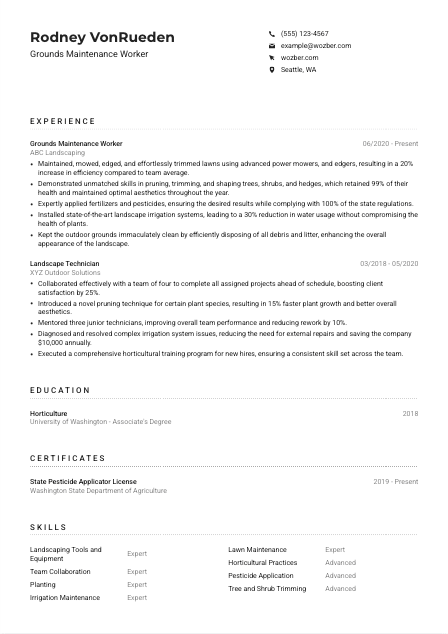
If the employer wants someone based in a certain area or willing to relocate, show that clearly in your city and state. In the example, listing Seattle, WA immediately addresses a stated requirement. Use location this way only when it matters to the role, not as filler.
A LinkedIn profile, portfolio, or site with landscaping projects, licenses, or equipment experience can add credibility if it is current. If you include a link, make sure the information matches your CV and reinforces your groundskeeping experience rather than distracting from it.
This section should confirm the practical details fast: who you are, what role you want, how to reach you, and whether you meet any stated location requirement. For a Grounds Maintenance Worker, that kind of clarity supports a faster hiring decision.




This is the section that carries the most weight for grounds maintenance roles. Employers want to know what sites you maintained, what equipment you used, what plant-care work you handled, and whether you can produce consistent results without creating safety or compliance issues.
List your jobs in reverse chronological order and prioritise positions tied to landscaping, groundskeeping, irrigation, horticulture, or outdoor property maintenance. Even if an earlier title was broader, such as Landscape Technician, keep the bullets focused on mowing, trimming, planting, irrigation repair, site cleanup, and other work that transfers directly to the target role.
Bullet points should show the actual tasks you handled and the standard you worked to. Instead of writing that you were responsible for lawn care, say that you maintained, mowed, edged, and trimmed lawns with power mowers and edgers. The sample does this well, and it works because it mirrors the posting while still sounding like real field experience.
Use metrics where they naturally fit the work. In grounds maintenance, that could mean faster completion times, reduced water use, lower repair costs, fewer compliance issues, stronger plant health, or improved client satisfaction. The example's 20% efficiency gain and 30% reduction in water usage are strong because they connect tools and irrigation work to measurable outcomes.
Do not crowd this section with unrelated accomplishments if they do not strengthen your case for outdoor maintenance, horticultural care, or equipment operation. A hiring manager looking for someone to prune shrubs safely or maintain irrigation systems needs to see those capabilities first. Keep your strongest role-relevant bullets near the top of each job entry.
Grounds maintenance is often team-based, especially on commercial properties, municipal sites, campuses, or large residential contracts. Include examples of coordinating with other workers, training junior staff, finishing assignments ahead of schedule, or communicating around site conditions and work priorities. In the sample, mentoring technicians and completing projects with a four-person team adds useful depth beyond technical tasks.
The experience section should show that you can maintain grounds safely, keep landscapes healthy, use equipment properly, and contribute to a dependable crew. When those points are backed by specifics and a few solid metrics, your background becomes much easier to place in the role.
Education is usually a supporting section in this field, but it can still strengthen your CV. Training in horticulture, plant science, turf management, or irrigation helps explain the knowledge behind your pruning decisions, pesticide use, and plant-care routines.
List the degree or training program that best supports your work in grounds maintenance. An Associate's Degree in Horticulture, like the one in the example, is a strong fit because it connects directly to planting, pruning, and overall plant health. If you do not have a degree, relevant coursework or vocational training can still add value.
Include the school name, degree, field of study, and graduation year or completion date. This section does not need extra design or long explanations. Clear structure keeps attention on the qualification itself.
If a posting emphasizes hands-on experience, do not overplay schooling. Instead, use education to reinforce your practical background. For example, horticulture training can support experience with shrub care, pesticide handling, or diagnosing irrigation-related plant stress without trying to replace field experience.
This matters most if you are earlier in your career. Include plant identification, irrigation systems, turf care, soil management, or pesticide safety coursework if it helps explain capabilities that are not yet fully developed in your work history.
Academic honors, horticulture club work, greenhouse projects, or campus grounds activities can help when you have limited professional experience. Keep them brief and only include them if they point toward the same kind of outdoor maintenance work the employer needs.
For Grounds Maintenance Worker roles, education works best when it reinforces what you can already do in the field. A concise entry that connects to plant care, irrigation, or landscape maintenance is enough.
Certifications can make a real difference in grounds maintenance because some tasks are regulated and some employers need people who can step into licensed work quickly. This section is especially important when the posting calls for pesticide application credentials.
If you hold a State Pesticide Applicator License or a similar credential, place it prominently. The job description here specifically asks for it where applicable, so it should not be buried. In many grounds roles, that license immediately expands the work you can legally handle.
List certifications that support pesticide application, irrigation, horticulture, equipment safety, or related landscape maintenance functions before anything more general. Relevance matters more than quantity in this section.
Show when the certification was issued and whether it is current. For licenses that require renewal, dates matter because employers need to know you can work within state requirements right away. The sample's
If you are currently completing a relevant certificate or renewal course, you can include it if it strengthens your application. This is useful when the employer values updated knowledge in pesticide handling, irrigation systems, or horticultural practice.
A well-built certificates section shows that you are qualified for regulated work and serious about maintaining current standards. For roles involving pesticide use or specialised grounds care, that can move your CV forward quickly.
The skills section should read like a working grounds maintenance toolkit. Employers are looking for a mix of hands-on landscape care, safe equipment use, basic problem-solving, and team communication that fits daily outdoor operations.
Start with the capabilities most central to grounds maintenance: lawn mowing and edging, pruning, planting, irrigation maintenance, pesticide application, landscaping tools and equipment, and debris removal. These are clearer and more useful than broad labels that could belong to almost any labour role.
Use the same terminology the employer uses when it matches your real background. If the posting says
Put the skills most important to daily performance near the top. For this type of role, equipment operation, horticultural practices, irrigation maintenance, lawn care, and safe pesticide use usually matter more than generic workplace traits. The sample's list is strongest where it leads with trade-specific skills and leaves softer skills to a supporting role.
A focused skills section helps both ATS systems and human reviewers connect your background to the work on site. Keep it rooted in groundskeeping tasks, equipment, and horticultural know-how rather than generic strengths.
Language ability matters in grounds maintenance when crews need to coordinate work, follow safety instructions, and communicate clearly with supervisors or clients. Keep this section factual and relevant to the communication demands of the job.
If the job requires English communication, put English at the top and state your actual level clearly. In this posting, strong English communication is required, so that should be visible right away.
Additional languages can be helpful on diverse crews or customer-facing properties, but they should come after the required language. A second language such as Spanish may support day-to-day coordination, depending on the team and client base.
Choose clear levels such as native, fluent, intermediate, or basic. Overstating language ability can create problems in a role where instructions, chemical handling guidance, and safety communication need to be understood accurately.
Only emphasize language ability when it adds something practical to the job. For grounds maintenance, that usually means smoother crew communication, clearer handoffs, and better interaction with residents, tenants, or site managers.
Language skills can strengthen your profile, but they do not replace hands-on grounds experience. Use this section to complement your CV, especially if the added language helps you work effectively across crews or service environments.
This section works best when it quickly confirms that you can communicate safely and effectively on the job. For a Grounds Maintenance Worker, that usually means clear English first, with any added language ability as a practical bonus.
The summary should give a quick read on your field background, the kind of grounds work you handle well, and any qualification that makes you easier to place in the job. In this role, that usually means blending experience, horticultural capability, equipment use, and teamwork into a few focused lines.
Read the job description first, then pull out the two or three requirements you can genuinely claim. For this role, that might include years of grounds maintenance experience, horticultural practices such as pruning and planting, safe equipment use, irrigation work, or pesticide application.
Start with a direct line that identifies you as a Grounds Maintenance Worker, Landscape Technician, or similar professional, followed by your years of relevant experience. That gives immediate context before the reader gets into the details.
Choose details that help the employer picture you on the job. Good examples include maintaining healthy lawns and shrubs, applying fertilizers and pesticides in compliance with regulations, reducing water waste through irrigation work, or supporting crew efficiency. The sample summary works because it stays close to the real work rather than drifting into generic personal traits.
Aim for 3 to 5 lines. That is enough space to cover your experience level, a few relevant specialties, and one or two performance points. A compact summary is especially effective when the rest of the CV already carries solid detail.
Your summary should quickly tell an employer that you know the work, can handle the tools and plant care involved, and can contribute to a reliable maintenance crew. If those points are clear, the rest of the CV has a strong start.
A Grounds Maintenance Worker CV should make practical capability easy to see: lawn care, pruning, irrigation upkeep, equipment handling, site cleanliness, and any regulated pesticide work you are licensed to perform. When each section is tailored to those realities, the document reads like someone who can step onto a property and contribute from day one.
Use Wozber to tighten the language, improve ATS optimisation, and present your experience in an ATS-compliant CV that stays clear to human reviewers. The final result should make one thing obvious: you can maintain grounds safely, efficiently, and to a professional standard.




