



Use Wozber and land your dream job
Create CV
No registration required
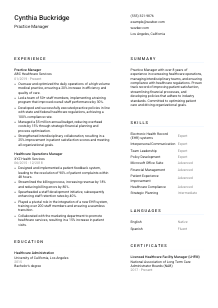
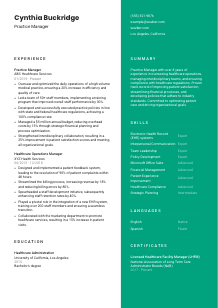
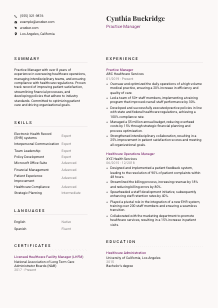
Steering medical realms, but your CV feels more directionless than a patient in a maze? Check out this Practice Manager CV example, created with Wozber free CV builder. It shows how to blend your healthcare expertise with administrative acumen, keeping your career path as streamlined as managing a top-notch clinic!
Practice Managers sit at the point where patient flow, staff performance, compliance, and financial control meet. Hiring teams want to see that you can keep a medical practice running smoothly while improving care delivery, whether that means tightening front-desk workflows, standardising policies, reducing billing friction, or helping providers and support staff work better together.
The first read usually comes down to whether your CV makes your operational scope clear fast. Wozber's free CV builder helps you shape that experience into an ATS-friendly CV format, so EHR work, staff leadership, budgeting, and regulatory oversight are easy to identify before anyone reaches the interview stage. That clarity matters when employers need someone who can step into daily practice operations with confidence.
In healthcare operations, small administrative misses raise questions quickly. Your contact section should reflect the same accuracy and professionalism expected from someone who manages schedules, staff coordination, and patient-facing processes.
Use your full name in a clear, readable format at the top of the page. For a Practice Manager, this section should feel orderly and businesslike, mirroring the professional standard expected in a clinical setting where documentation accuracy matters every day.
Place "Practice Manager" directly under your name when that matches the role you are pursuing. This immediately connects your CV to the opening and helps both recruiters and ATS filters place you in the right healthcare management lane rather than a broader operations category.
List a current phone number and professional email address, then check them carefully. A missed digit or outdated email undercuts credibility for a role that often handles patient communications, staff coordination, vendor follow-up, and time-sensitive operational issues.
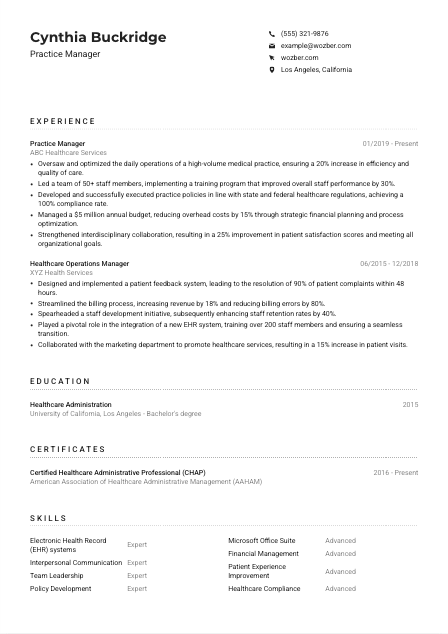
If the employer specifies an on-site location requirement, state your city and state clearly. In the example, listing "Los Angeles, California" directly supports the posting's location requirement and removes doubt about local availability for a practice-based leadership position.
Include a LinkedIn profile or professional website only if it is current and consistent with your CV. For Practice Managers, that profile should reinforce healthcare operations experience, leadership progression, and tools such as EHR platforms, not introduce conflicting titles or incomplete work history.
Keep this section clean, accurate, and aligned with the role. It should answer the basic logistics at a glance so the reader can move straight to your operational and leadership experience.




This is the section where employers decide whether you have handled the pace, complexity, and accountability of a healthcare environment. Strong Practice Manager experience goes beyond supervision. It shows operational control, measurable improvement, regulatory discipline, and the ability to lead staff through day-to-day demands.
Start by marking the responsibilities and requirements that define the opening. For a Practice Manager, that usually includes daily operations, staff hiring and coaching, policy development, compliance, budgeting, billing, reimbursement, and patient satisfaction. These themes should shape which achievements you choose and how you phrase them.
List positions in reverse chronological order and make the management path easy to follow. If your background includes titles such as Practice Manager, Healthcare Operations Manager, Clinic Manager, or similar roles, highlight the parts of each job that show responsibility for workflows, staff, finances, and provider coordination.
Practice management is measured through throughput, compliance, cost control, claim accuracy, staff retention, and patient experience. The sample CV works because it ties actions to outcomes, such as a 20% efficiency gain, a 15% reduction in overhead, and a 25% improvement in patient satisfaction. Use numbers like these when they reflect real results from your own work.
Replace generic duty statements with bullets that show what changed because of your work. "Managed billing operations" is flat. "Streamlined billing processes and reduced errors by 80%, improving reimbursement flow" tells the employer how you affected revenue-cycle performance and operational reliability.
Practice Managers often wear many hats, but your CV should prioritise the experience most relevant to medical practice operations. If a bullet does not help prove your ability to lead staff, improve patient care processes, manage budgets, support compliance, or work across departments, trim it or rewrite it so the connection is clear.
Your experience section should show that you can run a healthcare practice, improve how it performs, and keep standards high under pressure. When the bullets combine scope, action, and measurable outcomes, your value is much easier to trust.
Education matters here because it anchors your understanding of healthcare operations, administration, and business discipline. For experienced Practice Managers, this section does not need to be long, but it should clearly support the management responsibilities in the job posting.
If the posting calls for a bachelor's degree in Healthcare Administration, Business Management, or a related field, make that information easy to find. When your degree aligns directly, as in the example's Healthcare Administration degree, it immediately supports your fit for a practice leadership role.
List degree, field of study, school, and graduation year in a simple structure. Hiring teams reviewing healthcare management CVs want to confirm qualifications quickly, especially when the role combines operations oversight, finance, and compliance responsibilities.
If your degree is closely tied to healthcare administration, business operations, public health, or a similar field, present that clearly. It helps connect your academic training to real work such as policy development, budgeting, staffing, and practice performance management.
Most senior candidates can keep this section brief. Still, if you are earlier in your career or transitioning from a related healthcare operations role, selected coursework in healthcare finance, health policy, medical office administration, or compliance can reinforce your foundation.
Honors, leadership roles, or healthcare-related academic projects are worth mentioning if they support your professional direction. Keep the focus on items that strengthen your credibility for managing medical operations rather than general campus activity.
For a Practice Manager CV, education should confirm that your management background rests on relevant training. Clear degree information is usually enough, with extra detail reserved for cases where it adds real value.
Certifications are especially useful in healthcare management because they show continued investment in regulation, administration, and operational leadership. Even when a posting does not require them, the right credentials can strengthen how your CV reads against compliance-heavy and process-driven responsibilities.
Choose certifications that connect naturally to healthcare administration, facility management, compliance, revenue cycle work, or leadership. The example includes CHAP and LHFM, which are relevant because they support an operations-focused healthcare management profile rather than adding unrelated credentials.
List the certifications that add the most value for the target role. A short, relevant group reads better than a long list of marginal courses, especially when the employer is looking for someone who can oversee staff, policies, and financial performance in a medical setting.
Healthcare employers pay attention to whether credentials are active and current. Add issue dates, renewal ranges, or ongoing status when appropriate so the reader can quickly understand whether the certification reflects up-to-date knowledge.
If you have recent training in EHR adoption, healthcare compliance, reimbursement workflows, patient experience, or supervisory leadership, it can strengthen your CV even if the credential is not mandatory. Continuous development matters in roles where regulations, systems, and operating standards keep shifting.
Well-chosen certifications add weight when they support the actual work of running a healthcare practice. Focus on credentials that strengthen your command of compliance, operations, finance, or staff leadership.
A Practice Manager's skill list should read like the toolkit behind efficient clinic operations. Employers are looking for the mix that keeps teams organised, systems functioning, patients supported, and financial processes under control.
Start with the skills named in the opening, then match them only if you can support them elsewhere in the CV. In this case, EHR proficiency, Microsoft Office, interpersonal communication, team leadership, and healthcare compliance deserve priority because they map directly to daily practice management work.
This role sits between operations and staff management, so your skills section should reflect both. Pair technical and administrative abilities such as EHR systems, billing, budgeting, and policy development with leadership strengths like coaching, communication, performance management, and interdisciplinary coordination.
Avoid turning the section into a catch-all inventory. A focused set of skills works better, especially when each one is backed by experience. The sample CV does this well by combining operational skills like financial management and healthcare compliance with leadership and patient experience capabilities.
Your skills should show that you can manage the business side of care without losing control of people, process, or patient experience. If the list feels specific to a functioning medical practice, it is doing its job.
Practice Managers often work across front-desk staff, clinicians, patients, insurers, and external partners. Language proficiency can therefore affect communication quality, patient access, and day-to-day coordination, especially in diverse communities.
When the posting states strong verbal and written English skills, list English first and indicate your proficiency clearly. That directly addresses a stated requirement and supports the communication demands of policy writing, staff guidance, and patient-facing operations.
Additional languages can be valuable when they improve communication with the patient population or internal teams. In some markets, Spanish can strengthen a Practice Manager application because it supports smoother interactions at the front office, in follow-up communication, and across community-facing care settings.
Use clear descriptors such as Native, Fluent, Advanced, or Conversational. Accuracy matters here because language ability can affect patient communication, staff support, and the credibility of your CV overall.
Tailor this section based on where you are applying. A multispecialty clinic, community health setting, or patient base with frequent multilingual needs may place more value on additional language capability than another employer would.
If another language helps you reduce misunderstandings, improve patient satisfaction, or support culturally responsive service, that is worth showing. Keep it grounded in practical communication value rather than listing languages as a general bonus.
List the languages that matter, describe your level accurately, and let the section support the communication demands of the practice. For the right employer, that can be a meaningful differentiator.
Your summary should quickly establish the kind of practice environment you have managed and the results you tend to produce. For this role, that usually means operational control, staff leadership, compliance awareness, financial oversight, and patient experience improvement.
Read the posting carefully, then distill the central themes into your opening lines. For a Practice Manager, that often means experience overseeing practice operations, leading teams, managing financial processes, and maintaining compliance in a healthcare environment.
Lead with a direct professional identity statement such as "Practice Manager with 8+ years of experience in healthcare operations." This gives the reader immediate context and works well when followed by the kind of environment you have supported, such as a high-volume clinic, multisite practice, or specialty group.
Use the summary to surface two or three strengths that match the opening. The sample does this by highlighting patient satisfaction, financial process improvement, and regulatory alignment. Those points work because they echo the job's operational, compliance, and organizational goals.
Aim for three to five lines with no filler. Every sentence should carry real information about scope, strengths, or outcomes. By the end of the summary, the reader should understand the level of practice leadership you offer and what parts of the operation you handle well.
A well-built summary gives the employer a fast read on your management scope and your strongest results. Keep it specific to healthcare practice operations, and it will set up the rest of the CV effectively.
A Practice Manager CV works best when it shows command of operations, staff leadership, compliance, and financial performance in language that matches the job you want. Wozber's free CV builder can help you organise that experience into an ATS-compliant CV, refine wording around the employer's priorities, and present it in an ATS-friendly CV template that keeps the focus on your actual scope and results.
Before you apply, check that your CV makes three things easy to see: the scale of the practice you supported, the improvements you delivered, and the systems or processes you managed directly. That is the hiring picture most employers want to confirm.




