



Use Wozber and land your dream job
Create CV
No registration required
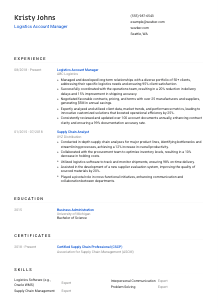
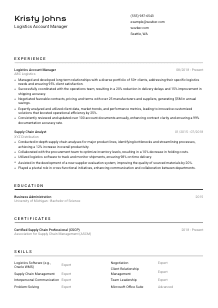
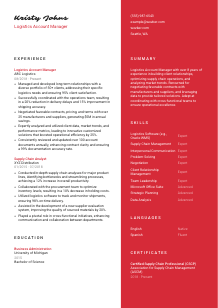
Orchestrating shipments, but your CV feels stuck in customs? Check out this Logistics Account Manager CV example, created with Wozber free CV builder. Learn how to match your coordination prowess to job specifics, ensuring your career journey flows as smoothly as a well-planned supply chain!
Logistics account management sits at the point where client retention, delivery performance, and commercial discipline meet. Hiring teams want to see that you can keep accounts stable while shipments move on time, suppliers stay aligned, and service issues are handled before they turn into lost revenue. Your CV should make that operating range visible, not bury it under generic account management language.
When the CV is tailored well, it quickly separates candidates who have managed real logistics relationships from those with only broad sales or customer service experience. Wozber's free CV builder helps you shape that distinction into an ATS-compliant CV by aligning your wording with the posting's logistics terminology, documentation needs, and client-facing scope. That makes it easier for a hiring team to see your command of accounts, coordination, and performance metrics.
For a Logistics Account Manager, the top of the CV should communicate business readiness right away. This section is simple, but it still affects how smoothly a recruiter can move your application forward, especially when the role includes location requirements, client contact, and cross-functional coordination.
Use your full name as the most prominent text on the page. Keep the formatting clean and professional so the CV opens with clarity, not design noise. In a role built on organisation and client trust, even this first detail should feel orderly.
Place "Logistics Account Manager" directly under your name when that is the role you are pursuing. This immediately aligns your profile with the opening and avoids ambiguity with adjacent titles such as Account Executive, Supply Chain Analyst, or Operations Manager. If your current title differs, your CV can still target the role as long as your experience supports it.
Include a reliable phone number and a professional email address. Add LinkedIn or a relevant professional website only if the content supports your logistics background with consistent titles, experience, and accomplishments such as account growth, delivery performance, or supplier negotiations.
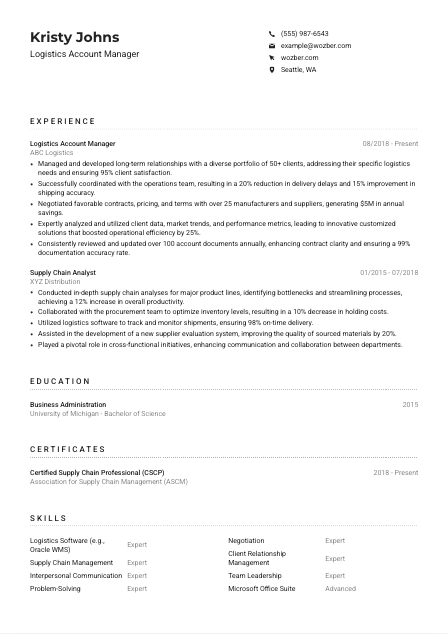
If a posting requires you to be in a specific market, address that in your personal details. Here, "Seattle, WA" works because the employer asked for candidates based there or willing to relocate. If you are relocating, state that clearly rather than leaving the reader to guess.
A digital profile can help if it reinforces your account portfolio, industry knowledge, or supply chain background. It is useful when it shows the same career story as your CV, not when it sends recruiters to outdated job titles or vague descriptions.
This section should make you easy to contact and easy to place. For logistics account management, that means clear role alignment, professional contact details, and any sample-specific location requirement handled upfront.




This is where you show how you manage client relationships in an operational environment. A Logistics Account Manager CV needs to connect commercial work with execution on the ground, such as delivery performance, supplier terms, account retention, cost savings, and documentation accuracy.
Before writing bullets, identify the operating themes behind the job description. In this case, the role centers on client relationship management, coordination with operations, contract negotiation, data analysis, and account documentation. Those themes should guide which achievements you include and which ones you leave out.
List your most recent role first, with job title, company name, and dates clearly shown. That format helps recruiters quickly trace your progression from analytical or operations-focused work into account ownership, supplier management, or client-facing logistics leadership.
Generic bullets like "managed client accounts" are too thin for this field. Show what changed because of your work. The sample CV does this well with metrics tied to client satisfaction, delivery delays, shipping accuracy, annual savings, and documentation accuracy. Those are the kinds of operational and commercial outcomes that hiring teams expect to see.
Choose bullets that reflect the real balance of the job. For logistics account management, that usually means a mix of account growth or retention, service coordination, vendor or supplier negotiation, and performance analysis. If you have earlier experience in supply chain analysis or operations, keep the bullets that show transferable strengths such as improving on-time delivery, streamlining inventory flow, or tracking shipment performance.
Results land harder when you show the environment behind them. Mention logistics platforms, order or shipment volumes, portfolio size, supplier count, service levels, or reporting cadence when they are relevant. For example, managing 50+ clients or maintaining 100+ account documents annually gives a far better picture of scope than a broad statement about being detail-oriented.
Your experience section should show that you can hold client relationships together while improving logistics performance. The best bullets connect account responsibility to outcomes a business actually tracks, such as retention, on-time delivery, savings, service accuracy, and operational efficiency.
Education matters here because it helps confirm the business and supply chain foundation behind your client-facing work. Keep the section straightforward, and make sure it reflects the degree level and field the employer requested without overexplaining.
If the posting asks for a bachelor's degree in Business, Supply Chain Management, or a related field, present your degree in direct terms. A degree such as "Bachelor of Science in Business Administration" lines up well because it supports the commercial, analytical, and operational parts of the role.
List the school, degree, field of study, and graduation year or date in a simple format. This section does not need extra design. It should be quick to scan, easy for ATS parsing, and clear enough that a recruiter can confirm the requirement in seconds.
If your major directly matches the posting, you usually do not need a long explanation. If it is adjacent, such as economics, operations, or industrial engineering, make sure the rest of your CV reinforces why that background supports logistics planning, account analysis, or supply chain work.
Early-career candidates can include relevant coursework in areas like supply chain management, procurement, operations, transportation, or business analytics. If you already have several years of logistics experience, coursework usually adds less value than space devoted to results in your work history.
Honors, leadership in supply chain associations, or relevant projects can help when they connect to the role. Keep them if they add something specific, such as analytical rigor, industry involvement, or early exposure to logistics systems and planning frameworks.
This section should quickly confirm that you meet the degree expectation and have a credible foundation in business or supply chain work. Keep it concise, accurate, and aligned with the level of experience shown elsewhere on the CV.
Certifications can strengthen a Logistics Account Manager CV because they show ongoing development in supply chain planning, inventory, operations, and process discipline. They are especially useful when the employer mentions them as a plus, as this posting does with CSCP and CPIM.
If you hold credentials such as CSCP or CPIM, feature them clearly. They reinforce your command of supply chain concepts that sit behind account decisions, from inventory planning to cross-functional coordination and supplier management.
Place logistics, supply chain, transportation, procurement, or operations certifications ahead of broader business courses. A short list of role-relevant credentials is stronger than a long list that does not connect to account management or logistics execution.
Include the issuing organisation and date or active period where appropriate. Current certifications suggest that your knowledge has kept pace with modern supply chain practices, systems, and planning methods rather than staying fixed at one point in your career.
If you do not yet have one of the preferred certifications, this section can still show direction through other relevant training. Prioritise learning that supports the actual work of the role, such as transportation operations, supplier performance, demand planning, or logistics analytics.
Use certifications to reinforce the operational depth behind your client-facing experience. For this kind of role, the right credential tells employers that your account decisions are grounded in real supply chain knowledge.
The skills section should read like a practical snapshot of how you operate. For Logistics Account Manager roles, that usually means a mix of client management, data handling, coordination, negotiation, and familiarity with logistics systems used to keep orders and deliveries on track.
Pull both direct and implied skills from the posting. Here, that includes logistics software, Microsoft Office Suite, client communication, supply chain knowledge, and data analysis. It also points to negotiation, account planning, problem-solving, and cross-functional coordination.
Choose skills that reflect the role's daily workflow rather than listing every capability you have. A balanced section might include logistics software, client relationship management, contract negotiation, market analysis, performance reporting, and communication with operations or suppliers. The sample CV handles this well by mixing technical, analytical, and interpersonal strengths.
Every skill listed should be backed up somewhere else on the CV. If you claim negotiation, the experience section should show supplier or manufacturer agreements. If you list data analysis, your bullets should reference performance metrics, customised recommendations, or process improvement results. That consistency matters to both recruiters and ATS screening.
This section should show that you can manage accounts in a logistics environment, not just maintain client communication. Keep the list tied to systems, analysis, coordination, and negotiation that the role actually requires.
Language ability matters in logistics when communication crosses client teams, suppliers, carriers, and sometimes international markets. Even when English is the only stated requirement, listing language proficiency accurately can strengthen your profile for account-facing work.
If the posting specifies English proficiency, list English clearly and use an honest proficiency level. This is especially important in roles that involve contracts, account documentation, issue resolution, and regular communication across teams.
Place the most relevant language first, then add others that could support client coverage, supplier communication, or broader market reach. Additional languages are particularly useful when the employer serves multilingual customers or international supply networks.
Terms like Native, Fluent, Professional Working, or Conversational are more useful than vague wording. Hiring teams need a realistic sense of whether you can handle client calls, write clear updates, or review documentation in that language.
Only list languages you can use in a work setting at the level you claim. In logistics account work, overstating proficiency can quickly become a problem when the role includes client calls, shipment coordination, or supplier follow-up.
A second language can strengthen your profile when it helps with service coverage, relationship building, or communication across regions. In the sample CV, Spanish adds useful range without distracting from the core requirement of strong English communication.
Present languages as practical communication capacity, not as decoration. In logistics account management, accurate language information can support your case for smoother client communication and broader operational reach.
The summary should quickly show the kind of logistics account manager you are. It needs to connect years of experience with the outcomes you manage, such as client satisfaction, delivery performance, supplier terms, operational efficiency, or account growth.
Start from the real centre of the job. For this role, that means managing client relationships while coordinating logistics activity, analysing performance, and improving service outcomes. Build your summary around that combination instead of using broad business phrases.
A direct opening such as "Logistics Account Manager with over 8 years of experience" works because it establishes seniority immediately. If your background is split across supply chain analysis and account management, you can still frame it clearly as long as the progression leads naturally into client ownership and logistics leadership.
Choose strengths that match the posting and that your experience section can support. Good examples include negotiating supplier terms, improving delivery accuracy, analysing client data, or building long-term account relationships. The sample summary works because it links relationship management, supply chain optimisation, contract negotiation, and tailored solutions in one tight paragraph.
Aim for 3 to 5 lines. That is enough space to establish your scope, your strongest capabilities, and the kind of business results you influence. Focus on logistics language that carries weight, such as portfolio management, shipment performance, supplier negotiation, customer retention, or operational efficiency.
Your summary should make a recruiter understand your value before they reach the first bullet in your experience section. For Logistics Account Manager roles, that means presenting yourself as someone who can protect client relationships while improving how the operation performs.
A Logistics Account Manager CV works best when it shows both sides of the job: the client relationship and the operational engine behind it. Your content should make it easy to see portfolio scope, supplier negotiation, service performance, and the metrics you influence.
Use Wozber to turn that experience into a targeted, ATS-friendly CV format with language aligned to the posting, stronger section structure, and practical ATS optimisation. The finished CV should make one thing clear right away: you can manage accounts while keeping logistics performance under control.




