



Use Wozber and land your dream job
Create CV
No registration required
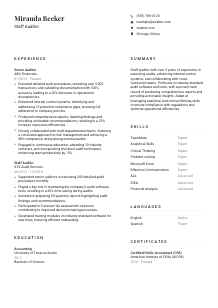
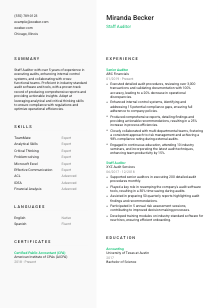
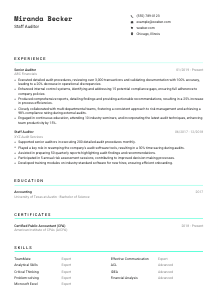
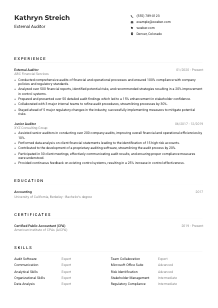
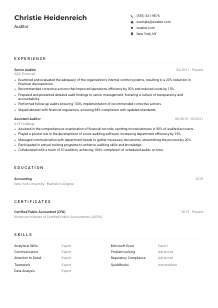
Reading through financial footnotes, but your CV seems off the balance sheet? Audit this Staff Auditor CV example, created with Wozber free CV builder. Learn how to sync your compliance and analytical abilities with job specifics, ensuring your career remains financially fortified!
Staff Auditor work lives in the details. Hiring teams want to see whether you can test transactions carefully, spot control weaknesses, document findings clearly, and turn audit work into recommendations that reduce risk and improve compliance. A CV for this field needs to make that operating standard visible fast.
In staff auditor hiring, vague finance experience often gets mistaken for audit experience unless the CV names the right procedures, tools, and reporting work. Wozber's free CV builder helps you shape that experience into an ATS-compliant CV with language that matches audit postings naturally, so reviewers can quickly see your exposure to testing, internal controls, and audit reporting.
This section should read like the header of a professional workpaper: clean, accurate, and immediately useful. For a Staff Auditor, that means showing clear identity, dependable contact details, and any location requirement the employer has stated.
Use your full name as the most prominent text on the page. Keep the formatting simple and professional so it is easy to find in both human review and ATS parsing.
Place the role title directly under your name when it reflects the job you are pursuing. Using "Staff Auditor" here helps connect your background to audit testing, control review, and compliance work from the first glance.
Include a reliable phone number and a professional email address, ideally based on your name. If you add a website or LinkedIn profile, make sure it supports your audit background with consistent dates, titles, and credentials.
Some audit roles are tied to office location, client-site work, or local regulatory coverage. In the example posting, being based in Chicago, Illinois is a stated requirement, so listing Chicago, Illinois in the header removes a practical screening question immediately.
A LinkedIn profile can help if it shows audit software, CPA progress, internal control work, or industry exposure that fits the role. Leave it off if it is incomplete or out of sync with your CV.
Keep the top of your CV precise and audit-ready. When your title, contact details, and any required location are easy to confirm, the reader can move straight to your audit experience.




This is the section that carries the most weight for a Staff Auditor. Employers are looking for evidence of actual audit execution: testing transactions, reviewing records, strengthening controls, writing findings, and working with other departments on risk and compliance issues.
Read the job description closely and mark the work verbs and audit terms it repeats. For this role, that includes executing detailed audit procedures, reviewing transactions and records, improving internal controls, preparing reports, and collaborating on risk management. Those phrases should shape how you describe your own work, as long as they match what you have actually done.
List roles in reverse-chronological order with company, title, and dates. Emphasize positions in public accounting, internal audit, or adjacent assurance work so the reader can quickly track your progression from supporting audit tasks to owning more of the audit cycle.
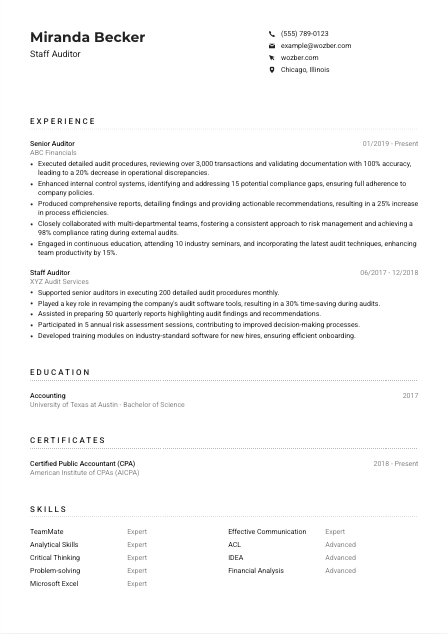
Your bullets should show what you examined, what you found, and what changed because of your work. Strong examples include the volume of transactions tested, the number of control gaps identified, the quality of audit reports produced, or the process improvements that followed. The sample CV does this well by linking audit findings to a 25% increase in process efficiency and a 20% drop in discrepancies.
Metrics make audit experience easier to trust when they reflect real scope. Quantify transaction volumes, frequency of audit procedures, number of reports delivered, compliance ratings, control deficiencies remediated, or time saved through better audit tools. Figures such as reviewing 3,000 transactions or supporting 200 procedures per month tell the reader the scale of your work.
Keep the focus on audit procedures, controls, reporting, compliance, software use, and cross-functional work with finance, operations, or risk teams. If a past task does not strengthen your case for audit execution or judgment, trim it and give the space to a stronger example.
Your experience section should leave no doubt that you can perform audit work, document it properly, and produce findings that lead to better controls and cleaner compliance results.
Audit roles usually have clear academic entry requirements, and employers check them quickly. Present your education so the degree, field, and institution are easy to confirm without slowing down the rest of the review.
If you hold a bachelor's degree in Accounting, Finance, or a related field, list it clearly. For the example role, a Bachelor of Science in Accounting directly meets the posted requirement, so that field should not be buried or abbreviated away.
Include degree, field of study, school name, and graduation year or date. Straightforward formatting helps both ATS systems and hiring managers confirm your academic qualification quickly.
When your major supports core audit work, spell it out. "Accounting" carries more value here than a vague reference to business studies because it connects directly to testing, controls, financial records, and reporting standards.
Recent graduates can include selected courses such as Auditing, Internal Controls, Financial Reporting, or Data Analytics if they strengthen limited work history. Once you have solid audit experience, coursework usually becomes secondary.
Honors, scholarships, accounting society leadership, or audit-related projects can help when they show technical discipline or early exposure to assurance work. Keep these additions relevant and concise.
Education should confirm that you meet the role's baseline qualification and, where useful, reinforce your grounding in accounting and audit practice.
Certifications matter in audit because they point to technical standards, professional commitment, and ongoing development. If a posting asks for a CPA or active progress toward one, make that status easy to spot.
Lead with certifications that directly affect audit hiring. For many Staff Auditor openings, the CPA carries the most weight, whether you are fully certified or actively pursuing it, because it signals commitment to accounting standards and professional rigor.
Only include certificates that strengthen your case for audit, compliance, accounting, internal controls, or related analysis work. A short, relevant list reads better than a broad collection of unrelated courses.
Include the issue date, expiration date if relevant, or an active date range for certifications in progress. In the example CV, listing the CPA with an ongoing date range makes the candidate's standing easy to understand.
Audit practices change with regulation, risk methods, and technology. Continuing education in audit analytics, internal controls, fraud risk, or audit software can strengthen your CV, especially if the target role emphasizes continuous learning.
A focused certificates section reinforces your technical credibility and shows that your audit knowledge is current, not static.
Staff Auditor skills should reflect how the work is actually done. Hiring teams look for a mix of audit software, analytical judgment, control awareness, reporting ability, and the communication needed to work with finance, operations, and compliance partners.
Start with the skills the posting names directly, then add closely related capabilities from your own background. Here, that includes analytical thinking, critical thinking, problem-solving, English communication, and familiarity with tools such as ACL, IDEA, or TeamMate.
List software and working strengths that connect to audit execution. If you have used TeamMate, ACL, IDEA, Excel, financial analysis, or control testing methods in real projects, bring them forward. The sample CV handles this well by combining audit platforms with core judgment skills rather than listing only generic soft skills.
A crowded skills section can dilute your message. Choose the abilities most relevant to audit procedures, risk assessment, documentation, reporting, and compliance review so the section supports the rest of your CV instead of repeating filler.
Your skills list should quickly confirm that you have the software familiarity and audit judgment to contribute from day one.
Language skills matter in audit when you need to write clear findings, discuss exceptions with stakeholders, or work across departments and client groups. Even when only one language is required, accuracy here still matters.
If the posting asks for strong English skills, make your English proficiency explicit. For audit work, this matters because reporting, documentation, and verbal follow-up all depend on precise language.
List the language most important to the role first. In this case, English belongs at the top, with any additional languages following in order of practical value.
Extra languages can be useful in audit environments with multilingual teams, cross-border operations, or diverse client contacts. A language such as Spanish can add range, especially if it has helped you gather information or explain findings more effectively.
Choose ratings you can support in real conversations, meetings, and written communication. Audit roles often require clear documentation and follow-up questions, so overstating proficiency can create problems quickly.
If the job involves stakeholder interviews, walkthroughs, report writing, or coordination across functions, language ability has direct practical value. Include it when it strengthens your ability to perform those parts of the job.
For a Staff Auditor, language skills are useful when they support clear reporting, accurate documentation, and effective communication with the people involved in the audit process.
Your summary should sound like an auditor describing their scope and strengths, not a generic finance professional introducing themselves. In a few lines, show your level of audit experience, the kind of work you handle, and the tools or credentials that matter most for the target role.
Start by naming your experience level and core area of work. A Staff Auditor summary should quickly establish whether your background is in external audit, internal audit, compliance-focused review, or a mix of those environments.
Mention the work that defines your value, such as executing audit procedures, reviewing internal controls, producing audit reports, or using audit software to improve testing efficiency. The sample summary works because it connects audit execution with control enhancement and actionable reporting.
If the role asks for 2+ years of audit experience, CPA status, or familiarity with ACL, IDEA, or TeamMate, include the ones that genuinely apply to you. This helps position your CV correctly before the reader reaches the detailed sections.
Aim for 3 to 5 lines with concrete wording. Skip broad traits unless they are tied to audit work, and focus on experience, scope, tools, and outcomes that make sense for the role you are targeting.
A well-written summary gives the reader an immediate sense of your audit background, your technical range, and the kind of value you bring to control reviews, compliance work, and audit reporting.
A Staff Auditor CV works when it shows real audit execution, not just general accounting exposure. Transaction testing, internal control review, audit reporting, software proficiency, and measurable improvements should all be easy to find.
Use Wozber's free CV builder to organise that experience into an ATS-friendly CV format, refine role-specific language with AI support, and check alignment with an ATS CV scanner. The result should make it easy for a hiring team to see that you can step into audit procedures, document findings properly, and contribute to stronger compliance outcomes.