



Use Wozber and land your dream job
Create CV
No registration required
Unearthing fiscal details, but your CV isn't adding up? Check out this Public Accounting Auditor CV example, created with Wozber free CV builder. Learn how to audit your accounting acumen to match job requisites, ensuring your career balances all the right ledgers!
Public accounting audit work is reviewed through the quality of your judgment, the rigor of your testing, and the clarity of the recommendations that follow. Hiring teams want to see whether you can move from financial records and control walkthroughs to actionable audit findings without losing accuracy, regulatory context, or client trust. Your CV should make that progression visible.
A tailored CV changes how quickly your audit background can be recognized, especially when employers are screening for direct experience in financial, operational, and compliance audits. Wozber's free CV builder helps you shape that experience into an ATS-compliant CV with language that matches the role, so the hiring team can quickly see your audit scope, control work, and reporting credibility.
Audit professionals are expected to be exact from the first line of communication. Your Personal Details section should reflect that same standard by making your identity, title, and availability easy to confirm without adding anything unrelated to the job.
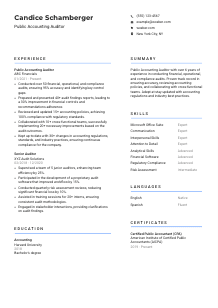
Place your full name prominently, then use a clear professional title directly underneath. For this role, "Public Accounting Auditor" works well because it immediately connects your background to audit engagements, compliance reviews, and financial control work. If your current title is slightly different, such as Senior Auditor, you can still use a target title when your experience clearly supports it.
List a phone number you actually answer and a professional email address built around your name. In public accounting, where client communication, management presentations, and follow-up on audit findings are routine, small details like an outdated phone number or casual email address can undermine the professional standard you want to project.
Some audit openings are tied to a specific office, client base, or on-site expectation. Here, the employer asks for someone located in New York City, NY, so showing "New York City, NY" in your header removes a practical question early. Use location this way when it answers a stated requirement, not as filler.
A LinkedIn profile or professional website can help if it reinforces your audit background with consistent titles, certifications, and career progression. Keep it aligned with the CV. If your profile includes CPA status, public accounting experience, or industry-specific audit work, it can strengthen the overall picture.
Do not include birth date, marital status, headshot, or other personal details that have no bearing on audit execution. Public accounting CVs are stronger when they stay focused on qualifications, certifications, experience, and communication readiness.
This section should read like the beginning of a well-prepared audit file: accurate, relevant, and easy to trust. When your contact details are precise and aligned to the role, the rest of the CV is easier to take seriously.




Experience is where public accounting CVs separate generic accounting backgrounds from real audit capability. Employers want to see the kinds of audits you handled, how you assessed controls, what recommendations you made, and whether your work led to better compliance, stronger processes, or reduced risk.
Start by identifying the recurring work in the job description, then make sure your bullets reflect those same audit activities if you have done them. For this opening, that includes financial, operational, and compliance audits, presenting findings to management, reviewing policies, and collaborating on corrective actions. When those responsibilities appear in your experience section with real context, your background reads as directly relevant instead of loosely related.
List your most recent audit role first and include employer, title, and dates in a format that is easy to scan. Public accounting hiring often depends on recent exposure to current standards, reporting practices, and control environments, so chronology matters. A straightforward timeline also helps show progression from staff or senior work into broader audit ownership.
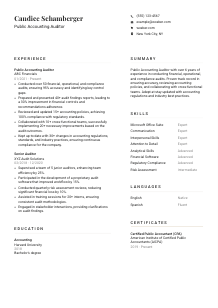
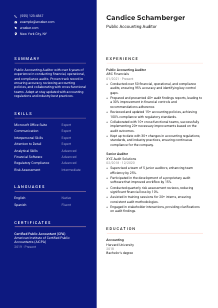
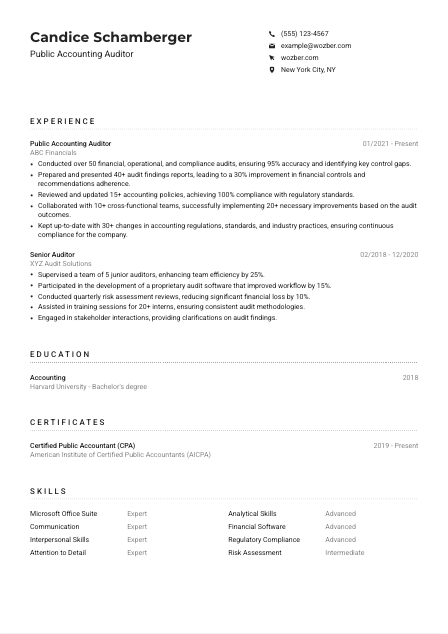
Avoid duty-only bullets like "responsible for audits." Show what you examined, what you identified, and what changed because of your work. The sample CV does this well by tying audits and reports to outcomes such as a 30% improvement in financial controls and full compliance after policy updates. That kind of wording shows both technical execution and business effect.
Numbers give hiring teams a sense of scale. Include audit volume, frequency, number of reports issued, policy revisions completed, team size supported, or measurable control improvements. "Conducted over 50 audits" and "prepared 40+ audit findings reports" are effective because they show workload and repetition in core audit work, not just one-off projects.
Focus on work that supports your case for audit readiness: control testing, risk assessment, report writing, compliance analysis, stakeholder communication, process improvement, and regulatory updates. If you include broader experience, frame it through an audit lens. Even a project such as helping improve proprietary audit software becomes relevant when you explain how it improved audit workflow or review efficiency.
A strong experience section shows the arc of your audit judgment, not just your job duties. By combining audit type, scope, findings, and measurable improvement, you give employers a practical reason to trust you with controls, compliance, and reporting.
For public accounting roles, education is usually straightforward, but it still carries weight. A degree in Accounting or Finance signals formal grounding in financial reporting, controls, auditing concepts, and regulatory frameworks that employers expect you to build on in practice.
When the posting calls for a Bachelor's degree in Accounting or Finance, list that information clearly and early in the education section. If your degree matches exactly, as it does in the example with a Bachelor's in Accounting, that alignment should be unmistakable.
Include degree, field of study, school name, and graduation year or date. Public accounting CVs do not need decorative formatting here. Clean presentation helps the reader confirm qualifications quickly and move on to the parts of the CV that show audit execution.
Do not assume the degree name alone tells the whole story. If your coursework was centered in Accounting, Finance, or another directly related discipline, spell that out. This matters when employers are screening for candidates who already understand financial statements, audit procedures, and compliance expectations.
If you are early in your career, you can include honors, audit-focused coursework, or academic projects tied to internal controls, forensic accounting, taxation, or financial analysis. For more experienced auditors, keep this brief unless a specialised course or graduate credential directly supports the target role.
Education matters, but public accounting employers usually make their decision on applied audit work and certification progress once you have a few years of experience. Let your degree confirm the required foundation, then let your experience carry the heavier argument.
This section should confirm that you meet the academic baseline for audit work without taking space away from stronger proof. When the degree is listed clearly and tied to the field, it does exactly what it needs to do.
In public accounting, certifications often carry direct hiring weight because they speak to technical standards, ethics, and professional commitment. For many audit roles, CPA status is one of the fastest ways to establish seriousness and level of qualification.
If the employer asks for a CPA or CPA eligibility, put that credential in a dedicated certifications section where it is easy to find. In the example CV, the CPA is listed clearly with issuer and active date, which immediately supports the candidate's standing for a public accounting audit role.
List certifications that reinforce your ability to work in public accounting, auditing, controls, or compliance. If you hold other credentials, include them only when they add something relevant to the role. A short, focused list usually reads better than a broad inventory of unrelated training.
Dates can help employers understand whether a credential is current and whether your knowledge is likely to reflect present-day standards. If you are not yet licensed but are eligible to sit for the CPA exam, say that clearly. That wording meets the requirement honestly and keeps your candidacy in play.
Public accounting changes with new standards, guidance, and compliance expectations. If you have recent continuing education in audit methodology, accounting standards, internal controls, or regulatory updates, it can reinforce that you stay current in the field rather than relying only on older credentials.
Certifications should confirm what the rest of your CV already suggests: that you understand professional standards and can operate credibly in an audit environment. For this field, a visible CPA or CPA-eligible status often makes that message much stronger.
A public accounting skills section should read like the toolkit behind your engagements. It needs a practical mix of technical capability, analytical judgment, and communication skills that support fieldwork, documentation, reporting, and collaboration with clients or internal stakeholders.
Review the posting for the actual capabilities being requested, then reflect those same themes in your skills list. Here, the employer highlights accounting software, Microsoft Office Suite, analytical ability, communication, and interpersonal skills. Those are useful anchors because they connect directly to audit documentation, spreadsheet analysis, reporting, and management discussions.
Only list skills you can support with examples from your experience. If you claim regulatory compliance, be ready to discuss policy reviews, control assessments, or how you tracked changes in accounting standards. If you list risk assessment, you should be able to explain the audit procedures or review cycles where you applied it.
Keep the section scannable and focused. A mix like accounting software, Excel or Microsoft Office, regulatory compliance, risk assessment, analytical skills, and communication works well because it balances technical and client-facing demands. The sample CV also shows how interpersonal skills can support collaboration across cross-functional teams after audit findings are issued.
When the skills section reflects the actual work of testing controls, analysing records, writing reports, and discussing findings, it strengthens the whole CV. Employers should be able to connect each skill to audit tasks they need done.
Language matters in auditing because the work depends on precise questioning, careful listening, and clear explanation of findings. If a role specifically requires English proficiency, treat that as part of your professional communication profile, not as a minor detail.
When the job description states proficient English speaking and listening skills, list English clearly with an honest proficiency level. Audit work involves interviews, walkthroughs, report discussions, and management presentations, so language ability affects daily execution as much as written polish.
Additional languages can help in firms that serve multilingual clients, international entities, or diverse internal teams. If you speak another language well, include it. In the example, Spanish adds useful breadth without distracting from the required English proficiency.
Terms such as Native, Fluent, Advanced, and Conversational are usually enough. Keep the scale simple and believable. Vague or inflated language claims can create awkward interview moments, especially in a profession built on precision.
If your experience includes cross-border reporting, multinational clients, or bilingual stakeholder communication, language skills deserve more prominence. If not, they can remain a short supporting section. Either way, they should match the reality of your work rather than serve as decoration.
Public accounting often requires nuanced conversation around controls, exceptions, and recommendations. Only claim the level you can use in those settings. Honest language ratings reflect professional judgment, which is exactly the quality employers want in an auditor.
For auditors, language skills are useful when they support interviews, reporting, and stakeholder trust. Listed accurately, they add another layer of credibility to how you present findings and work across teams.
Your summary should quickly establish the kind of audit professional you are. In a few lines, show your years of experience, the kinds of audits you handle, and the strengths that matter most for the target opening, such as control evaluation, compliance work, reporting, or cross-functional collaboration.
Before writing, decide what the employer should understand first about your background. For most public accounting auditors, that will be a combination of years in audit, audit types handled, and the level of responsibility carried across engagements. Keep the focus on practiced capability, not career aspirations.
Open with a direct line that establishes your identity and range, such as the example's "Public Accounting Auditor with over 6 years of experience in conducting financial, operational, and compliance audits." That works because it covers seniority and technical scope in one sentence without wasting space.
After the opening line, add two or three specifics that match the role. For this posting, useful points include preparing audit findings, reviewing accounting policies, collaborating with cross-functional teams, and staying current with accounting regulations. If accounting software proficiency is one of your strengths, include that only if it is supported elsewhere in the CV.
Aim for a compact paragraph, usually three to five lines. The summary should help the reader place you quickly before they move into your experience section. Dense, role-specific wording beats broad claims about being hardworking, detail-oriented, or results-driven.
A useful summary gives the hiring team an immediate sense of your audit range, professional level, and reporting strength. If it is specific enough, the rest of the CV feels easier to trust and easier to place against the role.
A Public Accounting Auditor CV works best when it shows how you handle real audit responsibilities: testing controls, reviewing policies, presenting findings, and helping organizations close compliance gaps. When each section supports that story with clear titles, relevant credentials, and measurable outcomes, the document feels grounded in audit practice rather than generic accounting work.
Use Wozber's free CV builder to organise your experience into an ATS-friendly CV format, strengthen role-specific wording with AI support, and check alignment with an ATS CV scanner before you apply. The finished CV should make it easy to judge your audit scope, regulatory awareness, and readiness to contribute from the first engagement.