



Use Wozber and land your dream job
Create CV
No registration required
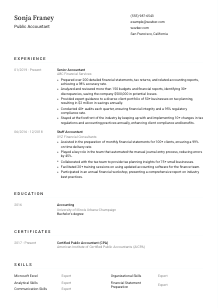
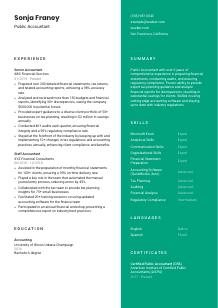
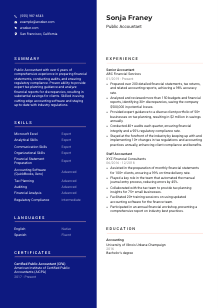
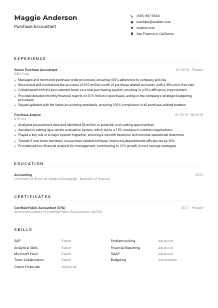
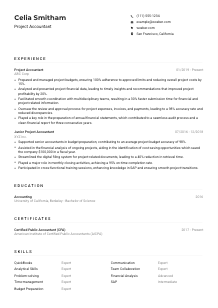
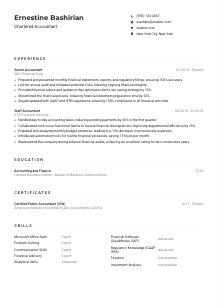
Tallying ledgers, but your CV isn't adding up? Check out this Public Accountant CV example, created with Wozber free CV builder. It shows how to seamlessly match your fiscal fluency with job prerequisites, driving your career balance sheet toward growth!
Public accounting CVs are read with a practical question in mind. Can this person handle client-facing financial work accurately, keep up with changing tax rules, and produce reports that hold up under review. Hiring teams look for proof in the form of financial statements, tax filings, audit work, discrepancy analysis, and client advisory outcomes, not broad claims about being detail oriented.
A tailored CV changes what gets noticed first. When your wording reflects the target role's accounting work, software environment, and compliance expectations, both recruiters and an ATS can place you faster in the right lane. Wozber's free CV builder helps structure that alignment in an ATS-friendly CV format, so your background reads clearly as public accounting experience rather than general finance support.
In public accounting, small administrative details carry weight because the work itself depends on accuracy and trust. Your header should make it easy to contact you, confirm basic eligibility, and immediately place you in the right professional context.
Place your full name at the top in a clean, easy-to-scan format. For a Public Accountant, this should feel as polished as a client deliverable, with no nicknames or distracting styling.
Add "Public Accountant" directly under your name when that matches the role you are applying for. This helps frame the rest of the CV around accounting, tax, audit, and reporting work from the first line.
Include a phone number and professional email address you monitor consistently. One typo in your contact line can block interviews just as quickly as one error in a financial report can create downstream issues.
If a role requires local presence, include your city and state clearly. In this example, listing San Francisco, California directly answers a stated requirement without forcing the reviewer to search for it.
Include LinkedIn or a professional website only if it supports your accounting background with consistent job titles, certifications, or client-facing expertise. If the profile is sparse or outdated, leave it off until it reflects the same level of professionalism as your CV.
Your personal details should do three things quickly: identify you, connect you to public accounting, and remove avoidable questions about location or contactability. Keep it clean and precise.




This is the section most likely to separate public accountants from broader accounting candidates. Hiring teams want to see the kind of work you owned, the client or reporting scope, and the business impact of your analysis, tax guidance, and audit support.
Start by pulling the core work from the job description and mirroring it honestly in your own history. For a Public Accountant, that usually means financial statements, tax returns, budget review, audit activity, compliance, and client advisory work. If those tasks appear in your background, name them directly instead of hiding them behind vague phrases like "handled accounting functions".
List positions from most recent to oldest, with employer, title, and dates easy to scan. That structure matters in accounting hiring because reviewers want to see your current level, whether your work is in public accounting or adjacent industry roles, and how your responsibility has progressed over time.
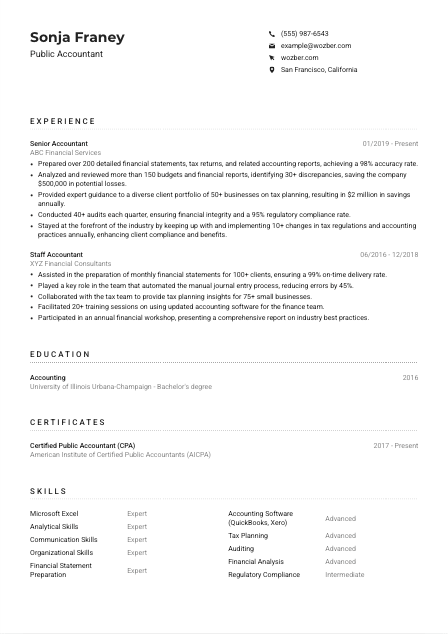
Every bullet should show what you delivered, reviewed, or improved. The sample CV does this well with specifics like preparing 200+ financial statements and tax returns, managing a portfolio of 50+ businesses, and conducting 40+ audits each quarter. Those details tell a hiring manager far more than a generic line about being responsible for reports or compliance.
Numbers matter in this field because they show scale and judgment. Use metrics tied to accounting work, such as accuracy rate, dollar savings, audit volume, on-time reporting, discrepancy findings, or error reduction. A bullet about identifying 30+ discrepancies and preventing $500,000 in losses gives immediate context for analytical strength.
Keep the section centered on public accounting relevance. Prioritise reporting, tax, audit, compliance, Excel-driven analysis, software use, and client guidance over unrelated administrative wins. If a prior role was broader, pull forward the pieces that align with the opening rather than listing every responsibility equally.
By the end of your experience section, a reviewer should understand what kinds of accounts, reports, audits, and client issues you have handled, and at what scale. That is the clearest proof that you can step into public accounting work without a long ramp-up.
For public accounting roles, education is not filler. It confirms the accounting or finance foundation behind your reporting, tax, and compliance work, and it often supports eligibility for required licensure.
If the posting asks for a Bachelor's degree in Accounting or Finance, make sure that appears clearly in this section. In the example, "Bachelor's degree" and "Accounting" are both stated outright, which removes any ambiguity for the reviewer or ATS.
List your degree, field of study, school, and graduation year or date range. Public accounting hiring rarely needs a decorative education section. It needs one that confirms credentials quickly and accurately.
When a job description specifies Accounting or Finance, use that same field naming if it matches your degree. Do not assume the employer will infer relevance from a broader business degree unless you make the concentration clear.
Relevant coursework can help if you are early in your career or moving into a more specialised accounting path. Classes in auditing, taxation, financial reporting, or advanced Excel can add useful context, but experienced public accountants can usually keep this section lean.
If you are a recent graduate, honors, accounting society leadership, or case competition work can add substance. Once you have several years of client work, audited statements, and tax preparation experience, those details become less important than your professional record.
Your education section should quickly confirm that you meet the role's academic requirement and have the accounting foundation the work demands. Keep it straightforward and easy to verify.
Credentials carry real weight in public accounting because they speak to licensure, technical standard, and ongoing professional development. When a posting requires a CPA, this section moves from helpful to essential.
If you hold a CPA and the role requires it, list it first and spell it out clearly. In this case, "Certified Public Accountant (CPA)" should be impossible to miss because it is a stated qualification, not a nice-to-have.
Focus on credentials that strengthen your case for tax, audit, reporting, or financial management. A second designation such as CMA can add range, but it should sit behind the CPA when public accounting licensure is the primary requirement.
Dates help show whether a certification is active, recent, or part of ongoing standing. That matters for licensed accounting work, where current status can influence eligibility and client trust.
Public accountants work in a field shaped by changing tax law, reporting standards, and compliance expectations. Updating certifications and relevant continuing education helps show that your knowledge is current enough for real client and regulatory demands.
For a Public Accountant, certifications are a direct marker of professional standing. Lead with the credentials that the role requires, keep them current, and make them easy to confirm at a glance.
Public accounting hiring depends on a mix of technical execution and client-facing judgment. Your skills section should reflect the tools you use, the accounting work you perform, and the professional strengths that support accurate reporting and advisory work.
Read the job description closely and extract both explicit and implied skills. Here, Microsoft Excel, accounting software, analytical ability, communication, and organisation are named directly, while tax planning, audit support, financial reporting, and compliance are clearly embedded in the responsibilities.
Lead with the capabilities that matter most for public accounting work you actually do. If the target role centers on financial statements, tax returns, audits, and budget review, those should appear before more general office or business skills.
Organise the section so it is easy to scan. You might cluster technical tools such as Excel and accounting platforms together, then list functional strengths like financial statement preparation, tax planning, auditing, and regulatory compliance. The sample CV handles this well by combining software knowledge with accounting functions.
A hiring team should be able to scan your skills and immediately recognize a public accountant who can work in spreadsheets, navigate accounting systems, analyse reports, and communicate recommendations to clients. Relevance matters more than volume.
Language ability matters differently in public accounting than it does in some other fields. It is usually less about broad international appeal and more about whether you can communicate clearly with clients, document work accurately, and handle written reporting without friction.
If the role requires English proficiency, list English prominently and use an honest proficiency level. In this posting, efficient handling of English-language tasks is explicit, so your CV should answer that requirement directly.
Place the language most necessary for the role at the top. For many U.S.-based public accounting roles, that will be English, followed by any additional language that supports client communication or a regional market.
Additional languages can be useful when serving small business owners, multilingual stakeholders, or cross-border accounts. They are not a substitute for accounting ability, but they can strengthen a client-service profile.
Choose levels you can defend in real client conversations, email communication, and document review. Overstating language fluency can become a problem quickly in a role that depends on precision.
Some public accounting roles serve local owner-operated businesses, while others work with multinational entities or diverse client bases. Mention extra languages when they fit that environment, not simply to fill space.
List language skills when they support the communication side of accounting work and meet stated requirements. Keep the focus on practical business use, especially where client interaction and written financial communication are part of the job.
Your summary should sound like someone who already works in public accounting, not someone broadly interested in finance. In a few lines, it should establish your level, core areas of practice, and the kind of measurable results you have delivered for clients or employers.
Use the job description to identify the themes that belong in your opening lines. For this role, that includes financial statements, tax returns, budget and report analysis, audit work, compliance, and client guidance on tax planning or financial decisions.
Open with your title, years of experience, and strongest area of practice. The example does this effectively by leading with more than 6 years in public accounting work tied to reporting, audits, and compliance.
A summary becomes more credible when it includes proof. Choose metrics that fit the profession, such as client savings, report volume, audit frequency, compliance performance, or error reduction. Keep the numbers selective so the paragraph still reads smoothly.
Aim for three to five lines that reflect the target role's terminology without sounding copied from the posting. This is a good place to mention accounting software, Excel-driven analysis, tax planning, or regulatory updates if those are central to your background and the opening.
A hiring manager should finish this section with a clear picture of your public accounting scope, your technical strengths, and the kind of results you deliver. If that is clear, the rest of the CV has the right opening context.
A well-tailored Public Accountant CV should make your reporting accuracy, tax and audit experience, software proficiency, and client advisory work easy to recognize. Each section needs to reinforce the same message with concrete accounting evidence, not general business language.
Use Wozber's free CV builder to organise that content into an ATS-compliant CV, then refine it with targeted wording, relevant keywords, and clean structure. The finished CV should make it easy to judge whether you can step into the accounting workload, compliance expectations, and client responsibilities of the role.




