



Use Wozber and land your dream job
Create CV
No registration required
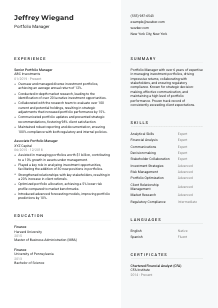
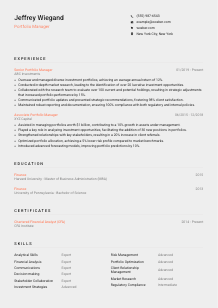
Juggling assets, but your CV doesn't showcase your portfolio? Check out this Portfolio Manager CV example, created with Wozber free CV builder. Learn how to present your investment expertise to match job requirements, setting your financial career on a trajectory as impressive as your top-performing stocks!
Portfolio management CVs are strongest when they show judgment under uncertainty. Hiring teams want to see how you balance return targets, risk tolerance, market research, and client objectives in real portfolios, not just that you have worked in finance. Your CV should make that investment decision-making visible through holdings analysis, allocation changes, performance results, and the way you communicate recommendations to clients or senior leadership.
CV tailoring changes how quickly that judgment comes through. When your experience, skills, and credentials mirror the language of the mandate, research, compliance, and reporting work in the posting, your background is easier to read in an ATS-compliant CV and easier to prioritise by a hiring team sorting through adjacent profiles in asset management, research, and advisory work. Wozber's free CV builder helps organise that alignment cleanly so the CV points back to what matters most here: portfolio ownership, analytical depth, and client-ready communication.
The top of a Portfolio Manager CV should read like someone already operating at the level of client trust and investment responsibility the role requires. Keep it clean, direct, and aligned with any practical filters in the posting so nothing distracts from your track record.
Place your full name prominently, then use the target title right below it. If you are applying for a Portfolio Manager position, say "Portfolio Manager" rather than a broader label like "Finance Professional." That immediate alignment matters when hiring teams are reviewing candidates across investment, research, and client-facing functions.
List a reliable phone number and a professional email address in a simple format. Portfolio management involves regular communication with clients, research teams, and senior stakeholders, so even small details should reflect polish and credibility. If you include a website or LinkedIn profile, make sure it supports your investment background with consistent titles, dates, and accomplishments.
Some openings use location as a firm filter. Here, New York City, New York is explicitly required, so placing it in your personal details removes uncertainty early. Treat this as tailoring to the opportunity, not as a universal rule for every Portfolio Manager CV.
A LinkedIn profile, investment commentary page, or professional website can help if it reinforces your portfolio management work. Use it when it shows useful context such as asset classes covered, market perspectives, speaking engagements, or leadership experience. Skip links that are sparse, outdated, or disconnected from your CV story.
Do not crowd this area with a full street address, headshot, or personal details unrelated to the role. For a Portfolio Manager, the priority is fast confirmation of identity, location when relevant, and professional accessibility. Save the substance for experience, certifications, and summary, where your investment record carries more weight.
Your personal details should remove friction, confirm key practical requirements, and position you immediately as a finance professional operating in portfolio management. Once that is clear, the rest of the CV can stay focused on returns, risk, research, and client stewardship.




This section carries the most weight for a Portfolio Manager. Titles matter, but hiring teams look deeper into the scale of portfolios, the quality of analysis behind your decisions, how you worked with research partners, and what results followed from your allocation calls and reporting discipline.
Start by isolating the responsibilities that define the job. In this posting, that includes managing investment portfolios against client goals and risk tolerance, conducting market research, evaluating holdings with a research team, communicating performance updates, and maintaining compliant reporting. Those points should guide which bullets you keep and how you phrase them.
List your positions in reverse chronological order and make the progression clear. Portfolio management hiring often distinguishes between candidates who supported portfolio activity and those who actually influenced allocation, risk posture, or client recommendations. A move from Associate Portfolio Manager to Senior Portfolio Manager, for example, naturally signals growth in discretion, scope, and accountability.
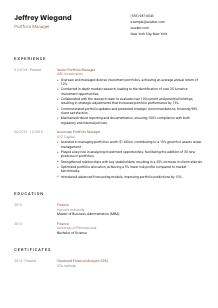
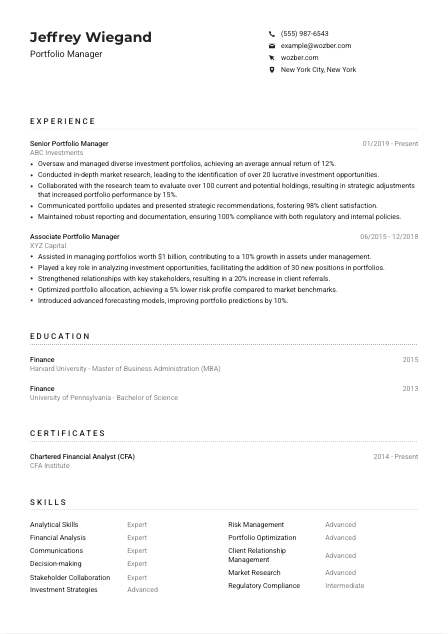
Focus each bullet on what you analysed, what action you took, and what changed. Strong Portfolio Manager bullets mention portfolio performance, AUM, benchmark outperformance, risk reduction, new opportunities identified, or changes in client retention or satisfaction. The sample CV does this well by pairing actions like evaluating more than 100 holdings with a result such as a 15% lift in portfolio performance.
Numbers carry real weight in investment hiring. Use metrics that belong to the work: annual return, AUM growth, risk-adjusted improvement, benchmark comparison, number of holdings reviewed, opportunities sourced, compliance rate, or client satisfaction tied to reporting quality. A bullet like "achieved an average annual return of 12%" tells a far clearer story than "managed portfolios successfully."
Keep the section centered on investment decisions, market analysis, stakeholder communication, and documentation discipline. If an older role is mostly operational or unrelated to portfolio work, trim it down unless it shows a foundation in research, analysis, or client reporting. Every bullet should help explain why you can manage capital responsibly and communicate strategy with confidence.
By the end of the experience section, a reader should understand the portfolios you handled, the analysis behind your recommendations, and the measurable results of your decisions. That is the core proof a Portfolio Manager CV needs to deliver.
Education matters in portfolio management because it frames your technical grounding in finance, markets, valuation, and investment decision-making. For experienced candidates, this section is usually concise, but it still needs to confirm that your academic background supports the level of analytical work the role demands.
When a posting asks for a bachelor's degree in Finance, Business, or a related field, make that qualification easy to find. List your degree, field, school, and graduation year clearly. If you also hold an MBA or another advanced finance-focused degree, include it above your bachelor's degree to reflect seniority and added investment training.
Use a clean, standard structure for each entry so the details are easy to scan. Portfolio management hiring does not need decorative formatting here. What matters is that a reviewer can quickly confirm the level, field, and institution behind your financial training.
If your degree maps directly to the role, make that obvious through the field name. The example CV lists both an MBA in Finance and a Bachelor of Science in Finance, which aligns closely with this posting. If your degree is adjacent, such as Economics, Accounting, or Business Administration, keep the presentation clear and let your experience and certifications reinforce the fit.
Early-career candidates can benefit from including coursework in investments, portfolio theory, financial modeling, derivatives, or risk management. For seasoned Portfolio Managers, coursework is usually less important unless it helps connect a less direct degree to investment work.
Honors, finance society leadership, research projects, or investment competitions can add value when they reinforce analytical strength or market interest. Include them if they sharpen the story of how you developed into an investment professional. Leave them out if they distract from stronger experience-based proof.
Your education section should quickly establish the academic foundation behind your portfolio analysis and investment judgment. Keep it concise, relevant, and clearly tied to finance, business, or another field that supports capital allocation work.
In portfolio management, certifications often carry real weight because they point to technical depth, discipline, and commitment to the profession. They are especially useful when the employer names a credential directly, as this posting does with the CFA.
If you hold the CFA or another investment-focused credential, feature it clearly in this section. When a posting explicitly requests a certification such as the Chartered Financial Analyst designation, meeting that requirement deserves immediate visibility. In the sample CV, the CFA is presented directly and supports the candidate's positioning well.
List certifications that reinforce portfolio construction, securities analysis, risk management, or client advisory credibility. A short list of highly relevant credentials is stronger than a long list of loosely related training. Prioritise what supports the actual work of evaluating holdings, shaping strategy, and reporting within regulatory boundaries.
Add the year earned and, when relevant, the active period or renewal status. Finance roles often place value on current knowledge of market practice, ethics, and regulatory expectations, so dates help show that your credential is active and not historical.
If you have continued with advanced courses, CE requirements, or specialised investment training, include that selectively. Portfolio Managers are expected to keep pace with changing markets, instruments, and compliance expectations, and recent professional learning can reinforce that you do.
This section should reinforce your technical standing in the investment field and make any required credential easy to spot. For many Portfolio Manager openings, that added layer of professional qualification can meaningfully strengthen the application.
The skills section should reflect how you actually manage portfolios, evaluate opportunities, and communicate decisions. Generic finance terms are not enough. Use a mix of analytical, investment, risk, reporting, and stakeholder-facing skills that match the level of the role.
Use the job description to identify the core capabilities the employer is emphasizing. Here, that includes analytical and decision-making skills, investment strategy knowledge, communication, stakeholder collaboration, market research, and portfolio oversight. Mirroring that language helps both ATS optimisation and human review when the terms match your real background.
Lead with capabilities tied directly to the work, such as financial analysis, portfolio optimisation, risk management, asset allocation, market research, performance reporting, and regulatory compliance. These are more useful than broad labels because they describe how a Portfolio Manager operates across analysis, recommendations, and client communication.
Portfolio management is both analytical and relational. Alongside hard skills like investment strategies and forecasting, include skills that show how you work with clients, investment committees, analysts, or senior management. The example CV handles this balance well by pairing financial analysis and risk management with stakeholder collaboration and client relationship management.
A hiring team should be able to scan your skills and immediately recognize someone who can analyse markets, shape portfolio strategy, explain decisions clearly, and operate within compliance expectations. Keep the list focused enough to support that picture.
Language ability matters more in portfolio management than many candidates assume because the job often involves explaining performance, risk, and recommendations in clear terms. When a posting names language fluency, treat it as a direct requirement rather than a minor detail.
This posting explicitly calls for English fluency, so English should appear first with an accurate proficiency level. For a Portfolio Manager, this supports client reporting, internal presentations, market commentary, and written documentation. Make it easy to confirm.
Extra languages can strengthen your profile when you work with international clients, global research coverage, or multilingual stakeholder groups. They are a useful addition, not a substitute for core investment qualifications. In the example CV, Spanish adds breadth without distracting from the finance credentials.
Choose simple, recognizable terms such as Native, Fluent, Advanced, or Conversational. Ambiguous descriptions make it harder to judge whether you can actually use the language in client updates, investment discussions, or written communication.
If another language has been part of your client service, market coverage, or reporting work, that can strengthen the case for including it. Portfolio management can involve cross-border exposure, regional research, or diverse client bases, and language skills can support those responsibilities when presented honestly.
Do not overstate fluency. If you can discuss market conditions casually but not lead a client meeting or write detailed commentary, choose a lower proficiency level. Accuracy matters because communication is central to trust in investment roles.
Your language section should confirm any stated fluency requirement and, where relevant, show added communication range across clients or markets. Keep it truthful and easy to scan.
The summary sits at the top of the CV, so it needs to establish your level quickly and in the language of portfolio management. Focus on years of experience, investment scope, analytical strengths, client or stakeholder communication, and a few results that make a reader want the detail below.
Before writing the summary, identify the few qualities the role is centered on. In this case, they are portfolio oversight, investment analysis, strategic recommendations, stakeholder communication, and compliance-minded reporting. Build the summary around those themes rather than trying to mention every credential you have.
Your first sentence should quickly establish who you are professionally. A phrase such as "Portfolio Manager with 6+ years of experience managing diversified portfolios and driving investment strategy" gives far more direction than a generic statement about being results-oriented. Seniority and portfolio focus should both appear early.
Choose two or three strengths that map directly to the posting, such as market research, risk-aware decision-making, holdings evaluation, client communication, or regulatory discipline. The sample summary works because it connects portfolio management expertise with strategic decision-making, stakeholder collaboration, and compliance.
Aim for a short paragraph that reads smoothly and points toward measurable work. You do not need to repeat every metric from the experience section, but the tone should still reflect outcomes, whether that means portfolio growth, strong returns, improved performance, or consistent client satisfaction. A compact summary with real investment substance is far more persuasive than a broad personal statement.
A good summary should position you as someone trusted to manage capital, interpret markets, and communicate strategy clearly. When it is tailored well, the rest of the CV reads as proof of that claim.
A Portfolio Manager CV should leave very little ambiguity about the level of capital, analysis, and client trust you have handled. When the sections above are tailored to the role, the hiring team can quickly connect your background to portfolio oversight, market research, holdings evaluation, and compliant reporting.
Wozber's free CV builder can help you turn that experience into a structured, ATS-friendly CV format, while its ATS CV scanner and AI CV builder features help surface missing requirements, strengthen job-aligned phrasing, and improve section-by-section matching. The result should make one thing easy to judge: you are prepared to manage portfolios with discipline, insight, and clear communication.