



Use Wozber and land your dream job
Create CV
No registration required
Calculated salary slips, but your CV isn't adding up? Crunch through this Payroll Manager CV example, created with Wozber free CV builder. Learn how to tabulate your payroll proficiency to align with job expectations, putting your career in the green and not in the red!
Payroll management sits at the intersection of compliance, operational accuracy, and employee trust. When payroll runs late, taxes are filed incorrectly, or employee records are out of sync with HR, the damage is immediate. Your CV needs to make that responsibility visible by showing the scale of payroll you handle, the controls you maintain, and the way you keep errors and penalties off the balance sheet.
Screening for payroll leadership often narrows quickly around a few concrete markers: payroll volume, tax compliance, system fluency, and people management. Using Wozber's free CV builder to tailor your wording into an ATS-compliant CV helps those markers appear early and in the right language, especially when the employer is scanning for terms such as payroll software, Excel, payroll tax regulations, and team leadership. That makes it easier to see whether you can run payroll accurately and lead the function with confidence.
Payroll Manager CVs do not need a decorative header. They need clear identification, dependable contact information, and any location detail the employer explicitly requires. Keep this section clean so the reader can move straight to your payroll scope and compliance background.
Use your full name in a larger font than the rest of the header so it is easy to find on screen or in print. Skip credentials here unless they are central to your professional identity and shown elsewhere, such as CPP. The goal is quick recognition, not visual flair.
Place "Payroll Manager" directly under your name if that is the role you are targeting. This immediately aligns your profile with the position and helps frame the rest of the CV around payroll operations, compliance oversight, reporting, and team leadership rather than broader accounting work.
List one phone number you answer consistently and an email address that looks business-ready. Payroll roles involve handling sensitive employee data, audit issues, and deadline-driven communication, so even small details should project care and professionalism. Double-check for typos before sending.
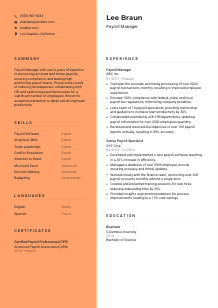
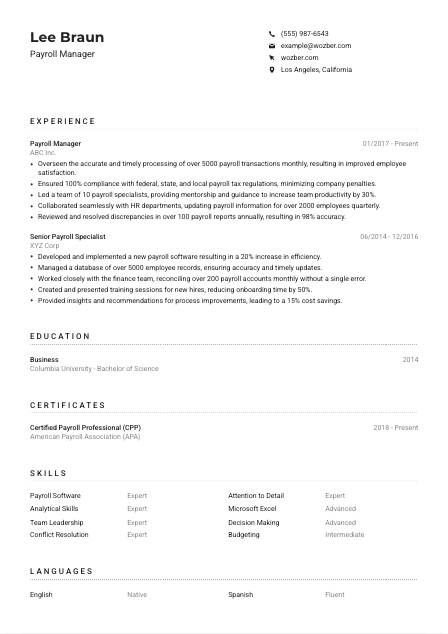
If the employer specifies a location requirement, reflect it clearly in this section. In the example, "Los Angeles, California" works well because the job calls for candidates based there. That kind of detail removes avoidable friction early in the review process.
A LinkedIn profile can help if it mirrors your CV and expands on payroll systems, leadership history, or certification details. Include it only if it is current and consistent. For payroll professionals, a polished online profile can reinforce progression from specialist to manager and show continuity in the field.
This section should confirm who you are, how to reach you, and whether you meet any explicit location requirement. Once that is clear, the rest of the CV can focus on what matters most in payroll hiring: accurate processing, regulatory control, and the ability to lead a dependable operation.




For a Payroll Manager, experience is where hiring teams look for operational proof. They want to see more than payroll familiarity. They want to know how much payroll you handled, how accurately you handled it, how you worked with HR and finance, and whether you improved the process while keeping compliance intact.
Read the posting closely and highlight the responsibilities that define daily performance. In this case, the essentials are timely payroll processing, payroll tax compliance, payroll reporting, partnership with HR, and leadership of payroll specialists. Those points should shape which achievements you choose and how you phrase them.
List roles in reverse chronological order with job title, company, and dates clearly shown. Payroll careers often show progression from payroll clerk or specialist to senior specialist and then manager. A clean timeline helps the reader follow that growth and quickly place your leadership experience in context.
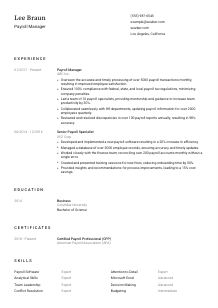
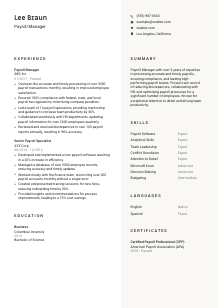
Focus each bullet on work that matters in payroll operations: transaction volume, tax compliance, reconciliations, discrepancy resolution, reporting accuracy, process improvement, and team oversight. The example does this well by stating responsibility for more than 5000 payroll transactions monthly, 100% compliance with tax regulations, and leadership of 10 payroll specialists. Those details tell the employer far more than broad claims about being responsible or detail-oriented.
Cut bullets that do not strengthen your case for payroll leadership. A hiring team for this role is more interested in payroll close accuracy, quarterly updates with HR, audit readiness, and issue resolution than in unrelated administrative wins. If you have broader finance experience, keep only the parts that connect directly to payroll processing, reporting, controls, or cross-functional coordination.
Quantify with measures that belong naturally in payroll work: number of employees paid, payroll runs per cycle, accuracy rate, turnaround time, tax compliance record, discrepancy volume, team size, and efficiency gains from systems or workflow changes. For example, reducing report discrepancies to 98% accuracy or improving team productivity by 30% gives the reader a grounded sense of operational performance.
Your experience section should show a clear progression toward owning payroll end to end. When the bullets cover volume, compliance, reporting, systems, and leadership in concrete terms, the reader can quickly see whether you are ready to manage a payroll function rather than simply support one.
Education is rarely the deciding factor for experienced payroll managers, but it still matters when the posting asks for a specific degree background. Keep this section straightforward and make it easy to confirm that you meet the academic requirement.
If the employer asks for a bachelor's degree in Business, Accounting, or a related field, list that degree clearly. In the example, a Bachelor of Science in Business aligns directly with the requirement and supports the candidate's foundation in financial operations and business processes.
Include degree, school, field of study, and graduation year or date range if helpful. Hiring teams do not need a dense academic record here. They need to confirm that your education is relevant and easy to scan alongside your payroll experience.
When your field of study matches the language in the job description, do not bury it. "Business" or "Accounting" should be easy to spot because those fields connect naturally to payroll calculations, controls, tax rules, and reporting discipline.
Early-career candidates can use this space to show payroll-relevant coursework such as accounting, taxation, finance systems, or business analytics. For a seasoned Payroll Manager, that level of detail is usually optional unless it explains a particularly relevant specialization.
Honors, leadership roles, or notable projects are worth adding only if they support your professional story. For example, a finance systems project or an accounting leadership role can reinforce analytical strength, but most experienced candidates should keep the emphasis on work history and certification.
For payroll management roles, education works best as a concise confirmation of your business or accounting foundation. Keep it brief, relevant, and easy to verify so the focus stays on payroll execution and leadership.
Certifications carry real weight in payroll because they show formal commitment to the field and familiarity with current regulations and standards. If you hold a payroll credential, give it clear space on the page.
When a posting mentions Certified Payroll Professional, list CPP prominently if you have it. That credential speaks directly to payroll knowledge, compliance depth, and professional commitment. In the example, placing CPP at the top immediately reinforces the candidate's specialization.
Choose certifications that strengthen your case for managing payroll operations, tax requirements, systems, or people leadership. Leave out unrelated training that does not support the role. A short, focused list is more persuasive than a long one with weak relevance.
Certification dates show currency, which matters in a field shaped by changing tax rules, reporting requirements, and system practices. If the credential is active or recently earned, that timing can reinforce that your knowledge is current.
Even when CPP is the headline credential, ongoing payroll, tax, HRIS, or Excel training can help, especially if your recent work involved system changes or process redesign. Payroll leaders are expected to stay current because compliance mistakes are costly and highly visible.
A relevant certification section tells the employer that your payroll knowledge is not only practical but formally developed. That matters when the role involves tax compliance, reporting scrutiny, and oversight of a payroll team.
Payroll Manager skills should read like the toolkit behind accurate payroll runs and controlled processes. Balance technical capability with the leadership and analytical strengths needed to manage a team, review exceptions, and work across HR and finance.
Start with the skills named in the posting and match them only where you genuinely have them. Here, payroll software, advanced Microsoft Excel, analytical ability, attention to detail, and strong English communication should all be visible. Using the employer's wording helps both human reviewers and ATS screening pick up the right matches.
Do not turn this section into a master inventory. Pick skills that support payroll management work directly, such as payroll processing, tax compliance, reconciliation, payroll reporting, Excel, HR collaboration, team leadership, and issue resolution. The sample skill list works because it stays close to what the job requires instead of drifting into generic business traits.
If your CV format allows it, group skills by type such as Payroll Systems, Compliance and Analysis, and Leadership. That makes it easier to scan and helps the reader connect your tools and strengths to actual payroll workflows, from processing and reporting to coaching specialists and resolving discrepancies.
A well-built skills section should make the employer think, "This person can run the process, analyse the reports, and lead the team." Keep the list focused on the systems, controls, and management strengths that matter in payroll.
Language skills are usually a supporting detail for Payroll Managers, not a headline qualification. They matter most when the posting asks for strong written and verbal communication or when the workforce includes multilingual employees, vendors, or stakeholders.
If the role calls for strong English, place English first and label your proficiency clearly. Payroll managers write employee-facing communication, respond to sensitive pay questions, and coordinate with HR and finance, so strong English is more than a checkbox. It supports accuracy and trust.
Include other languages if they are relevant to the employee population or operating environment. For example, Spanish may be useful in many payroll teams depending on workforce demographics, but it should remain a secondary point unless the employer specifically asks for it.
Use plain labels such as Native, Fluent, Intermediate, or Basic. Overstating language ability can create problems quickly in payroll, where misunderstandings about pay, deductions, or tax forms can lead to confusion and complaints.
If the payroll function covers multiple states, international teams, or a multilingual employee base, languages can add practical value. If not, keep this section short and let payroll operations, compliance history, and systems expertise carry the application.
Additional languages can strengthen communication across departments or with employees, but they should not crowd out your core payroll qualifications. Present them as a practical asset, not a substitute for payroll knowledge or managerial experience.
For most Payroll Manager applications, language skills should support the story rather than lead it. Make English proficiency clear, add other languages honestly, and keep the main emphasis on payroll accuracy, compliance, and leadership.
The summary needs to establish your payroll scope quickly. In a few lines, it should tell the reader how long you have worked in payroll, what level of responsibility you have held, and which strengths make you credible for a managerial seat.
Start with a direct statement that places you in the field, such as Payroll Manager with 6+ years in payroll administration or payroll leadership. That immediately anchors the reader in relevant experience instead of making them infer your background from later sections.
Mention the capabilities the job emphasizes most, such as accurate payroll processing, payroll tax compliance, payroll software proficiency, Excel, discrepancy resolution, and team leadership. The example summary works because it connects years of experience with compliance, process improvement, collaboration with HR, and management of payroll operations.
A summary gains credibility when it points to scale or results. You might mention supporting payroll for thousands of employees, reducing discrepancies, improving processing efficiency, or leading a productive payroll team. Those details carry more weight than general words like dedicated or hardworking.
Aim for a compact paragraph that can be read in seconds. Payroll hiring teams often move quickly to experience, so the summary should sharpen your positioning, not repeat every section of the CV. Save full detail for the bullets below.
A clear summary helps the reader understand your level before they reach the rest of the CV. When it highlights payroll scope, compliance discipline, systems strength, and leadership in a few clean lines, the rest of your application lands faster.
Before applying, review your CV against the posting line by line. Make sure the language around payroll processing, tax compliance, Excel, payroll software, HR collaboration, and team management appears where it is supported by your experience. That is what makes the document feel tailored rather than generic.
Wozber can help you tighten that alignment through its free CV builder, ATS-friendly CV templates, and ATS CV scanner, so your CV stays clear to both the hiring team and the software screening it. The final result should make one thing obvious: you can run payroll accurately, keep compliance under control, and lead the function with confidence.




