



Use Wozber and land your dream job
Create CV
No registration required
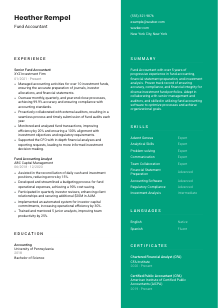
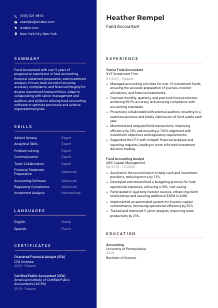
Into accounts, but your CV seems like a spreadsheet in grayscale? Check out this Fund Accountant CV example, created with Wozber free CV builder. Learn how to present your financial finesse in a way that matches job specifics, making your career graph as lucrative as the portfolios you manage!
Fund accounting CVs are read through the lens of control, accuracy, and reporting discipline. Hiring teams want to see that you can keep day-to-day fund activity clean, close the books on schedule, and produce financial statements that hold up under audit and investor scrutiny. Your CV should make that operating standard visible, not bury it under generic accounting language.
A tailored CV helps separate fund accounting experience from broader corporate accounting backgrounds by surfacing the right terms early, such as investor allocations, valuations, close processes, and fund audits. Wozber's free CV builder helps you shape that experience into an ATS-compliant CV with language that mirrors the posting and stays easy to read, so the hiring team can quickly see your readiness for fund-level reporting and control work.
The top of the CV should answer a few practical questions immediately: who you are, what role you do, and whether basic logistics line up. For fund accounting openings, that means a clean professional header with the exact role title, dependable contact details, and location when the posting makes it relevant.
Use your full name as the most visible line on the page. Keep the formatting simple and professional so the CV reads like a finance document, not a creative portfolio. Fund accounting hiring leans toward precision and order, and that starts with a header that is easy to scan.
Place "Fund Accountant" directly below your name if that is the role you are targeting. This helps frame the rest of the CV around fund reporting, reconciliations, close support, and investor accounting instead of leaving the reader to infer your specialization from past job titles alone.
Include a phone number and a professional email address that you check regularly. Make sure both are accurate. When a team is coordinating interviews around close calendars, audit support, or multiple stakeholders, missed messages can cost you momentum.
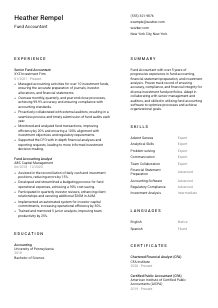
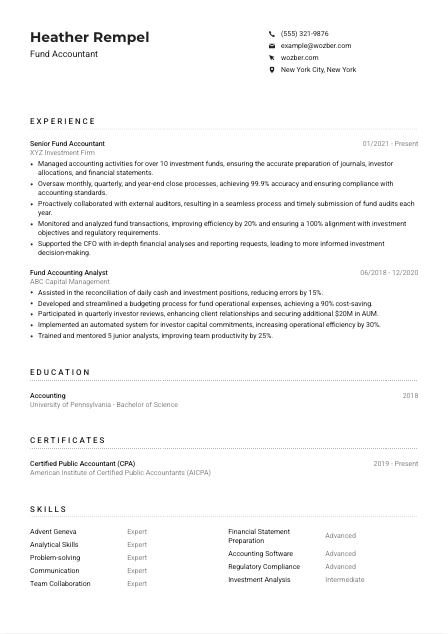
If the employer specifies a location, include your city and state. In the example, New York City, New York belongs in the header because the job explicitly requires it. That kind of detail helps remove avoidable friction before anyone even reaches your experience section.
Add LinkedIn or a professional website only if it supports your candidacy. A useful profile might reinforce your fund accounting progression, certifications, systems exposure, or reporting background. If you include a link, make sure the information matches your CV and reflects the same level of professionalism.
This section does not need personality flourishes. It needs clean identification, the right title, accurate contact details, and any required location information. When those basics are handled well, the reader can move straight to your fund accounting experience without distraction.




Experience carries the most weight in fund accounting because employers need proof that you have handled recurring reporting cycles, transaction activity, and audit-facing deliverables in a controlled environment. Your bullets should show what funds you supported, what accounting work you owned, and what changed because you handled it well.
Read the description and isolate the work that defines the role. For a Fund Accountant, that usually includes journal entries, investor allocations, financial statements, close support, transaction monitoring, valuations, audit coordination, and ad hoc analysis. Those functions should appear in your experience section using language that matches your actual background.
List each role in reverse chronological order with job title, company name, and dates. This lets hiring teams quickly understand your progression from analyst-level work into broader ownership, whether that means supporting a few funds, managing a larger portfolio, or taking on more direct contact with auditors and senior finance leaders.
Each bullet should describe a real piece of fund accounting work and the result. The example does this well by naming responsibilities such as managing accounting activities for more than 10 investment funds, preparing investor allocations, and producing financial statements. That is stronger than vague bullets about "assisting with accounting functions" because it shows scope and direct ownership.
Use numbers where they reflect real performance. In fund accounting, that may include number of funds supported, close accuracy, reduction in reconciliation errors, efficiency gains from process improvements, audit timeliness, or assets under management when relevant. The sample's 99.9% close accuracy and 20% efficiency improvement work because they are tied to accounting processes, not generic performance claims.
Keep the section centered on fund accounting, investment operations support, reporting, compliance, reconciliations, and analysis that matters to the role. If you have broader accounting experience, select bullets that still connect to controls, month-end close, cash and position reconciliations, or stakeholder reporting. Every line should help the reader understand how you would handle assigned funds from transaction review through financial statement delivery.
The best experience sections show steady control over recurring accounting work, not just exposure to finance teams. If your bullets make it clear that you can manage fund activity, close accurately, support audits, and answer senior reporting requests, you are speaking the language of the role.
Education matters here because the role sits on technical accounting judgment, financial reporting discipline, and comfort with regulated investment activity. The section should confirm that you have the academic base expected for fund accounting without taking attention away from your professional record.
List the degree that aligns most directly with the posting. For this kind of role, a bachelor's degree in Accounting, Finance, or a related field is the core requirement, so make that easy to find. If your major is closely connected but not identical, use the exact formal wording from your institution.
Use a consistent format with degree, field of study, school name, and graduation date. Fund accounting hiring often moves through CVs quickly, especially when recruiters are screening for minimum qualifications before the finance team reviews technical fit. A clear education entry helps that first pass go smoothly.
Specific wording matters. "Bachelor of Science in Accounting" tells the reader more than a shortened or generic label. In the example CV, that degree title aligns directly with the posting and reinforces the candidate's accounting foundation without extra explanation.
If you are early in your career, selected coursework can support your candidacy. Prioritise classes that connect to financial reporting, investments, portfolio accounting, auditing, or advanced accounting rather than long course lists. Once you have several years of relevant fund experience, this detail usually becomes optional.
Honors, academic awards, or finance-related student activities can strengthen the section when they add real context, especially for recent graduates. Keep them if they support a story of technical preparation or analytical strength. Skip them if your work history already provides stronger proof.
This section does not need to be elaborate. It should quickly establish that you meet the degree requirement and have the accounting or finance background expected in fund environments. Once that is clear, your experience can carry the deeper argument.
Certifications carry weight in fund accounting because they suggest depth in accounting standards, financial analysis, and professional discipline. If you hold a CPA or CFA, make sure the credential is easy to spot and presented in a way that supports the role you are targeting.
Start with certifications that matter most to fund accounting employers. A CPA is especially relevant when the role emphasizes financial statements, close accuracy, and audit coordination. A CFA can also add value where fund performance, valuation context, or investment knowledge are part of the environment.
List the certifications that strengthen your candidacy for the target role instead of every training item you have completed. In a fund accounting CV, a concise section with CPA, CFA, or similarly respected finance credentials makes a stronger impression than a long list of minor courses.
Include the year earned, active date range, or status where appropriate. This helps employers understand whether the credential is current and professionally maintained. In the example, both CPA and CFA are shown with ongoing dates, which supports continued professional standing.
Fund accounting intersects with changing standards, reporting expectations, and control requirements. If you hold a credential with continuing education obligations, keep it active and present it accurately. Current certification status supports the impression that your technical knowledge is being maintained, not left behind.
You do not need a crowded section here. A few well-chosen credentials, clearly presented, can reinforce your command of accounting standards, reporting discipline, and the level of professional rigor expected in fund finance teams.
The skills section should reflect the systems, technical strengths, and working habits that support fund accounting work day after day. Keep it grounded in actual job requirements, especially software, reporting ability, analytical judgment, and compliance-minded execution.
Start with the posting and note the required tools and capabilities. For this role, that includes fund accounting software such as Advent Geneva, along with analytical, problem-solving, and communication skills. Use the exact terminology when it matches your experience so both ATS filters and human reviewers can connect your background to the opening.
Focus on skills that help you perform fund accounting tasks, not broad finance buzzwords. Relevant entries might include fund accounting software, financial statement preparation, reconciliations, regulatory compliance, investor allocations, close processes, and variance analysis. The example's mix of Advent Geneva, financial statement preparation, and regulatory compliance is a good model because it ties directly to the responsibilities in the posting.
Place the most relevant technical and role-specific skills first, then support them with softer capabilities that matter in practice, such as communication and team collaboration. For fund accounting, systems fluency and reporting accuracy usually carry more screening value than generic workplace traits. A well-ordered list helps the reader understand your toolkit in seconds.
A useful skills section gives a quick read on whether you can operate inside the fund accounting workflow, from systems use to statement prep to issue resolution. Keep it specific, prioritised, and close to the language of the target role.
Language skills are usually a supporting section for fund accountants, but they can still matter. Clear communication is part of the job when you are working with auditors, internal finance teams, operations staff, and sometimes investors or offshore partners, so list languages in a straightforward way.
If the posting requires a language, place it first and show your level clearly. Here, English proficiency is explicitly required, so it should appear before any additional languages. That small detail helps confirm basic role eligibility immediately.
Order languages by their importance to the role. For most U.S.-based fund accounting jobs, English belongs first because it is the working language for reporting, audit communication, and management requests. Mark it as "Native" or "Fluent" only if that level is accurate.
Additional languages can be helpful, especially in firms with global operations or investor communication across regions. Include them if they are real working skills, and avoid overstating your level. In the example, Spanish adds breadth without distracting from the accounting core of the CV.
Keep the wording simple with terms such as "Native," "Fluent," "Intermediate," or "Basic." Hiring teams do not need elaborate explanations here. They need a quick and credible read on whether you can communicate effectively when the role requires it.
If you have experience with international funds, cross-border reporting, or communication with global service providers, language ability can support that narrative. Mention it when it helps explain your working range, not just to fill space on the CV.
For most fund accounting CVs, this is a brief section. Handle it cleanly, put required English proficiency first, and include other languages only when they add genuine context to your work with auditors, teams, or international stakeholders.
Your summary should quickly tell the reader what level of fund accounting work you have handled and where your strengths sit. A few well-chosen lines can establish experience with fund portfolios, close cycles, reporting accuracy, audit coordination, and systems before the reviewer reaches the detailed sections below.
Start with your title, years of experience, and main area of specialization. Keep it specific to fund accounting rather than broad finance language. If your background includes hedge funds, private equity, mutual funds, or other structures, mention that only when it strengthens the match and reflects your real experience.
Use one or two sentences to show what you consistently deliver. Good summary language for a fund accountant often points to accurate financial reporting, timely close processes, clean reconciliations, audit support, and dependable analysis for leadership. The example summary works because it ties experience to accuracy, compliance, and financial integrity rather than generic ambition.
Include a few concrete details that reinforce your level, such as years in fund accounting, number of funds supported, software proficiency, or strong results in close and reporting work. The sample's mention of more than 5 years, financial statement preparation, and collaboration with auditors and senior management gives the reader useful context fast.
Aim for a compact paragraph that earns every word. A summary that is too broad can blur the distinction between fund accounting and other accounting paths. Stay close to the target role so the reader reaches your experience section already expecting to see fund-level reporting, controls, and analytical support.
When written well, this section gives the hiring team an immediate read on your fund accounting scope, technical strengths, and reporting discipline. Keep it concise, specific, and aligned with the kind of fund work the role needs you to handle.
A Fund Accountant CV should now show the essentials clearly: accounting ownership, close and reporting discipline, audit coordination, systems familiarity, and the level of fund activity you have handled. Those are the details that help a finance team judge whether you can step into assigned funds and keep the books accurate.
Use Wozber's free CV builder to refine structure, tailor wording, and present your experience in an ATS-friendly CV format. With Wozber's ATS CV scanner, you can align your CV more closely with the posting, strengthen missing terminology, and submit a CV that reads cleanly to both screening systems and fund accounting hiring teams.