




Use Wozber and land your dream job
Create CV
No registration required
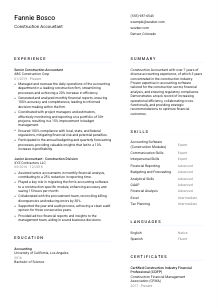
Balancing the books in hard hats? Check out this Construction Accountant CV example, built with Wozber free CV builder. Learn how to align your financial skills with construction needs, hammering out a career reflection as solid as the projects you budget for!
Construction accounting gets reviewed through a different lens than general staff accounting. Hiring teams want to see whether you can keep job costs, reporting, compliance, and project-facing communication under control in an environment where budgets move, billing issues surface fast, and project managers need numbers they can trust. Your CV should make that operating range visible early.
A targeted CV also helps separate broad accounting experience from true construction finance experience. Using Wozber's free CV builder to mirror the posting's language and keep an ATS-compliant CV organised makes it easier to surface the details that matter here, such as job cost tracking, financial reporting accuracy, and collaboration with project teams.
For a Construction Accountant, the header should do one practical job well: confirm who you are, how to reach you, and whether basic logistics line up. Keep it clean, professional, and easy to scan so the reader can move quickly to your project accounting background.
Use your full name as the most visible text in the header. Skip nicknames and decorative formatting. Construction accounting roles often move through HR, finance leadership, and operations stakeholders, so a straightforward presentation helps your CV look credible from the first line.
Place your target title directly under your name. If you are applying for a Construction Accountant position, say exactly that. It immediately frames your experience around job costing, financial reporting, compliance, and budgeting rather than general accounting work, and it also supports ATS matching.
Include a reliable phone number and a professional email address. Check them carefully. A missed digit or outdated email can cost you an interview, especially when hiring moves quickly after a controller or finance manager finds relevant construction-sector experience.
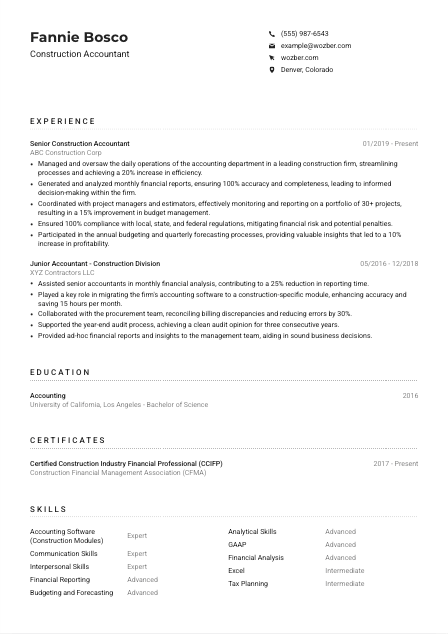
If the employer asks for a specific location or relocation readiness, include your city and state. In the example, listing Denver, Colorado directly supports the posting's location requirement. When a posting includes that kind of filter, handling it in the header removes an avoidable question.
If you include LinkedIn or a professional website, make sure the information matches your CV. For this profession, that profile should reinforce items like construction industry accounting experience, ERP or accounting software exposure, certifications, and measurable reporting or job cost results.
Your personal details should answer the basics without friction and quietly support the role requirements. Once that is handled, the reader can focus on whether your accounting experience fits a construction environment.




This section usually carries the most weight. Hiring managers want to see how closely your past work matches the financial demands of construction operations, from reporting and reconciliations to cost variance tracking and regulatory compliance.
Before rewriting bullets, isolate the work the employer actually needs done. In this case, that includes running daily accounting operations, producing accurate financial reports, working with project managers and estimators on job cost variances, supporting budgeting and forecasting, and staying compliant with construction-related regulations. Those are the themes your experience bullets should reflect in natural language.
List roles in reverse chronological order with job title, company name, and dates. That format lets the reader follow your progression from junior accounting work into higher-responsibility construction finance work, such as the sample move from Junior Accountant in a construction division to Senior Construction Accountant.
Construction accounting is operational accounting. Focus bullets on reporting cycles, job cost monitoring, billing accuracy, audit support, variance analysis, subcontractor or procurement coordination, and process control. A line like "coordinated with project managers and estimators to monitor a portfolio of 30+ projects" works because it shows cross-functional involvement tied to project finances, not just back-office bookkeeping.
Quantified results make your scope easier to understand. Use numbers tied to efficiency, reporting speed, error reduction, audit outcomes, compliance, profitability, or project volume. The example's 20% efficiency gain, 25% reduction in reporting time, and support for 30+ projects are strong because they describe business effect in terms finance leaders recognize.
Leave out bullets that are too generic or disconnected from construction accounting work. If a task does not show financial oversight, reporting accuracy, cost tracking, software use, compliance, forecasting, or collaboration with project stakeholders, it probably does not deserve space over more relevant experience. Prioritise the bullets that make you look ready to step into a construction firm's accounting workflow.
Your experience section should show that you can support the financial side of active construction work, not just maintain ledgers. When the bullets connect accounting discipline to project performance, your CV reads like a closer match for the role.
Education is usually a straightforward section for Construction Accountant roles, but it still needs to confirm that your training lines up with the finance and accounting foundation the employer expects.
Check the stated education requirement and match it precisely where you can. Here, the employer asks for a bachelor's degree in Accounting, Finance, or a related field. If your degree meets that standard, make it easy to find.
List your degree, field of study, school, and graduation year. This is enough for most accounting roles and keeps the section ATS-friendly. The sample's "Bachelor of Science, Accounting, University of California, Los Angeles" covers the requirement cleanly.
When your education directly supports the role, do not bury it. A bachelor's degree in Accounting is a clear match for a Construction Accountant opening, so let that alignment work for you rather than relying on the reader to infer it.
If you are early in your career or the degree title is broader, relevant coursework can help. Topics like cost accounting, auditing, financial reporting, taxation, or construction management finance can strengthen the section. If you already have several years of directly relevant experience, keep this brief.
Honors, scholarships, or accounting-related student organizations can be useful if they reinforce your profile and you are not yet deep into your career. Once your CV has substantial construction accounting experience, these details should stay secondary to your work history.
Your education section should quickly establish that you meet the formal accounting foundation for the position. Once that box is checked, the CV can return focus to job cost control, reporting, and project-facing finance work.
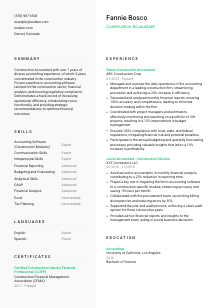
Certifications help when they show deeper knowledge of accounting standards, reporting discipline, or the construction industry itself. For this role, they are especially useful when they reinforce specialization rather than simply adding another credential line.
Start with the certifications the employer already recognizes. Here, CCIFP and CPA are listed as pluses, which tells you the company values either construction-specific financial expertise or broader accounting licensure. If you hold one of them, make sure it is easy to spot.
Lead with credentials that relate to construction finance, reporting, audit readiness, or compliance. The sample uses CCIFP well because it speaks directly to construction industry financial practice, which carries more weight here than a generic unrelated certificate.
Add issue dates or active date ranges when relevant, especially for credentials that require maintenance. A current certification tells the employer your knowledge is still active and professionally maintained.
Construction accounting changes with regulations, tax treatment, revenue recognition practices, and software workflows. Keeping certifications updated shows that you stay current on the financial rules and operational realities that affect contractors and project-based reporting.
A well-chosen certification section can reinforce that your accounting background includes construction-specific depth. That is especially useful when an employer wants someone who can step into project-driven financial work with less ramp-up time.
The skills section should reflect how the work actually gets done. For Construction Accountant roles, that means combining accounting fundamentals with tools and abilities tied to project-based financial control.
Read the job description for both technical and interpersonal requirements. In this posting, construction-specific accounting software, analytical ability, communication, interpersonal skills, financial reporting, budgeting, and forecasting all matter. Those should shape your skills section before you add anything extra.
Choose skills you can back up elsewhere on the CV. Useful entries for this profession often include job cost accounting, financial analysis, budgeting and forecasting, GAAP, reconciliations, audit support, Excel, and ERP or accounting software with construction modules. The sample's mix of accounting software, financial reporting, GAAP, and budgeting is on the right track because the experience section supports those claims.
Order matters. Lead with the capabilities that best match the role, especially construction accounting systems, financial reporting, variance analysis, compliance knowledge, and cross-functional communication with project teams. Save broader or less critical skills for the bottom so the section mirrors the priorities of the opening.
Your skills section should read like the toolkit of someone who can manage construction accounting work in practice. Keep it focused on systems, finance disciplines, and project-facing capabilities that the rest of the CV can support.
Language details matter most when the posting names a requirement or when communication across crews, vendors, clients, or internal teams is part of the job. In construction accounting, clear written and spoken communication affects reporting, issue resolution, and coordination.
If the employer specifies a required language, list it clearly. Here, effective use of English is essential, so English should appear first with an accurate proficiency level.
Order your languages by relevance to the role. For this CV, "English - Native" belongs first because the job requires strong communication for reporting, collaboration, and compliance-related work.
If you speak other languages, include them when they are useful in the work environment. In some construction settings, an additional language can support smoother communication with field teams, subcontractors, or vendors. Spanish, for example, may be an asset in many markets even when it is not formally required.
Use realistic labels such as Native, Fluent, Advanced, Intermediate, or Basic. If you claim a language, expect to use it in meetings, emails, or phone calls tied to billing questions, documentation, or project coordination.
Do not overstate the importance of languages if the position is primarily domestic and English-based. Include them when they add practical value, but keep the emphasis where it belongs for this profession: financial control, reporting, software, and project coordination.
For most Construction Accountant CVs, this section should confirm strong English communication and note any additional useful languages without distracting from your accounting qualifications.
Your summary needs to explain quickly why your background fits a construction environment. It should combine your accounting tenure, industry exposure, and the kind of financial work you can own from day one.
Start with your professional identity and experience level. A line like "Construction Accountant with 7+ years of accounting experience" works because it tells the reader both your specialty and your level of seniority before they reach the work history.
Pull in two or three strengths that match the posting closely. For this kind of role, that often means construction accounting software, financial reporting, job cost analysis, budgeting support, compliance, or cross-functional coordination with project managers and estimators.
Use the summary to hint at results, not to repeat your whole experience section. Metrics such as improving reporting efficiency, reducing errors, supporting multi-project oversight, or contributing to stronger profitability can work well. The sample summary succeeds because it links software expertise and compliance knowledge to operational efficiency and better financial outcomes.
Aim for a compact paragraph of about three to five lines. Skip generic traits unless they are tied to the work. "Strong communicator" is weaker on its own than a statement showing you collaborate with project managers on cost variances or provide management with forecasting insight.
Your summary should tell the reader, within a few lines, that you understand construction accounting and can contribute to reporting accuracy, project cost control, and financial planning. That sets the tone for the rest of the CV.
You now have the structure for a Construction Accountant CV that reflects how the role is actually reviewed, from project-facing accounting experience to software, compliance, and reporting depth.
Use Wozber's AI CV builder to tighten your language around the target posting, keep an ATS-friendly CV format, and check alignment with an ATS CV scanner before you apply.
The finished CV should make one thing easy to judge: you can manage construction financial work with accuracy, context, and control.




