



Use Wozber and land your dream job
Create CV
No registration required
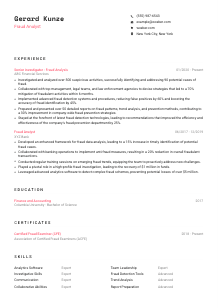
Unmasking deceptions, but your CV raises eyebrows? Check out this Fraud Analyst CV example, created with Wozber free CV builder. Learn how to outline your investigative insights to match job demands, making your career path as solid as a verified transaction!
Fraud analysis is built on judgment, pattern recognition, and disciplined follow-through. Hiring teams want to see that same rigor in your CV. Instead of broad claims about being analytical, show how you investigated suspicious activity, worked across compliance or legal channels, improved detection processes, and turned findings into action through reports, recoveries, or prevention measures.
When the CV mirrors the language of the role, it becomes much easier to separate hands-on fraud analysts from candidates with only adjacent risk or operations experience. Wozber's free CV builder helps you shape that alignment in an ATS-friendly CV format, so key terms like fraud detection, investigations, analytics software, and reporting are easy to read by both the ATS and the people deciding whether you can handle live fraud cases.
For a Fraud Analyst, the header should communicate professionalism and remove avoidable doubts. Recruiters do not need extra biography here. They need accurate contact details, a clear role identity, and, when relevant to the posting, confirmation that location requirements are already met.
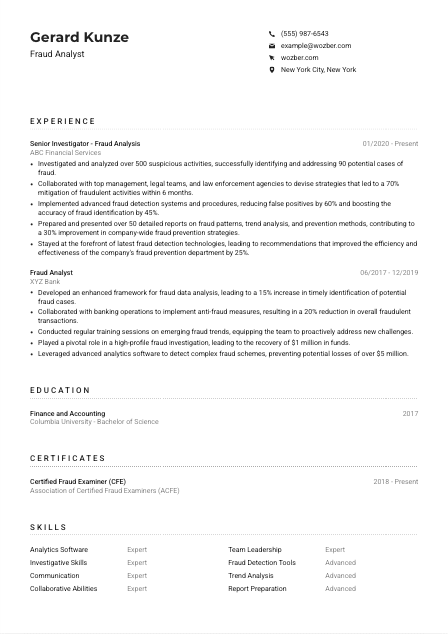
Place your name at the top in a slightly larger font so it anchors the page immediately. Keep it simple and professional. In the example, Gerard Kunze's name is easy to spot, which helps the document feel organised from the first line.
Add "Fraud Analyst" directly under your name when that is the role you are pursuing. This keeps your positioning clear and helps align the CV with the posting, especially when the employer is screening for candidates with direct fraud investigation experience rather than broader financial analysis backgrounds.
Fraud teams work in high-trust environments, so small errors can hurt credibility. Make sure your phone number works, your email is professional, and the information matches your LinkedIn or other public profiles.
If the employer asks for a specific location, show it in your header. Here, listing New York City, New York helps address a stated requirement right away. For other fraud analyst roles, only include city and state when location or regional availability matters to the employer.
Include LinkedIn or another professional profile if it supports your application with consistent job titles, dates, certifications, or fraud-focused accomplishments. For this field, consistency matters. A profile that matches your CV reinforces trust.
Do not add age, marital status, photo, or other personal details unless local hiring norms specifically require them. Keep the top of the CV focused on professional information and maintain an ATS-compliant CV structure that stays clean and easy to parse.
This section should answer three questions fast: who you are, what role you do, and how to reach you. If location is part of the screening, cover that here as well. Then let the rest of the CV carry the investigative detail.




This is the section where a Fraud Analyst CV either becomes credible or stays generic. Employers look for signs that you have worked real alerts, investigated suspicious activity, collaborated with operational or legal partners, and improved controls or outcomes. Your bullets should show what you handled, how you handled it, and what changed because of your work.
Before writing bullets, identify the main demands in the posting. For this role, that includes investigations, fraud detection systems, cross-functional collaboration, reporting, and keeping methods current. Use those workstreams to decide which achievements deserve space and which older bullets can be cut.
Start with your most recent position and include employer, title, and dates. For fraud careers, progression matters. A title like Senior Investigator - Fraud Analysis, as shown in the example, immediately suggests deeper case ownership and broader coordination than an entry-level operations role.
Do not stop at saying you "analysed transactions" or "reviewed alerts." Show what you uncovered, escalated, prevented, recovered, or improved. The example does this well by tying investigations to identified fraud cases, collaboration to mitigation results, and reporting to stronger prevention strategies.
Numbers carry weight when they reflect how fraud teams actually operate. Strong examples include suspicious activities reviewed, fraud cases confirmed, losses prevented, funds recovered, false positives reduced, detection accuracy improved, or turnaround time on investigations. Metrics like the sample's 60% drop in false positives or $5 million in prevented losses make the scope of work concrete.
If you have experience beyond fraud, prioritise the parts tied to investigations, controls, data analysis, reporting, customer or transaction review, and stakeholder coordination. A hiring manager should not have to dig through unrelated finance or operations tasks to understand that you can handle suspicious activity reviews and fraud prevention work from day one.
Your experience section should show how you think through fraud problems and what business result followed. When a reviewer can see case volume, investigative methods, system improvements, and prevention outcomes in a few lines, your background becomes much easier to trust.
Fraud Analyst roles often ask for a bachelor's degree because the work draws on financial reasoning, documentation discipline, and investigative judgment. Your education section does not need to be long, but it should clearly show that you meet the academic baseline and, when helpful, reinforce your analytical foundation.
If the posting calls for a bachelor's degree in Finance, Accounting, Criminal Justice, or a related area, list your degree in a way that makes the connection obvious. Do not leave the reader guessing whether your academic background fits the role.
Present school, degree, and field of study in a consistent order. Clean formatting helps the reviewer find the credential quickly and keeps the section easy for ATS parsing.
When your field is directly connected to the job, be explicit. The example's Bachelor of Science in Finance and Accounting speaks directly to fraud analysis in financial settings because it suggests comfort with transactions, controls, and reporting.
If you are earlier in your career or changing into fraud work, selected coursework can help. Topics like forensic accounting, auditing, financial crime, criminal law, data analytics, or risk management can support your move. If you already have several years of fraud experience, coursework is usually optional.
Honors, research projects, or capstone work are worth mentioning when they connect to analytical problem-solving, investigative methods, or financial review. Keep it relevant. A generic list of campus activities adds less value than one line that supports your readiness for fraud analysis.
This section should quickly confirm that you meet the educational requirement and, where useful, underline your analytical grounding. If the degree is relevant and easy to read, it has done its job.
Certifications can add weight in fraud hiring because they show continued study in investigative practice, financial crime, controls, or compliance. They are especially helpful when they reinforce the kind of work the employer handles, whether that is transaction fraud, banking controls, or broader financial investigations.
Start with the job ad. If a certification is required or preferred, mirror it exactly. If none is specified, list the credentials that most clearly support fraud analysis work rather than filling space with unrelated training.
Lead with certifications tied to investigations, fraud prevention, anti-money laundering, or financial crime. In the example, the Certified Fraud Examiner credential is a strong addition because it directly supports investigative and fraud detection responsibilities.
Add the year earned or the active date range so the employer can gauge recency. In a field where fraud patterns, tools, and regulatory expectations change, current credentials can support your relevance.
Fraud analysts are expected to stay current on detection methods, analytics tools, and emerging schemes. If you have recent fraud-focused training, workshops, or continuing education, include it when it adds to the story of active professional development.
A certificate helps most when it lines up with the investigations, controls, and reporting expected in the role. Keep this section selective and current so it adds real weight rather than extra noise.
The skills section should read like a practical operating toolkit for fraud work. Hiring teams expect a mix of analytical ability, investigative judgment, reporting strength, and collaboration with stakeholders such as operations, compliance, legal teams, or law enforcement. Keep the list focused on what you genuinely use.
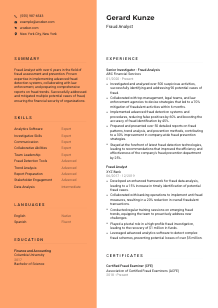
Use the job description to identify the hard and soft skills that matter most. Here, fraud detection tools, analytics software, investigative skills, communication, and collaboration are all explicitly relevant. Those belong near the top if they reflect your real background.
Fraud analysts need more than software proficiency. Add the abilities that shape daily execution, such as suspicious activity analysis, trend reporting, interview or case documentation, stakeholder communication, and control improvement. The sample skills list works because it combines tool-related capability with investigative and collaborative strengths.
Avoid padding this section with broad terms that could belong on any CV. Choose the skills that support fraud investigations and prevention work first. A concise, relevant list gives a hiring manager a faster read than a long inventory of generic business skills.
A focused fraud analyst skills section should reflect how you work: reviewing activity, investigating anomalies, using detection tools, writing reports, and coordinating with others to reduce risk. If the list sounds like your real day-to-day, it is doing useful work.
Language matters in fraud analysis because the role depends on accurate documentation, clear escalation, and steady communication with internal teams and, at times, external parties. If a posting names a language requirement, treat it as a qualification to confirm clearly rather than a minor extra detail.
When the job asks for advanced English, list English first and state your level plainly. That matters in fraud work because reports, case notes, and stakeholder communication need precision.
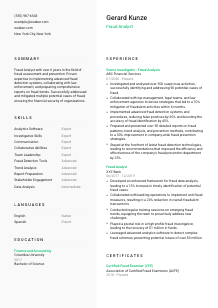
Put the most important language for the role at the top, then add others that could support investigations or customer-facing review work. In this example, English appears first, which matches the posting and keeps the requirement easy to find.
Extra languages can be useful in fraud environments that involve diverse customer bases, cross-border transactions, or multilingual coordination. Spanish, for example, may strengthen communication range in some organizations, though it is an added benefit rather than a universal requirement.
Choose standard labels that employers understand immediately.
Not every fraud analyst role needs multiple languages, but some do benefit from them, especially in banking, payments, or international operations. Include languages that genuinely support your work and avoid overstating proficiency in a setting where accuracy matters.
For this role, language entries should be clear, honest, and easy to interpret. If English is required, make that obvious. Any additional language should support the operational context of the job.
The summary should quickly establish the kind of fraud work you have done and the level at which you have done it. A hiring manager reading the top of the page should understand your experience, your investigative strengths, and the type of outcomes you have delivered before getting into the detail of your work history.
Pull the main themes from the job description and reflect the ones you can genuinely support. For this opening, that means investigations, analytics, detection systems, reporting, and collaboration with internal stakeholders or law enforcement.
Start with a direct introduction such as Fraud Analyst with 6+ years of experience. That gives immediate context and helps distinguish you from candidates whose background may be adjacent but not centered on fraud work.
Use one or two specifics that define your value. Good examples include identifying suspicious activity, implementing fraud detection improvements, reducing false positives, preparing trend reports, or supporting major investigations. The sample summary works because it points to systems, collaboration, and prevention outcomes rather than relying on vague claims.
Aim for a short paragraph that can be scanned in seconds. Every phrase should earn its place. Replace generic descriptors with facts about scope, tools, or outcomes so the summary reads like a concise professional profile rather than a personal statement.
When the summary is done well, it tells the reader what kind of fraud analyst you are, how much experience you bring, and where you create value. That gives the rest of the CV a sharper frame.
You now have a clear framework for presenting fraud analysis experience in a way that hiring teams can read quickly and trust. Use Wozber's free CV builder to organise your casework, prevention results, technical skills, and credentials into a polished, job-aligned document.
Finish with an ATS-friendly CV format, then use Wozber's ATS CV scanner to check whether your language reflects the posting's real priorities. The final result should make one thing easy to judge: whether you can investigate suspicious activity, strengthen fraud controls, and contribute from the start.




