



Use Wozber and land your dream job
Create CV
No registration required
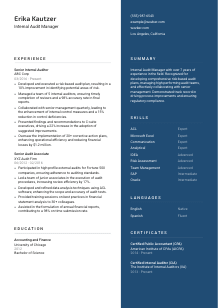
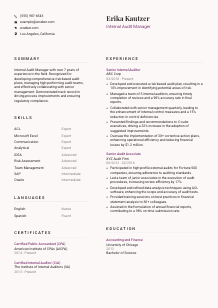
Into audits, but your CV feels unseen? Check out this Internal Audit Manager CV example, created with Wozber free CV builder. It shows how to spotlight your audit acumen in line with job expectations, clearing the path for your career to pass a thorough examination (and receive high ratings, of course!).
Internal Audit Manager CVs are read through the lens of judgment. Hiring teams want to see how you plan audits around risk, challenge weak controls, and move findings into corrective action that leadership will actually implement. If your CV stays at the level of task lists, it misses the real standard of the job: protecting the business through disciplined audit planning, clear reporting, and practical recommendations.
A tailored CV changes how quickly that leadership scope comes through, especially when an ATS is screening for audit planning, internal controls, certifications, and audit tools. Wozber's free CV builder helps you align your wording with the role, keep an ATS-compliant CV structure, and surface the parts of your background that show you can lead audit work, guide auditors, and influence management decisions.
This section is simple, but it still does screening work. For an Internal Audit Manager, the header should immediately show a professional identity, reliable contact details, and any location alignment that removes avoidable questions early in the review.
Use your full name as the clearest element at the top of the page. Keep the formatting clean and professional so the document starts with the same control and clarity expected in audit reporting.
Use "Internal Audit Manager" directly beneath your name when that is the role you are pursuing. It helps frame your background around audit leadership rather than a broader accounting or compliance profile, which matters when employers are sorting between adjacent candidates.
List a current phone number and a professional email address you check regularly. Internal audit hiring often moves through several conversations with HR, finance leaders, and business stakeholders, so your contact details need to support quick follow-up without friction.
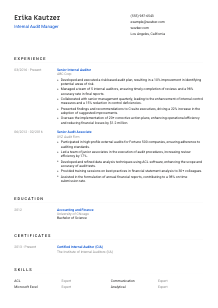
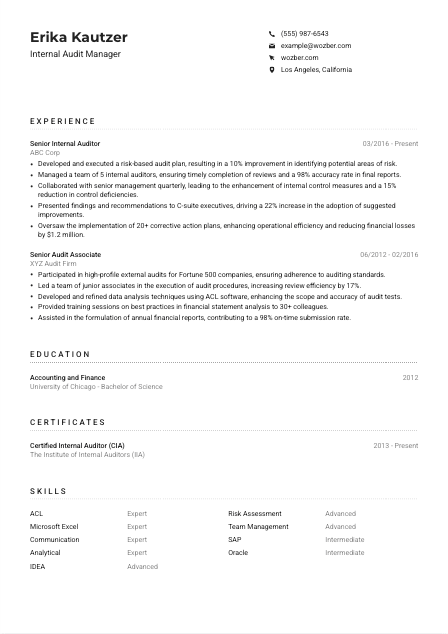
If the posting specifies a city or relocation requirement, reflect that clearly in your header. Here, listing Los Angeles, California helps address the stated location expectation up front. If you are relocating, say so plainly rather than leaving the employer to guess.
Include LinkedIn or a professional website only if it reinforces your CV with consistent titles, certifications, and career dates. For audit leaders, a polished profile can support credibility, especially if it shows certifications like CIA or CPA and a steady progression through internal audit, external audit, or accounting roles.
Your personal details should make the administrative side of hiring easy. When the title, contact information, and location are aligned, the reader can move straight to your audit experience and leadership scope.




The experience section carries the most weight for this position. Internal Audit Manager hiring centers on whether you have led risk-based work, improved control environments, managed auditors, and communicated findings in a way that changes decisions and operations.
Read the posting and mark the responsibilities that define the role's actual scope. In this case, that includes building a risk-based audit plan, guiding auditors, partnering with senior management, presenting findings, and tracking corrective action plans. Those themes should shape which achievements you highlight and the language you use.
List your positions in reverse chronological order and make the progression clear. For Internal Audit Manager roles, employers usually want to see a path through internal audit, external audit, or accounting work that built toward broader planning authority, people management, and cross-functional influence.
Focus each bullet on what you led, what audit or control issue you addressed, and what changed as a result. Strong examples include developing audit plans, reducing control deficiencies, improving report accuracy, or increasing adoption of recommendations. The sample CV does this well by linking audit activity to outcomes such as stronger control measures and higher implementation rates.
Numbers help hiring teams understand your operating level. Use metrics that fit audit work naturally, such as team size, audit cycle improvements, report accuracy, reduction in deficiencies, corrective actions closed, dollar losses avoided, or savings from process improvements. A line such as overseeing 20+ corrective action plans and reducing financial losses by $1.2 million tells far more than a general claim about process improvement.
Keep the emphasis on work that strengthens your case for audit leadership. If an achievement does not connect to risk assessment, controls, compliance, reporting, stakeholder management, or audit team performance, it likely belongs lower on the page or off the CV entirely. This role calls for a focused story, not a complete career archive.
By the end of this section, the reader should understand the level of audit work you have owned, the teams you have led, and the operational or financial results your recommendations produced.
Education will not outweigh audit leadership experience, but it still matters because it confirms the financial and accounting foundation behind your judgment. For this role, the degree should support your credibility in controls, reporting, and risk analysis.
When a posting asks for a bachelor's degree in Accounting, Finance, or a related field, present that information directly and without extra formatting. A degree in accounting and finance immediately supports your fit for work involving internal controls, audit procedures, and financial analysis.
List your degree, field of study, school, and graduation year in a straightforward format. Audit hiring often involves fast CV reviews by HR and finance leaders, so clarity matters more than decorative detail.
If your degree closely aligns with the requirement, do not bury it. "Bachelor of Science in Accounting and Finance" speaks more directly to audit work than a generic degree label and helps the employer connect your education to the role's technical expectations.
Most experienced Internal Audit Manager candidates do not need a course list. Add coursework only if it highlights useful foundations such as auditing, financial reporting, internal controls, or data analysis and fills a meaningful gap in your early-career profile.
Honors, scholarships, leadership roles, or major projects can help if you are earlier in your management track or if they relate to accounting, governance, or analytical work. Once you have several years of audit experience, keep these details brief so the section stays secondary to your professional record.
This section should confirm that your technical grounding matches the role's demands, then get out of the way so your audit experience and certifications can carry the argument.
For Internal Audit Manager roles, certifications are often a deciding factor rather than a bonus. They show formal command of audit standards and accounting principles, and they immediately strengthen credibility with finance leadership and hiring committees.
If the employer asks for a CIA or CPA, list that credential prominently. Those designations speak directly to the role's expectations and should never be buried below less relevant training or memberships.
Keep the section focused on certifications that support internal audit, accounting, compliance, or financial oversight. For this role, CIA and CPA are far more persuasive than broad business courses because they map to how audit quality and technical depth are evaluated.
Include the year earned and, if relevant, indicate that the credential is active. That helps employers understand both your tenure in the profession and the currency of your qualification, especially in regulated or standards-driven environments.
Audit leaders are expected to stay current with control frameworks, regulatory changes, and audit methodology. Ongoing professional development, whether through continuing education or additional governance and risk credentials, reinforces that you are maintaining the technical judgment the role requires.
Certifications should quickly confirm that your audit knowledge is formal, current, and trusted. In many Internal Audit Manager searches, that clarity moves your CV forward faster.
The skills section should mirror how the role is executed day to day. For an Internal Audit Manager, that means balancing technical tools, control and risk expertise, and the communication skills needed to guide auditors and present findings to leadership.
Start with the exact requirements in the job description, then add closely related skills you genuinely use. Here, that includes ACL or IDEA, advanced Microsoft Excel, analytical ability, communication, interpersonal skills, and team guidance. Together, these describe both the audit work and the management side of the role.
Place the most relevant audit and leadership skills first rather than mixing them randomly. A hiring team should see audit software, risk assessment, internal controls, reporting, and team management before broader or less critical tools. The sample CV gets this largely right by giving visibility to ACL, Excel, risk assessment, and team management.
Do not turn the section into a software inventory. Choose the tools, methods, and interpersonal strengths that actually support internal audit planning, fieldwork, testing, reporting, and follow-up. A shorter list with clear relevance is stronger than a long list that muddies your profile.
Your skills section should read like the toolkit of someone who can run audits, coach auditors, analyse data, and communicate findings in language business leaders can act on.
Language skills matter here because audit managers spend a large part of the job interviewing stakeholders, writing findings, and presenting recommendations clearly. Communication ability is not separate from the work. It shapes how well audit conclusions are understood and acted on.
If the job calls for strong English communication, list English clearly and use an honest proficiency level. For an Internal Audit Manager, this matters across audit interviews, report writing, executive presentations, and follow-up discussions on remediation.
Lead with English if it is explicitly requested. Using "Native" or "Fluent" makes the requirement easy to confirm and avoids uncertainty about your ability to handle written findings and verbal communication with leadership teams.
Additional languages can strengthen your profile when the company operates across regions, serves multilingual teams, or audits diverse business units. They are supportive credentials, not a substitute for audit expertise, so keep them secondary to the required language.
Use standard labels such as "Native," "Fluent," "Intermediate," or "Basic." Internal audit work depends on nuance, especially when discussing control deficiencies or recommendations, so overstating fluency can become a real issue later in the process.
Only include languages you could comfortably use in professional settings. For audit management, that means being able to ask clear questions, understand operational explanations, and communicate recommendations without confusion. If an additional language helps you do that across teams, it is worth listing.
This section should confirm that you can communicate clearly in the language the role requires and, where relevant, work effectively across broader stakeholder groups.
The summary sets the direction for the rest of the CV. For an Internal Audit Manager, it should quickly establish your years of experience, your command of risk-based auditing and internal controls, and the level of leadership you bring to audit planning and reporting.
Before writing, identify the few requirements that define the position most clearly. Here, those are audit leadership, risk-based planning, collaboration with senior management, control improvement, and recognized credentials. Build your summary around those points instead of generic statements about being results-driven.
Start with your title or closest equivalent and your years of relevant experience. For example, an Internal Audit Manager or senior audit leader with 7+ years across internal audit, external audit, and accounting gives the reader immediate context for your level.
Use the next lines to show what you are known for. Mention strengths such as developing risk-based audit plans, leading audit teams, presenting findings to leadership, strengthening internal controls, or driving remediation. The sample summary works because it stays close to these core functions instead of drifting into broad finance language.
Aim for 3 to 5 lines with no filler. Every phrase should help explain your audit scope, leadership level, or business impact. A concise summary with role-specific language is also easier for an ATS and a hiring manager to interpret quickly.
When this section is working, the rest of the CV reads with the right context. The employer should already understand that your background covers audit planning, team leadership, control improvement, and communication with senior stakeholders.
An Internal Audit Manager CV should make one thing easy to see: you know how to identify risk, lead audit work, communicate findings clearly, and follow issues through to remediation. When those points are backed by metrics, certifications, and relevant tools, your experience reads at the level the role demands.
Use Wozber's free CV builder to shape that experience into an ATS-friendly CV format, refine your language with AI where needed, and check alignment with an ATS CV scanner. The finished CV should give hiring teams a clear read on your audit leadership, technical grounding, and readiness to run a risk-based audit function.