



Use Wozber and land your dream job
Create CV
No registration required
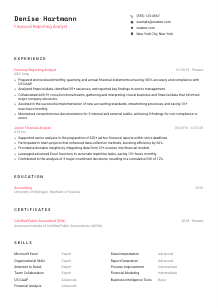
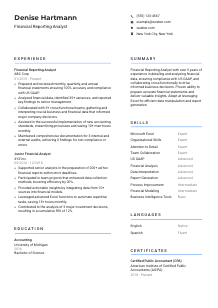
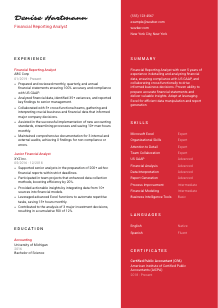
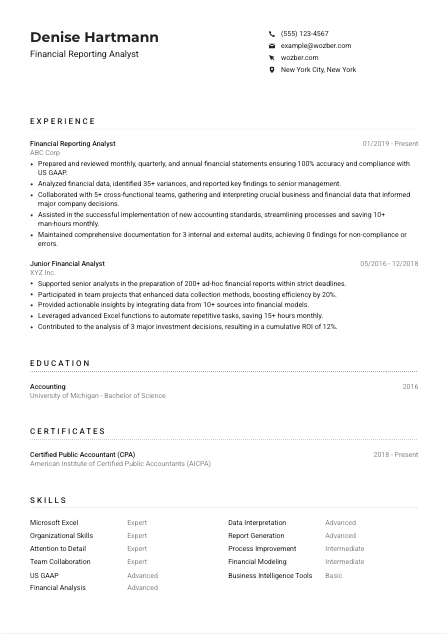
Juggling financial figures, but your CV doesn't add up? Check out this Financial Reporting Analyst CV example, created with Wozber free CV builder. Learn how to align your reporting prowess with job requirements, presenting your fiscal fluency in a way that makes your career graph soar straight to the top!
Financial reporting work leaves little room for vague claims. Hiring teams want to see whether you can close reporting cycles accurately, explain variances clearly, support audits with clean documentation, and work comfortably inside US GAAP requirements. Your CV should make that operating standard visible from the first section onward.
A tailored CV changes how quickly your reporting background comes into focus, especially when finance roles are filtered through ATS terms tied to statements, variance analysis, compliance, and Excel-heavy reporting work. Wozber's free CV builder helps you align your language with the posting and produce an ATS-compliant CV that shows where your experience fits the reporting cadence, control environment, and analytical depth the employer needs.
For financial reporting roles, the contact section is simple but consequential. It should confirm that you are reachable, professionally presented, and, when relevant, already in the required market so the employer can move straight to your reporting experience.
Lead with your full name and use the exact target title directly underneath when it matches your goal. "Financial Reporting Analyst" works well here because it mirrors the posting and immediately anchors your background in financial statements, variance analysis, and reporting support rather than broader finance work.
List a reliable phone number and a professional email address with no casual handles or outdated domains. In a role centered on accuracy, small details matter. A typo in your contact information sends the wrong message before the hiring manager even reaches your reporting accomplishments.
If the posting names a required location, reflect that clearly in this section. Here, "New York City, New York" directly addresses the stated requirement and removes uncertainty about availability. Only do this when location matters to the application, not as filler.
A LinkedIn profile or personal site can help if it reinforces your finance background with matching titles, dates, and credentials. Keep it consistent with your CV, especially around accounting designations, reporting scope, and progression from analyst roles into more ownership over close, review, or audit support work.
Skip details that do not help a finance employer evaluate you, such as full street address, photo, age, or marital status. This section should confirm identity, contact access, and any location requirement, then get out of the way so your reporting experience can do the heavy lifting.
Your personal details should answer the basics in seconds: who you are, what role you are pursuing, how to reach you, and whether you meet any location requirement in the posting. Once that is clear, the reader can focus on your financial reporting track record.




This is the section where finance employers look for proof that you can handle recurring reporting deadlines, review financial data carefully, and communicate issues that affect the close or the statements. Strong bullets show scope, accuracy, tools, and business impact, not just a list of tasks.
Pull the main responsibilities from the posting and match them to work you have actually done. For this role, that means financial statement preparation, variance analysis, audit documentation, collaboration across departments, and support for accounting standard changes. The sample CV does this well by reflecting monthly, quarterly, and annual reporting work instead of describing finance work in broad terms.
For every role, include job title, employer, and dates in a consistent format. Clear structure matters in finance hiring because readers often scan quickly for progression, stability, and time spent in reporting or adjacent analysis roles before reading the bullets in detail.
Replace generic duty statements with outcomes tied to reporting quality, speed, or insight. A bullet such as "Analysed financial data, identified 35+ variances, and reported key findings to senior management" works because it shows analytical judgment and communication, both central to this profession. Use the same approach for close support, reconciliations, audit prep, or reporting automation.
Use numbers that belong naturally in finance: reporting frequency, number of variances identified, hours saved through Excel automation, audit results, number of teams supported, or volume of reports delivered. In the example, "0 findings for non-compliance or errors" is especially strong because it ties documentation quality to an audit outcome that hiring managers immediately understand.
If you have done budgeting, modeling, or ad hoc analysis, keep the bullets that support the target role and trim the rest. A Financial Reporting Analyst CV should emphasize statement preparation, GAAP compliance, close-cycle analysis, documentation discipline, and process improvement before broader finance work. Relevance matters more than trying to include everything you have ever handled.
By the time someone finishes this section, they should understand the reporting environments you have worked in, the cadence you supported, and the quality of your analysis and documentation. That is what separates a finance CV from a real financial reporting CV.
Financial reporting positions usually start with a straightforward academic filter. Hiring managers want to confirm that your degree supports the accounting or finance foundation needed for statement preparation, compliance work, and analytical review.
If you hold a degree in Accounting, Finance, or a related field, make that easy to find. This posting asks for a bachelor's degree in one of those areas, and the example CV meets it with a Bachelor of Science in Accounting. When your field matches the requirement, do not bury it.
List degree, field of study, school, and graduation year or date in a clean order. Finance employers do not need decorative formatting here. They need quick confirmation that your academic background supports reporting, reconciliation, and compliance work.
If your title is broad, such as Bachelor of Science, make sure the field is prominent enough to read at a glance. "Accounting" or "Finance" carries screening value for this kind of role because it points to formal grounding in financial statements, controls, and reporting principles.
Early-career candidates can include relevant coursework such as intermediate accounting, financial statement analysis, or auditing if it helps explain readiness for the role. Once you have several years of reporting experience, keep education tighter unless honors, scholarships, or academic distinctions are especially relevant.
Additional training can help if it sharpens your reporting profile, such as coursework in GAAP updates, SEC reporting, internal controls, or advanced Excel. This is especially useful when your degree is related but not directly in accounting or finance.
Your education section should quickly confirm that you have the technical foundation for financial reporting work. If the degree aligns well and the format is clean, the reader can move on to the experience and credentials that carry more weight at this level.
In financial reporting, certifications can add real weight because they point to technical discipline and a deeper command of accounting or financial analysis standards. They are especially useful when the employer lists them as preferred rather than required.
When a job mentions CPA or CFA, place those certifications at the top if you hold them. For this opening, either credential supports your candidacy, though a CPA often has especially strong relevance for GAAP-based reporting, close review, and audit-facing work.
Do not pad this section with every short course or webinar. Prioritise credentials that reinforce accounting knowledge, reporting judgment, compliance awareness, or financial analysis depth. A shorter list with clear relevance reads better than a crowded one.
Add earned dates or active date ranges when that helps show that the credential is current. The sample CV does this well with ongoing CPA and CFA listings, which quickly communicate active professional development and maintained qualifications.
Financial reporting changes with new standards, regulatory expectations, and internal control requirements. If you earn a major designation or complete substantial reporting-related training, add it promptly so your CV reflects your current level of professional readiness.
A well-chosen certifications section tells employers that your reporting knowledge is backed by formal professional standards. For accounting-heavy environments, that added credibility can matter quickly.
This section should read like the toolkit behind your reporting output. The best Financial Reporting Analyst skill lists combine technical reporting capability with the analysis, organisation, and collaboration needed to close accurately and explain what the numbers mean.
Start with the skills the employer explicitly values, then add closely related strengths you genuinely use. For this job, that includes Microsoft Excel, analytical ability, organisation, attention to detail, and English proficiency, along with finance-specific capabilities such as US GAAP and financial analysis.
Include hard skills tied to the work itself, such as financial statement preparation, variance analysis, audit documentation, Excel functions, reporting tools, or US GAAP knowledge. Then support them with operational strengths like cross-functional collaboration and detail control, which matter when gathering data from multiple teams and closing under deadline.
Put the most important reporting skills first rather than listing them randomly. In this case, Excel, US GAAP, financial analysis, report generation, and attention to detail deserve early placement because they map closely to the responsibilities in the posting and the achievements shown in the example CV.
A focused skills list helps the employer confirm that your experience is supported by the tools and working habits the role depends on. Every item should connect back to reporting accuracy, analysis quality, or execution during the close.
Financial reporting depends on precise written and verbal communication. Whether you are documenting support for auditors, explaining a variance to management, or coordinating inputs from other teams, language proficiency affects how clearly your analysis lands.
If the posting specifies English, list it first with an honest proficiency level such as "Native" or "Fluent." This role requires strong English, which matters for financial statement commentary, documentation, and management reporting as much as for day-to-day communication.
Additional languages can be valuable in multinational companies, shared-service environments, or teams working across regions. They are rarely the main hiring criterion for financial reporting, but they can strengthen your profile when cross-border communication is part of the business.
Stick to standard labels such as Native, Fluent, Intermediate, or Basic. Finance employers value accuracy, and language claims should be as precise as the rest of the CV.
If another language supported reporting coordination, document translation, or communication with international stakeholders, that context can make the entry more meaningful. Otherwise, a simple list is enough.
Do not overstate your level or turn this into a larger narrative than it needs to be. If English is the only required language, meet that requirement clearly and treat any additional languages as supporting information.
Your languages section should confirm that you can communicate reporting information clearly in the working language of the role. Any additional fluency is a bonus when it supports broader business communication.
The summary should quickly position you within financial reporting, not general finance. In a few lines, show your level, your core reporting strengths, and the type of results or responsibilities you have handled most consistently.
Start with a direct line that names the role and your years of experience, such as "Financial Reporting Analyst with 5+ years of experience." That immediately tells the reader you belong in statement preparation, variance review, and reporting analysis rather than in a broader catch-all finance category.
Choose two or three strengths that align closely with the posting, such as US GAAP compliance, financial statement preparation, variance analysis, audit support, or advanced Excel use. The example summary works because it stays close to these core reporting themes instead of trying to cover every finance skill at once.
A summary becomes more convincing when it hints at results, such as improving reporting efficiency, maintaining high accuracy, or delivering insights that informed management decisions. Keep the detail light here, then support it with full metrics in the experience section.
Weave in the same language the employer uses, including terms like US GAAP, financial statements, variance analysis, process improvements, or audit documentation when they reflect your actual background. This helps with ATS optimisation and makes your experience read as directly aligned with the role.
A sharp summary tells the employer, within a few lines, what kind of reporting professional you are and where your strengths sit. It should make the next sections feel like proof of a clear financial reporting profile, not a search for one.
A Financial Reporting Analyst CV should make accuracy, analytical judgment, reporting cadence, and compliance discipline easy to see. When your sections are aligned with the posting and supported by specific metrics, the employer can quickly understand the level of reporting responsibility you have already handled.
Use Wozber's free CV builder to tighten structure, align wording with the job description, and strengthen ATS optimisation with an ATS-friendly CV format and targeted scanning support. The final result should make one thing clear fast: you can step into the reporting cycle, produce dependable analysis, and support clean financial statements with confidence.




