



Use Wozber and land your dream job
Create CV
No registration required
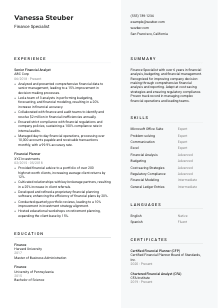
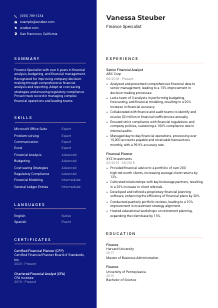
Into digits, but your CV looks bankrupt? Check out this Finance Specialist CV example, created with Wozber free CV builder. It shows how to sharpen your profile to match job expectations, ensuring your career ROI stays in the green!
Finance Specialist hiring usually turns on one practical question: can you translate financial data into decisions the business can act on. A CV for this work needs to show more than general finance exposure. It should make your reporting judgment, forecasting discipline, compliance awareness, and operational accuracy visible in a few quick scans.
The first filter often happens before anyone reads deeply. Finance CVs get sorted by degree match, years in analysis, core tools such as Excel, and evidence of work in budgeting, reporting, and day-to-day financial operations. Wozber's free CV builder helps shape that information into an ATS-compliant CV that reflects the employer's language, so hiring teams can quickly see whether your background supports financial reporting, modeling, and control work at the level they need.
For finance roles, the header is not a decorative section. It confirms basic hiring logistics fast: who you are, how to reach you, and whether you meet any location or title requirements attached to the opening. Keep it clean, accurate, and aligned with the position you are targeting.
Use your full name in the largest text on the page so it anchors the document immediately. In finance hiring, clear formatting matters because the CV is expected to reflect care with detail, the same way a report or reconciliation would.
Place "Finance Specialist" directly under your name when that is the job you are applying for. This removes ambiguity, especially if your recent titles vary, such as Financial Analyst or Financial Planner, but your experience still supports budgeting, forecasting, reporting, and financial operations.
Your contact information should be easy to scan and error-free. Missed digits or an unprofessional email address create unnecessary doubt in a field where accuracy is part of the job.
If the posting requires you to be in San Francisco, California, say so in your header if that applies. When location is a stated condition, meeting it upfront can keep your application from being screened out before your analysis or operations experience is reviewed.
Include LinkedIn or a professional website only if it supports the same story as the CV. For finance candidates, that usually means a complete career history, credentials, and role progression rather than a generic profile with missing dates or inconsistent titles.
Your personal details should clear basic hiring checks without slowing the reader down. If this section is accurate, professional, and aligned to the opening, the employer can move straight to your finance background.




This is the section finance leaders read most closely. They want to see the kind of analysis you handled, the decisions you supported, the controls you maintained, and the scale of the financial activity you managed. Job titles alone are not enough. Your bullets need to show business impact, reporting responsibility, and operational reliability.
Before you edit anything, identify the work that appears repeatedly in the posting. For a Finance Specialist, that often includes financial analysis, performance reporting, budgeting, forecasting, financial modeling, compliance, and oversight of transactions such as accounts payable, accounts receivable, payroll, or general ledger activity. Those recurring themes should guide which bullets stay and which ones get cut.
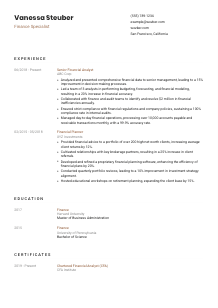
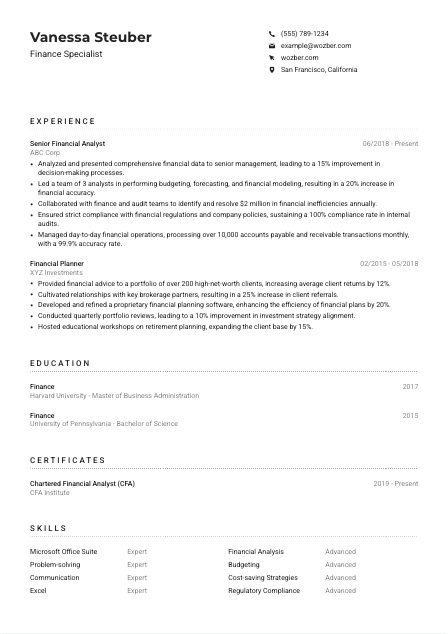
Use reverse chronological order and make sure each entry quickly shows its finance relevance. If your background includes adjacent work, lead with roles that show direct exposure to analysis, reporting, planning cycles, or financial operations. In the example CV, the move from Financial Planner to Senior Financial Analyst works because the more recent role clearly aligns with management reporting and budgeting responsibilities.
Each accomplishment should show what you analysed, built, improved, or controlled, and what happened as a result. Strong finance bullets often connect your work to forecast accuracy, faster reporting, reduced inefficiencies, lower costs, cleaner audits, or better management decisions. The sample does this well with points such as improving decision-making by 15% and increasing financial accuracy by 20%, both of which tie analysis work to outcomes leaders care about.
Quantification matters here because finance work is measured through precision, scale, and outcomes. Include figures tied to budgets, transaction volumes, audit results, variance reduction, savings identified, forecasting accuracy, or turnaround times. A bullet about managing more than 10,000 payable and receivable transactions at 99.9% accuracy tells a hiring manager far more than saying you "handled daily operations."
Prioritise bullets that support the target role, even if other achievements are impressive. For this kind of opening, a line about client growth only helps if it also demonstrates financial planning depth, portfolio analysis, or revenue impact. Keep the focus on work that maps to analysis, controls, reporting, and operational finance so the CV reads as a clear match rather than a broad business profile.
Your experience section should show that you can read the numbers, explain them, and manage the financial processes behind them. When the bullets connect analysis to decisions and operations to accuracy, your fit for a Finance Specialist role becomes much easier to judge.
For finance positions, education is often a straightforward screening point. A degree in Finance, Accounting, or a related field can determine whether the application moves forward, especially when the role combines analysis, reporting, and compliance responsibilities. Present your academic background clearly and keep the most relevant qualification easy to find.
If the posting asks for a Bachelor's degree in Finance, Accounting, or a related discipline, make sure that match is obvious. Do not bury the field of study. In a finance CV, the degree and major often matter more than extra description.
List each education entry in a consistent structure: degree, field, school, and graduation year. Clean presentation matters because it mirrors the organised reporting style expected in finance teams and makes ATS parsing more reliable.
When you have multiple degrees, make sure the one most aligned with the role reads clearly at a glance. A Bachelor of Science in Finance directly addresses the requirement here. An MBA can strengthen the profile further, but it should support, not obscure, the baseline qualification.
If you are early in your career, relevant coursework in financial modeling, corporate finance, accounting, or investment analysis can strengthen this section. If you already have several years of experience, that level of detail is usually less important than your reporting and budgeting work history.
Academic honors, case competitions, finance clubs, or research projects can add value when they reinforce analytical training or leadership. Keep them brief and relevant. The education section should support your candidacy, not compete with the experience section for space.
Education should confirm that you have the finance foundation the role calls for. Once that requirement is easy to verify, the reader can focus on how you have applied that training in real reporting, planning, and operations work.
Certifications can carry real weight in finance, especially when they reinforce analytical depth, planning knowledge, or professional rigor. They are most useful when they relate directly to the work in the posting and when the status is current and easy to understand.
If the employer mentions CFA or CFP as preferred, place those credentials high in this section when you hold them. Matching a preferred certification does not replace experience, but it can strengthen your standing quickly, especially in analysis-heavy or planning-linked finance roles.
Choose certifications that support the type of finance work you want to do. A shorter list of well-matched credentials is stronger than a long list of unrelated courses. In the example, CFA and CFP both reinforce analytical and advisory credibility in ways that connect naturally to the target role.
Include the year earned or the active date range if the credential requires maintenance. Finance employers often look for current professional standing, and clear dates help them understand whether the certification is active, recent, or historical.
If you are working toward a recognized finance credential, you can include that progress when it is honest and specific. This is especially useful when the certification supports work in valuation, planning, compliance, or investment analysis. Just make sure the wording reflects your actual status.
Relevant credentials add another layer of trust to your profile. When they match the finance work in the posting and are presented clearly, they reinforce your technical grounding without distracting from your operating experience.
A Finance Specialist skills section should reflect the real mix of technical ability and business judgment the job requires. Hiring teams look for tools, analytical methods, and communication strengths that support reporting, planning, compliance, and operational accuracy. This section works best when it is curated, not exhaustive.
Review the job description for stated and implied skills. Here that includes financial software, Microsoft Office Suite, Excel, analytical ability, problem-solving, communication, budgeting, forecasting, financial modeling, compliance, and transaction management. Build the section from those signals, not from a generic finance keyword list.
List the skills most central to the role first, especially tools and capabilities named in the posting. Excel deserves prominent placement for many finance jobs because it supports modeling, reconciliations, variance analysis, and reporting workflows. The example CV also benefits from listing financial analysis, budgeting, regulatory compliance, and general ledger work in a visible way.
Resist the urge to include every platform or broad soft skill you have ever used. A tighter list gives the employer a clearer read on your suitability for the work. Choose the skills that support how finance performance is actually judged: accuracy, analysis quality, reporting capability, systems fluency, and communication with stakeholders.
Your skills section should make it easy to see whether you can handle the tools, analysis, and communication the role depends on. When the list mirrors the work itself, it supports both ATS alignment and a more credible read of your background.
Finance work depends on clear communication, whether you are presenting performance results, explaining variances, or coordinating with payroll, audit, or operations teams. If the posting requires English, state that plainly. Additional languages can help, but only when presented honestly and with useful context.
When English is listed as essential, include it clearly with an accurate proficiency level. This matters for finance roles because reports, management updates, and policy communication all depend on precise language.
If you speak additional languages, include them when they could be useful for cross-functional communication, client interaction, or multinational finance activity. In the example, Spanish adds range, though it remains secondary to the required English proficiency.
Terms such as "Native," "Fluent," "Intermediate," and "Basic" are enough. Avoid vague descriptions. Hiring teams need a realistic sense of how well you can write, present, or communicate in a business setting.
Not every finance role needs multilingual capability. Include extra languages because they add practical value, not because the section feels empty. For some employers, especially those dealing with global clients, international reporting, or distributed teams, this can still be a useful differentiator.
Language skills are most valuable when they support clear financial communication. Keep the section factual, and let required proficiency lead the way.
The summary is your quickest chance to define the level and direction of your finance background. It should tell the reader what kind of finance professional you are, how much relevant experience you bring, and which results or specialties make you worth closer review. Keep it compact, but make every line carry role-specific information.
Read the posting closely before drafting the summary. For a Finance Specialist, that usually means emphasizing analysis, reporting, forecasting, budgeting, compliance, and financial operations rather than writing a broad business introduction.
Open with your title or closest equivalent, your years of experience, and your core finance focus. A line such as "Finance Specialist with 6+ years in financial analysis, budgeting, and financial management" works because it establishes seniority and specialization quickly.
Choose examples that reflect the work the employer needs done. Improvements in management decision-making, gains in forecast accuracy, savings uncovered through inefficiency reviews, or strong audit performance are all more useful than generic claims about being results-driven. The example summary works because it points to decision support, cost-saving strategies, compliance, and complex financial operations.
Aim for 3 to 5 lines. That is enough space to establish your finance focus and strongest supporting proof without repeating the experience section. Short summaries work best when each sentence names a concrete finance capability, business outcome, or operating area.
By the end of the summary, the reader should understand your finance specialty, your level of experience, and the kind of business value you bring. That clarity sets up the rest of the CV to confirm the details.
A Finance Specialist CV works when it makes the financial work itself easy to follow: the analysis you handled, the reports you produced, the forecasts you built, the controls you maintained, and the operational accuracy you delivered. Tailoring each section around those points gives hiring teams a much clearer picture of how you would perform in the role.
Use Wozber's free CV builder to shape that information into an ATS-friendly CV format, strengthen wording with AI-assisted tailoring, and check alignment with an ATS CV scanner before you apply. The final document should make one thing easy to see: you can support sound financial decisions and keep the numbers running accurately.