



Use Wozber and land your dream job
Create CV
No registration required
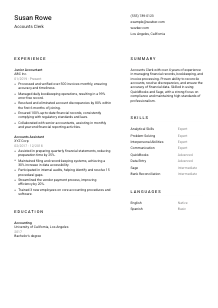
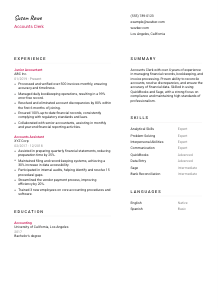
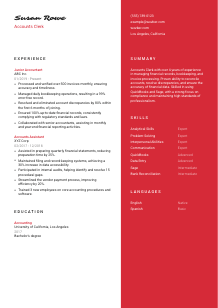
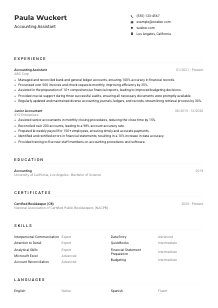
Balancing ledgers, but your CV doesn't tally up? Check out this Accounts Clerk CV example, created with Wozber free CV builder. It shows how to align your numerical dexterity with job prerequisites, making your accounting career report all green!
Accounts Clerk hiring often comes down to one practical question fast: can you keep financial records accurate while handling the daily volume of invoices, reconciliations, data entry, and discrepancy follow-up that keeps the books moving. CVs that stay too general tend to hide the work that matters most here, such as transaction volume, bookkeeping accuracy, software use, and support for month-end reporting.
When your CV is tailored around those accounting workflows, hiring teams can quickly distinguish routine office support from real bookkeeping capability. Wozber's free CV builder helps you shape that experience into an ATS-compliant CV by aligning your wording with the posting's terminology, so tasks like invoice processing, bank reconciliations, and reporting support are easier to recognize at a glance.
For an Accounts Clerk, the header does more than identify you. It establishes basic hiring logistics right away, including role alignment, contact reliability, and, when the posting asks for it, location. Keep this section clean, professional, and directly usable by a recruiter or controller reviewing multiple accounting CVs in one sitting.
Use your full name in the largest text on the page so it is easy to spot in a stack of applications. Clean formatting matters in accounting roles because it reflects the same care you are expected to bring to entries, reconciliations, and record maintenance.
Match your title to the role you are applying for when it accurately reflects your background. If the opening is for an "Accounts Clerk," using that title, or a close match from your recent bookkeeping work, helps both ATS screening and human reviewers place you in the right lane immediately.
Your contact information needs to be complete and error-free. A wrong digit in your phone number creates the same impression as an avoidable mistake in an invoice record.
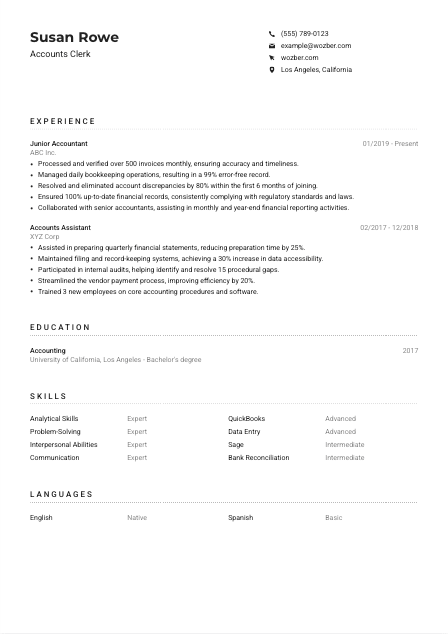
Some Accounts Clerk openings are tied to an office location because the work involves on-site bookkeeping support, vendor paperwork, or coordination with finance staff. In this example, listing Los Angeles, California directly in the header shows you meet that stated requirement without making the employer search for it.
Include LinkedIn or a professional website only if it supports your accounting profile. If your LinkedIn reinforces your bookkeeping history, software experience, and education, it can strengthen consistency across your application.
This section should confirm who you are, how to reach you, and whether you meet any immediate screening requirement such as location. For an Accounts Clerk CV, a tidy header already reinforces the kind of accuracy the role depends on.




This is the section most hiring managers read first for an Accounts Clerk opening. They want to see whether you have handled the rhythm of real accounting operations, from invoice verification to bank reconciliations, discrepancy resolution, and reporting support. Focus less on generic office duties and more on the financial work you owned, the systems you used, and the scale you handled.
Read the job description line by line and map each major duty to something you have already done. For this role, that means showing experience with invoice and purchase order processing, bookkeeping entries, reconciliations, discrepancy follow-up, compliance-minded recordkeeping, and support for month-end or year-end reporting.
List your most recent accounting or bookkeeping position first so reviewers can see your current level of responsibility right away. Include job title, employer, and dates clearly, then let the bullets show how your work progressed from support tasks to broader ownership of financial records or reporting activity.
Each bullet should show what you handled and what happened because you handled it well. The sample CV does this effectively with points such as processing more than 500 invoices monthly and maintaining a 99% error-free record, which tell a hiring manager far more than "responsible for accounts payable tasks."
Quantify work in ways that are natural for finance teams to value. Good measures include invoice volume, reconciliation accuracy, reduction in discrepancies, faster report preparation, audit support, payment-cycle improvements, or compliance consistency. These details make your contribution concrete and credible.
If a bullet does not strengthen your case for handling bookkeeping and transactional accounting, replace it. Prioritise entries that show financial accuracy, software use, cross-checking, reporting support, and issue resolution. Even when you have broader administrative experience, lead with the work that proves you can keep records current and dependable.
A hiring team should be able to scan your experience section and quickly understand your transaction volume, bookkeeping range, software familiarity, and record of accuracy. For an Accounts Clerk, that combination usually carries more weight than broad claims about being organised or detail-oriented.
For many Accounts Clerk openings, education is a straightforward screening point. If the employer asks for a bachelor's degree in Accounting, Finance, or a related field, make that information easy to find and easy to read. There is no need to overcomplicate this section when the requirement is clear.
If you hold a bachelor's degree in Accounting, Finance, or a closely related discipline, list it clearly and without abbreviations that could slow a reviewer down. In the example, a bachelor's degree in Accounting aligns directly with the posting's education requirement.
Include the institution, degree, field of study, and graduation year or date. That is usually enough for an Accounts Clerk CV unless the employer specifically asks for transcripts, GPA, or additional academic detail.
When your degree matches the job requirement, place it prominently and keep unrelated education secondary. If your background is in a related field rather than accounting itself, help the connection by using the official field name as listed by your school.
If you are newer to accounting work, a short mention of relevant coursework such as financial accounting, managerial accounting, payroll, or auditing can help bridge limited experience. Once you have solid bookkeeping or accounting history, professional results matter more than classroom detail.
Short courses in bookkeeping systems, accounting software, payroll, or financial reporting can be useful additions, especially if they support a tool or workflow mentioned in the posting. Keep them concise and directly connected to the job you are targeting.
Education should answer the employer's requirement quickly and without extra interpretation. Once the degree match is clear, the rest of your CV can do the heavier work of proving accounting experience and day-to-day capability.
The skills section should read like the toolkit behind your experience, not a list of generic strengths. For Accounts Clerk roles, that usually means a mix of accounting software, bookkeeping functions, accuracy-focused process skills, and a few people skills that matter when resolving discrepancies or coordinating with vendors and finance staff.
Start with the terms the employer already uses. In this posting, that includes QuickBooks or Sage, analytical and problem-solving skills, communication abilities, bookkeeping operations, invoice processing, and bank reconciliations. These are the clearest clues about what belongs in your skills section.
List software and accounting skills that show how you do the work, not just broad strengths. Good examples for this kind of role include QuickBooks, Sage, data entry, bank reconciliation, invoice verification, account discrepancy resolution, and financial record maintenance. The sample CV handles this well by mixing software knowledge with core bookkeeping tasks.
A shorter, targeted skills section usually performs better than a long inventory. Choose the abilities that support the job's daily workflow and leave out items that do not add to your accounting profile. If communication or interpersonal skills are listed, they should support actual finance work such as vendor follow-up, issue resolution, or coordination during reporting cycles.
Every skill here should connect back to a task the employer needs done accurately and consistently. If your list mirrors the posting and matches the work described in your experience section, it will read as credible to both ATS filters and accounting managers.
Language ability is not the core decision point for most Accounts Clerk roles, but it still matters when the job specifically requires English or when the workplace involves regular communication with vendors, internal departments, or a multilingual customer base. Keep this section factual and proportionate to the role.
If the posting states that English is essential, list it first and use an honest proficiency level such as Native or Fluent. That immediately addresses a stated requirement and removes doubt about your ability to handle written records, email communication, and day-to-day finance coordination.
Additional languages can be useful in accounts environments that interact with diverse vendors, staff, or clients. They are usually secondary for the role, but they can still add value. In the example, Spanish is a useful supporting detail rather than the centerpiece of the application.
Keep proficiency labels simple and accurate. Terms like Native, Fluent, Intermediate, and Basic are easy to understand and set the right expectation if the employer needs phone, email, or in-person communication across languages.
Do not overstate the strategic importance of languages if the actual job is focused on bookkeeping accuracy and financial process support. Include them, but keep the emphasis on accounting qualifications unless multilingual communication is clearly part of the role.
For an Accounts Clerk application, languages should clarify communication ability, not compete with your accounting experience. Lead with English when required, then include additional languages that genuinely add business value.
The summary sits near the top of the CV, so it should immediately establish your level of accounting experience, the bookkeeping work you handle well, and the systems or results that make you relevant for the opening. Avoid broad self-description. Use the space to set up the financial responsibilities you can step into from day one.
Read the posting first, then decide which parts of your background belong in the top summary. For an Accounts Clerk role, that usually means years of accounting or bookkeeping experience, familiarity with invoices and reconciliations, software proficiency, and support for reporting or compliance.
Start with a direct line that places you in the accounting function. A phrase such as "Accounts Clerk with 4+ years of experience in bookkeeping, invoice processing, and financial record maintenance" is stronger than a generic introduction because it names the work immediately.
Use one or two sentences to mention the systems and results that match the posting. The sample summary does this well by referencing QuickBooks, Sage, reconciliations, discrepancy resolution, and accuracy in financial data. That combination tells the reader both how you work and where you add value.
Aim for a short paragraph that can be scanned in seconds. Every phrase should earn its place by clarifying experience level, accounting focus, software familiarity, or measurable strengths. Leave broader detail for the experience section, where you can back it up with metrics and context.
A well-written summary tells the employer right away whether your background fits the opening's day-to-day finance work. When it highlights bookkeeping scope, software use, and accuracy-focused results, the rest of the CV has a clear foundation to build on.
An Accounts Clerk CV works best when it makes the routine financial work visible: invoice handling, reconciliations, bookkeeping accuracy, discrepancy resolution, software use, and support for reporting cycles. If those elements are easy to find, your application already reads closer to how the job is actually performed.
Use Wozber to turn that experience into an ATS-friendly CV format with language that matches the posting naturally and cleanly. The final result should make it easy for a hiring team to see that you can step into the accounting workflow and keep the records right.




