



Use Wozber and land your dream job
Create CV
No registration required
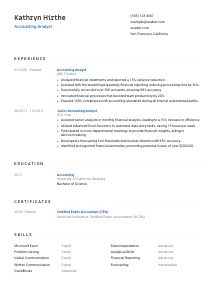
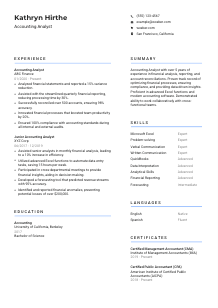
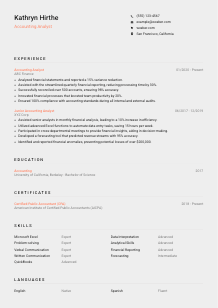
Crunching financial figures, but your CV seems unbalanced? Check out this Accounting Analyst CV example, created with Wozber free CV builder. It shows how to present your analytical acumen to match job expectations, and plot your career in the black, not the red!
Accounting Analyst work gets judged in the details. Hiring teams want to see whether you can read financial statements closely, catch discrepancies before they grow, and keep monthly or quarterly reporting accurate under deadline pressure. Your CV should make that operational reliability visible, not bury it under generic claims about being detail-oriented or analytical.
When the CV is tailored well, the first scan quickly shows where you have handled reconciliations, variance analysis, reporting cycles, audit support, and the Excel or accounting systems behind that work. Wozber's free CV builder helps turn that experience into an ATS-compliant CV by aligning section language and keywords with the posting, so the hiring team can immediately see your accounting scope and reporting discipline.
This section is short, but it still answers a few practical questions right away: who you are, what role you are targeting, and whether any location requirement creates friction. For accounting roles, clean presentation matters because it mirrors the precision expected in financial reporting and reconciliations.
Use your full name as the most prominent text on the page. Keep formatting straightforward and easy to read. An Accounting Analyst CV benefits from the same discipline as a close process review: clear structure, no clutter, and no unnecessary styling competing with the information underneath.
Place "Accounting Analyst" directly under your name if that is the role you are pursuing. Matching the posted title helps position you correctly, especially when your past titles vary slightly, such as "Junior Accounting Analyst" or a broader accounting title with analysis responsibilities.
Your contact information should make follow-up easy and look business-ready.
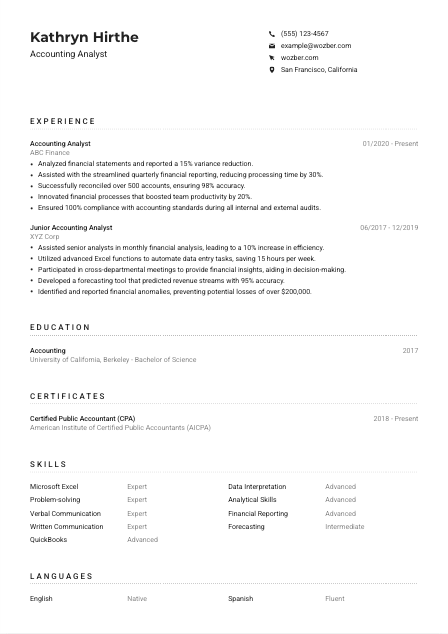
If the job calls for someone based in San Francisco or willing to relocate, state the city and state when applicable. The example CV does this well by listing "San Francisco, California," which removes an avoidable question early in the review. Use this only when location is relevant to the opening you are targeting.
Add LinkedIn or a professional website only if the content supports your CV. That profile should reinforce your accounting background, software familiarity, certifications, and career progression rather than introduce conflicting dates or vague descriptions.
A precise header sets the tone for everything that follows. Keep it clean, complete, and aligned with the role so the reader can move straight into your accounting experience without avoidable questions.




For an Accounting Analyst, the experience section carries most of the hiring weight. This is where you show how you handled close activities, reconciliations, financial reporting, variance review, audit preparation, and process improvement in real business settings. Specific outcomes matter because accounting teams need people who can work accurately at volume and explain what the numbers mean.
Read the posting and mark the work that appears central to the role. In this case, the priorities are financial statement analysis, variance reporting, monthly and quarterly reporting, reconciliations, process improvement, and audit support. Those themes should shape which bullets you lead with and what language you mirror in your own accomplishment statements.
Present each role with the job title, employer, and dates first so the reader can follow your progression through accounting and finance work.
Avoid bullets that only repeat routine tasks such as "responsible for reconciliations." Show scope, accuracy, and business effect instead. The example CV improves this by saying "Successfully reconciled over 500 accounts, ensuring 98% accuracy," which tells the reader both volume and performance. That kind of phrasing works especially well for close support, reporting, forecasting, and anomaly detection.
Numbers strengthen this section when they reflect real accounting outcomes: variance reduction, reporting speed, reconciliation accuracy, hours saved through Excel automation, audit compliance, or losses prevented through anomaly review. A bullet like "reduced quarterly reporting processing time by 30%" says far more than a vague claim about improving efficiency because it ties your work to reporting cadence and team output.
Trim bullets that do not support the target job. For Accounting Analyst roles, the best material usually comes from financial analysis, reporting cycles, account review, controls, compliance, system use, and cross-functional finance support. Leave out unrelated operational tasks unless they directly show analytical judgment or measurable cost impact.
Your experience section should leave no doubt that you can analyse statements, reconcile accounts, support reporting deadlines, and improve financial processes. When those contributions are specific and measured, your CV reads like someone who can step into the accounting team and contribute quickly.
Accounting Analyst roles usually ask for a degree because the work depends on formal grounding in accounting principles, financial analysis, and reporting logic. This section does not need much space, but it should clearly confirm that you meet the baseline academic requirement and support the rest of your accounting profile.
If the posting asks for a bachelor's degree in Accounting, Finance, or a related field, make sure your degree and field are easy to find. A Bachelor of Science in Accounting, like the example CV shows, directly supports roles involving reconciliations, variance analysis, reporting schedules, and audit preparation.
List the degree, field of study, school name, and graduation year in a consistent format. Accounting hiring often involves quick comparisons across applicants, so clean structure helps the reviewer confirm qualifications without searching through extra text.
If your degree is in Accounting, state that clearly. If it is in Finance or a related field, keep the wording accurate and let your experience or coursework reinforce the accounting side of your background. Precision matters here just as it does in financial documentation.
Most experienced candidates can keep this section concise, but coursework can help if you are early in your career or moving from a related finance path into accounting analysis. Subjects such as financial accounting, managerial accounting, auditing, cost accounting, or financial statement analysis are the most useful to highlight.
Honors, strong academic awards, or finance and accounting leadership activities can add value when they support your candidacy. If you have several years of direct accounting experience already, these details matter less than your reporting, reconciliation, and compliance accomplishments.
This section should quickly answer one practical question: do you have the academic foundation for the role? If the answer is obvious at a glance, the reader can move on to the experience that shows how you apply that foundation in practice.
Certifications carry real weight in accounting because they point to technical depth, professional standards, and continued investment in the field. They are especially useful when the job description names a preferred credential, as this one does with the CPA.
Prioritise credentials that connect directly to accounting analysis, reporting, and compliance. A CPA is especially relevant when the role includes audit support, financial statement work, and adherence to accounting standards. The example CV also lists a CMA, which adds strength for roles with a stronger planning, analysis, or management reporting component.
You do not need to include every certificate you have ever completed. Choose the ones that improve your case for this kind of work, especially credentials tied to accounting standards, financial analysis, internal controls, or reporting expertise.
Listing the issuing body and active dates adds helpful context, particularly for recognized credentials such as CPA or CMA. It shows whether the certification is current and gives the hiring team a clearer picture of your professional progression.
Accounting standards, audit expectations, and reporting tools change over time. If you are pursuing or maintaining certifications, that signals continued engagement with the profession. For candidates with similar experience levels, active professional development can help separate one profile from another.
Relevant certifications support the case that you can handle regulated financial work with care. When the posting names a preferred credential, make it visible and current.
The skills section should read like a practical toolkit for the job, not a grab bag of CV keywords. For an Accounting Analyst, that usually means a mix of accounting systems, Excel capability, reporting knowledge, analytical judgment, and communication strong enough to explain findings to finance partners or managers.
Start with the job posting and identify the tools and capabilities tied to day-to-day performance. Here, that includes accounting software, Microsoft Excel, analytical thinking, problem-solving, data interpretation, and communication. Those are worth featuring because they connect directly to reconciliations, variance analysis, reporting support, and process improvement.
Accounting Analysts need more than system knowledge. Alongside hard skills such as Excel, QuickBooks, financial reporting, or forecasting, include communication skills that support explaining variances, resolving discrepancies, and collaborating with finance or audit teams. The example CV handles this balance well by combining software skills with written and verbal communication.
Keep the section focused on the abilities that would actually help you succeed in month-end close, account review, reporting, and compliance work. A shorter, more relevant list usually performs better than a longer one padded with generic skills. If you use Wozber's AI CV builder, it can help surface the skill terms and related phrasing that match the job description most closely.
Every skill listed should connect to a task you can perform or a result you can support. When the section reflects real accounting work, it strengthens both ATS alignment and human review.
Language ability is usually a supporting detail for Accounting Analyst roles, but it can still matter. English proficiency is often required because reporting commentary, audit documentation, reconciliations, and internal communication all depend on precise written and verbal language.
If the job requires English, list it clearly and give it the top position in this section. That quickly confirms you can handle written reporting, cross-functional communication, and the documentation standards common in accounting environments.
Include additional languages after the required one, especially if they could help in multinational reporting teams, shared service environments, vendor communication, or client-facing finance work. In the example CV, Spanish adds breadth without distracting from the core accounting profile.
Choose ratings that accurately reflect how well you can work in that language.
Not every Accounting Analyst position needs multilingual ability, but it can help in companies with international subsidiaries, cross-border reporting, or shared accounting operations. Include extra languages when they add real context to the kind of environment you can work in.
Language skills should support your accounting profile, not distract from it. Keep this section concise and relevant, with the clearest emphasis still on your reporting, reconciliation, and analytical capabilities.
For most accounting roles, this section is straightforward. Confirm the required language first, state your level honestly, and let any additional language skills add context where they genuinely support the work.
The summary sits at the top of the CV, so it should quickly establish the kind of accounting work you do best. For this role, that means experience level, core areas such as financial analysis and reporting, and a few concrete strengths that match the employer's priorities.
Start with your title or professional identity and your years of relevant experience. In the example, "Accounting Analyst with over 5 years of experience in financial analysis, reporting, and account reconciliations" works because it immediately places the candidate in the right lane for the role.
Your next line should highlight the capabilities most relevant to the opening, such as variance analysis, process improvement, compliance, audit support, or data-driven reporting. Choose two or three priorities that reflect the job description instead of trying to summarise your entire career.
Aim for a short paragraph that can be read in seconds. Accounting summaries work best when they use concrete terms like financial reporting, reconciliations, Excel, accounting software, compliance, and process improvement rather than broad statements about being hardworking or results-driven.
A good summary gives the reader a clean lens for the experience section that follows. If the role emphasizes reporting cycles and reconciliations, your summary should prepare the reader to see those strengths echoed in your bullets, skills, and certifications.
A focused summary helps the reviewer understand your value before they reach the first job entry. Keep it close to the posting, grounded in real accounting work, and specific enough to frame the rest of the CV well.
A tailored Accounting Analyst CV should make a few things obvious within one read: you can analyse financial statements, reconcile accounts accurately, support reporting cycles, work comfortably in Excel and accounting systems, and communicate findings clearly. If those points are visible in your summary, experience, skills, and certifications, your CV is doing its job.
Use Wozber to organise that material into an ATS-friendly CV format, align your language with the posting, and strengthen section-by-section ATS optimisation. The finished CV should make it easy for a hiring team to picture you handling the numbers, deadlines, and control work the role requires.