



Use Wozber and land your dream job
Create Resume
No registration required
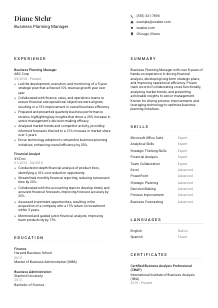
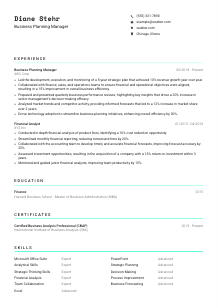
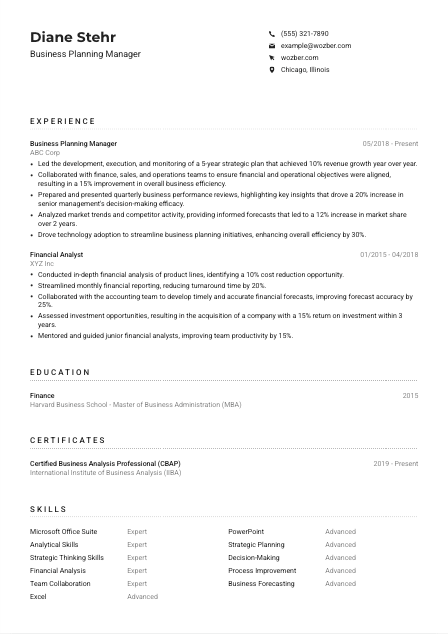
Plotting strategic moves, but your resume isn't mapping it out? Check out this Business Planning Manager resume example, created with Wozber free resume builder. It shows how to align your business acumen and forecasting skills with job criteria, setting your career trajectory on the most lucrative course!
Business Planning Managers sit close to the decisions that shape growth, margins, and resource allocation. Hiring teams look for people who can turn operating data, market movement, and financial assumptions into plans leadership can actually use. Your resume needs to show that you have done that work before, with enough scope and business impact to be trusted with long-range planning and performance reviews.
A tailored resume changes how quickly your planning background reads against the role. When the language reflects strategic planning, financial targets, forecasting, executive presentations, and process improvement, it is easier for both recruiters and ATS filters to connect your experience to the opening. Wozber's free resume builder helps you organize that alignment in an ATS-friendly resume format so the hiring team can quickly see where you drive planning discipline, sharper forecasts, and better business decisions.
This section is simple, but it still carries practical hiring weight. For a Business Planning Manager, clean contact details suggest the same discipline expected in board-ready decks, forecast files, and performance review materials. Keep it direct, professional, and aligned with any explicit requirement in the posting.
Place your full name at the top, then use the exact target title beneath it when it matches your experience. If you are applying for a Business Planning Manager position, naming that role upfront immediately frames the rest of the resume around planning ownership, financial analysis, and strategic execution.
List a reliable phone number and a professional email address in a format that would look appropriate in executive communication. This role often involves presenting to senior management and working across finance, sales, and operations, so even the basics should reflect polish and accuracy.
If the employer specifies a city or relocation requirement, address it here. In the example, listing Chicago, Illinois directly supports the posting's location requirement and removes an avoidable question before anyone gets to your experience.
A LinkedIn profile can strengthen your application if it mirrors the resume and includes planning-focused achievements such as forecast accuracy gains, revenue growth support, or cross-functional planning work. Only include a website if it adds useful professional context, such as publications, presentations, or a business portfolio.
Age, marital status, and similar details do not help hiring teams evaluate your ability to build strategic plans, analyze performance, or present recommendations to leadership. Use the space for information that supports the role instead.
Your contact section should read like the first line of a well-run planning process. Accurate, concise, and aligned with the posting. That sets the right tone for the more substantive proof in the sections that follow.




This is the section most likely to determine whether you move forward. For Business Planning Manager roles, employers want to see who owned planning cycles, improved forecast quality, partnered across functions, and turned analysis into action for leadership. Your bullets should make that operating impact unmistakable.
Read the posting for the work that sits at the center of the role, not just the title. Here, the priorities include long-term strategic planning, financial target setting, cross-functional alignment, business performance reviews, market analysis, and process improvement. Those themes should guide which achievements you choose and how you phrase them.
Start with your most recent role and make each entry easy to scan with company, title, and dates. Under each position, focus on planning responsibilities that show scale, such as owning annual or multi-year plans, supporting leadership reviews, improving reporting cadence, or coordinating inputs from finance, sales, operations, or product teams.
Generic duties like "responsible for planning" do not say enough. Show what changed because of your work. The example does this well by tying strategic planning to 10% year-over-year revenue growth, cross-functional alignment to a 15% efficiency improvement, and market analysis to market-share gains. That kind of framing makes planning work tangible.
This field is naturally measured through growth, efficiency, forecast accuracy, reporting speed, margin improvement, adoption, or decision quality. Use numbers wherever they are real and relevant. A bullet about streamlining monthly reporting or raising forecast accuracy tells far more than a broad statement about analytical skill.
Prioritize bullets that show strategic thinking, financial analysis, executive communication, and business process improvement. If an older role contains useful planning work, keep it. If it leans heavily toward unrelated administrative or operational tasks, trim it so the planning narrative stays clear.
A Business Planning Manager resume should show more than participation. It should show ownership, business judgment, and measurable planning results. When each bullet connects analysis to a decision or outcome, your experience reads at the right level.
Education matters here because the role sits at the intersection of business strategy and financial analysis. Most employers want to see the expected academic foundation quickly, then move on to your planning track record. Present the section cleanly and let relevance do the work.
If the posting calls for a Bachelor's degree in Business, Finance, or a related field, make sure that credential is easy to find. If you also hold an MBA, place it prominently because it supports the strategic and financial depth often associated with planning leadership roles.
List degree, field of study, school, and graduation year in a consistent order. Hiring teams reviewing planning resumes do not need decorative formatting here. They need fast confirmation that you meet the educational baseline.
Business Administration, Finance, Economics, Accounting, and similar fields all support this function. In the example, a Bachelor's in Business Administration and an MBA in Finance reinforce both operational and financial grounding, which matches the role well.
Honors, relevant projects, or finance and strategy case work can help, especially earlier in your career. If you are already several years into FP&A, business planning, or strategic finance work, keep those details brief unless they directly strengthen your candidacy.
For a manager-level planning role, the education section should support your resume, not dominate it. Once you have 5+ years of relevant work, the heavier proof usually belongs in experience, forecasting outcomes, planning ownership, and executive-facing results.
Your education section should confirm that you have the academic base for strategic and financial planning work. After that, let your experience carry the argument.
Certifications are not always mandatory for Business Planning Manager roles, but the right ones can sharpen your profile. They work best when they reinforce the kind of planning, analysis, and business improvement work already visible in your experience.
When a posting mentions certifications such as CBAP or FP&A, list them near the top of this section if you have them. They directly support strengths that matter in business planning, including analytical structure, business requirements thinking, forecasting discipline, and financial interpretation.
Choose certifications tied to planning, analysis, finance, process improvement, or business systems rather than listing every course completion. The example's CBAP and FP&A credentials work because they reinforce both strategic analysis and financial planning depth.
Add the organization and active dates so the credential is easy to validate. This is especially useful for certifications that require maintenance, continuing education, or current standing.
Planning roles increasingly intersect with data tools, process automation, and operating model design. If you pursue newer credentials in analytics, financial modeling, or process improvement, update this section so your resume reflects how the field is changing.
Relevant certifications will not replace real planning results, but they can strengthen how your resume reads, especially when they support forecasting, analysis, and business decision-making at a manager level.
A Business Planning Manager is usually evaluated on a mix of financial skill, strategic thinking, operational understanding, and presentation ability. Your skills section should reflect that mix in the language employers actually use, without turning into a generic keyword list.
Start with the capabilities the employer names clearly. In this case, that includes strategic thinking, financial analysis, Excel, PowerPoint, business planning, and cross-functional collaboration. These are likely to matter in both ATS screening and human review.
Give prominence to skills that support actual deliverables, such as strategic planning, forecasting, business performance analysis, process improvement, financial modeling, and executive presentation development. Broad soft skills can stay, but they should not crowd out the operating tools of the role.
Put the most relevant items first so the section reflects the job's priorities at a glance. In the example, Microsoft Office Suite, analytical skills, strategic thinking, financial analysis, Excel, PowerPoint, and business forecasting all support the responsibilities described in the posting.
This section should confirm that you can build the models, shape the story, and support the decisions the role requires. Keep it focused on planning work people can recognize immediately.
Language requirements are usually straightforward, but they still matter for a role that involves executive reviews, cross-functional meetings, and written planning materials. Present language ability in a way that supports communication credibility, especially if the posting names a required language.
If the role requires English mastery, list English at the top with an accurate proficiency level. That matters here because the job includes presenting business performance reviews and communicating strategic recommendations to senior management.
Additional languages can be useful when the company operates across regions, works with international teams, or values broader stakeholder communication. They are a plus, but they should sit behind the primary language requirement, not compete with it.
Terms like Native, Fluent, Advanced, or Conversational help set realistic expectations. Overstating language ability can create problems quickly in a role that depends on clear reporting, presentation, and executive discussion.
If your planning work has included global markets, regional business reviews, or multilingual stakeholder groups, listing another language can support that story. If not, keep the section simple and accurate.
If you are actively building language skills that support your target market or company footprint, update proficiency levels over time. Keep the resume focused on usable communication ability, not aspiration alone.
For this kind of planning role, language proficiency matters most when it strengthens your ability to present, influence, and coordinate across stakeholders. Keep that connection clear.
The summary sits at the top of the page, so it needs to establish level, specialty, and business value quickly. For a Business Planning Manager, that usually means linking years of experience with planning ownership, analytical depth, and leadership-facing impact in a few tight sentences.
Use the posting to identify the mix you need to convey in your opening lines. Here, that means strategic planning, financial analysis, business reviews, market insight, cross-functional coordination, and process improvement. Those ideas should shape the summary instead of broad leadership language.
Start with your title or closest equivalent, then mention your years of relevant experience. The example summary does this well by establishing more than 8 years in financial analysis, long-term planning, and operational improvement, which immediately positions the candidate at the right level.
Choose strengths that reflect the role and that you can prove elsewhere in the resume. For example, mention leading strategic plans, improving efficiency, strengthening forecasts, or delivering insights to senior management if those claims are backed by measurable bullets below.
Aim for 3 to 5 sentences with clear, role-relevant language. Skip generic adjectives and repeated buzzwords. A concise summary that names planning scope, analytical focus, and business outcomes will land better than a broad paragraph about being results-driven.
Your summary should tell the reader, quickly and credibly, what kind of planning leader you are. If it aligns with the posting and matches the evidence in your experience section, it gives the rest of the resume a strong start.
A Business Planning Manager resume should show how you connect analysis to business direction. That means clear planning ownership, measurable outcomes, strong financial and market insight, and communication that holds up in front of senior leadership.
Use Wozber's free resume builder and ATS resume scanner to align your wording with the job description, strengthen ATS optimization, and present your experience in an ATS-friendly resume template. The finished resume should make it easy to judge your ability to lead planning cycles, improve decision-making, and support long-term business targets.




