



Use Wozber and land your dream job
Create Resume
No registration required
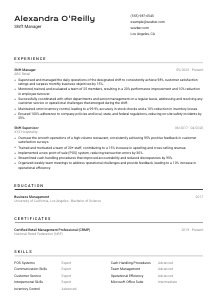
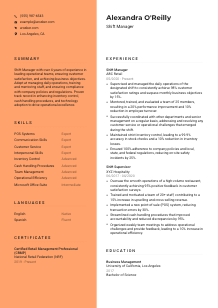
Joystick in hand, but your resume on pause? Navigate this Shift Manager resume example, created with Wozber free resume builder. Learn how to map your leadership skills and staffing savvy to match the job's rhythm, making sure your career growth never hits the "Reset" button.
Shift Managers are hired to keep service steady when the pace picks up, the team needs direction, and small operational mistakes can turn into lost sales, stock issues, or customer complaints. Your resume should make that operational control visible. Show how you run a shift, coach staff, handle cash and inventory accurately, and keep standards consistent across busy trading hours.
When that experience is tailored to the posting, the first review becomes much clearer. Wozber's free resume builder helps you align your language with the job ad and present it in an ATS-friendly resume format, so hiring teams can quickly see whether you've managed the kind of shift performance they need, from customer satisfaction to compliance and team supervision.
For a Shift Manager, the contact section does more than identify you. It should immediately confirm practical basics such as role alignment, professional communication, and, when requested, local availability. Keep it clean, accurate, and easy to scan.
Use your full name as the clearest heading on the page. Keep the formatting simple and professional so the resume opens with the same clarity employers expect from someone running a shift, handling escalations, and communicating instructions to staff.
Place "Shift Manager" directly under your name when that is the role you are pursuing. This helps frame the rest of the resume around supervisory experience, day-to-day operations, and customer-facing leadership instead of leaving your level unclear.
Include a reliable phone number and a professional email address. Accuracy matters here. If an employer wants to schedule an interview quickly for a fast-moving operations role, broken contact details create an avoidable gap. A straightforward email format also supports a professional first impression.
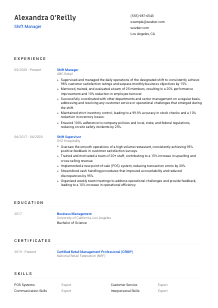
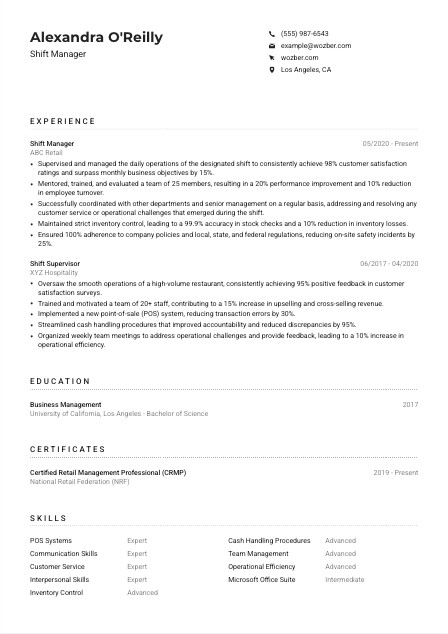
If the employer specifies a city or region, reflect that clearly in your contact details. In the example, listing Los Angeles, CA immediately answers a stated requirement. That kind of detail is worth including when local presence affects scheduling, commute reliability, or eligibility.
A LinkedIn profile or personal website is optional, but it should support the same story as your resume. For a Shift Manager, that might mean reinforcing your supervisory progression, retail or hospitality background, and operational achievements rather than linking to anything unrelated.
This section should confirm who you are, what role you are targeting, and whether you meet any immediate logistical requirements. Make those basics easy to verify from the first lines.




This is where hiring teams look for proof that you can keep operations moving, lead frontline staff, and respond well when service, stock, or staffing issues hit at once. Focus less on duty lists and more on what you improved, controlled, or delivered during each shift.
Read the posting closely and underline the work that defines success in the role. For Shift Manager openings, that often includes supervising daily operations, training team members, resolving customer issues, monitoring inventory, handling cash procedures, and maintaining policy compliance. These are the ideas your bullets should echo in your own words.
Use reverse-chronological order so your latest management or shift-lead experience appears first. That layout helps employers quickly see your current level of responsibility, whether you have been trusted with a team, and how recently you handled retail or hospitality operations.
Each bullet should show what you achieved while performing the work, not just that you were assigned to it. The example does this well by tying supervision to 98% customer satisfaction and business targets exceeded by 15%, and by linking team mentoring to lower turnover. That approach gives your shift leadership real weight.
Metrics matter when they reflect how the operation is actually measured. Customer satisfaction scores, stock accuracy, shrink reduction, sales lift, transaction error reduction, turnover, safety incidents, and efficiency gains all fit naturally on a Shift Manager resume. Choose numbers that show control over service, people, and process.
Prioritize experience that connects to staffing, customer service, cash accountability, inventory control, compliance, and cross-department coordination. Leave out older or unrelated details that do not strengthen your case for managing a live shift environment. Every bullet should point back to operational leadership.
Your experience section should show that you have already managed the pressure points of the job. When the bullets reflect real team scope, measurable results, and day-to-day operational control, employers can picture you on the floor quickly.
Education usually plays a supporting role for Shift Manager positions, but it still helps establish business knowledge, leadership training, and career progression. Present it clearly, especially when the posting lists a degree as preferred.
Start with the educational requirement in the posting. Here, a bachelor's degree in Business Management or a related field is preferred, so candidates who have that background should make it easy to spot without forcing the reader to search for it.
List your degree, field of study, school, and graduation year in a clean structure. Hiring teams reviewing operations candidates are usually moving quickly, so clarity matters more than extra formatting.
If your degree connects directly to management, operations, business, hospitality, or a related area, make that relevance obvious. In the example, a Bachelor of Science in Business Management aligns neatly with the employer's preference and supports the candidate's supervisory background.
Recent graduates can benefit from listing coursework or projects tied to operations, team leadership, service management, or business performance. If you already have several years of shift supervision, that extra detail usually matters less than your work results.
Honors, leadership roles, or relevant extracurriculars can help if they demonstrate initiative, people leadership, or operational responsibility. Keep them only if they support the same management story your resume is already telling.
For most Shift Manager applications, education should confirm useful business grounding and then get out of the way. Keep it concise and clearly tied to the level of responsibility you are pursuing.
Certifications are not always required for Shift Manager roles, but the right one can strengthen your case, especially in retail, hospitality, safety, or supervisory operations. Treat this section as targeted support for your experience, not a catch-all list.
Check whether the role emphasizes retail operations, hospitality service, safety compliance, or people management. Even when no certificate is required, a relevant credential can reinforce your readiness. The CRMP in the example adds useful retail management context because it supports the candidate's store-floor leadership experience.
Choose certifications that strengthen your claim to supervise staff, maintain standards, or manage operations. Broad or unrelated courses add little value compared with credentials tied to service leadership, inventory, compliance, or management training.
Include the issue date or active period when the timing helps. This is especially useful for certifications connected to current procedures, safety practices, or industry standards, because it shows the knowledge is recent enough to apply on the job.
Shift Managers are often promoted based on dependable execution and readiness for broader responsibility. Ongoing certification or renewal can support that story by showing you keep building your management capability alongside hands-on experience.
A well-chosen certificate can sharpen your profile, especially when it matches the operating environment. Keep this section relevant, current, and connected to the kind of shift leadership the employer needs.
A Shift Manager skills section should read like the toolkit behind a successful shift. Include the operational, technical, and people skills that show you can keep service running, support staff performance, and maintain process discipline.
Start with the skills the employer actually names. In this case, inventory control, cash handling, communication, interpersonal ability, POS systems, Microsoft Office, and English communication all appear directly or indirectly in the requirements. Those terms are strong anchors for your own skills section.
Shift Managers need both operational tools and frontline leadership. Pair hard skills such as POS platforms, stock control, cash reconciliation, and reporting with people skills such as coaching, conflict resolution, team supervision, and customer service. That mix reflects the real demands of the job.
Do not overload this section with every capability you have picked up over time. Prioritize the skills most likely to matter during a shift and in ATS screening. A clean list of role-specific skills, especially in an ATS-compliant resume, helps the employer quickly connect your background to the opening.
Your skills section should support the same picture shown in your experience: someone who can manage people, process transactions accurately, control stock, and keep customer service standards steady across the day.
Language ability can matter more than candidates sometimes realize in shift-based environments. Clear communication affects team direction, customer service, training, and escalation handling, especially in busy stores, restaurants, or service locations.
If the job ad specifically calls for English communication, list English prominently with your actual proficiency level. That instantly addresses a stated requirement and reassures the employer that you can lead staff conversations, handle customer issues, and follow operational procedures clearly.
Lead with the language required for the role, then include additional languages that could help in staff coordination or customer interactions. In many customer-facing operations settings, bilingual ability can be a practical advantage during service and training.
List all languages you can genuinely use in a professional setting. For Shift Managers, this can strengthen your profile when the workforce or customer base is diverse, or when the role involves frequent on-the-floor communication.
Use clear labels such as Native, Fluent, Conversational, or Basic. Honest language ratings help employers understand whether you can conduct team huddles, explain procedures, or resolve service issues in that language.
Additional languages are most valuable when they support real work needs such as coaching staff, serving customers, or reducing misunderstandings during busy periods. The example's English and Spanish combination is a strong illustration for a customer-facing market, though the exact language mix will vary by employer and location.
For a Shift Manager, language skills are useful when they improve communication on the floor. Present them clearly so employers can see where they may strengthen service, supervision, or team coordination.
The summary sets the tone for the rest of the resume. For a Shift Manager, it should quickly establish your experience level, operating environment, and the results you are trusted to deliver during a live shift.
Before writing, identify the few themes that matter most for the opening. For many Shift Manager roles, that means day-to-day operations, team supervision, customer satisfaction, inventory or cash control, and compliance with procedures. Use those priorities to shape the summary instead of writing a generic management profile.
Start with a direct introduction that names your role and your years of relevant experience. This immediately places you in the right lane. In the example, "Shift Manager with over 4 years of experience" works because it establishes both title alignment and tenure in one line.
Mention the areas where you consistently deliver, such as training teams, improving customer satisfaction, tightening inventory accuracy, or streamlining cash procedures. Keep the claims grounded in the type of results your experience section can support.
Aim for a short paragraph that can be read in seconds. Three to five lines is usually enough to show your management scope, operating strengths, and value to the business without repeating every detail that appears later in the resume.
A well-written summary should make the rest of the resume easier to read. By the time someone reaches your experience section, they should already understand that you lead shifts, manage people well, and keep daily operations under control.
A Shift Manager resume works when it shows calm control in a fast-moving environment. If your sections clearly reflect team supervision, customer service results, inventory and cash accuracy, and compliance with procedures, you are presenting the kind of background employers look for on the floor.
Use Wozber's free resume builder to sharpen that alignment, organize your content in an ATS-friendly resume template, and check role-specific language with the ATS resume scanner. The finished resume should make one thing easy to judge: whether you can step into a shift, lead the team, and keep operations running smoothly.