



Use Wozber and land your dream job
Create Resume
No registration required
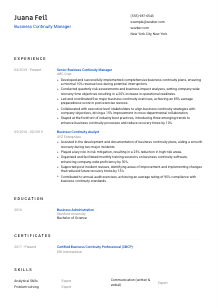
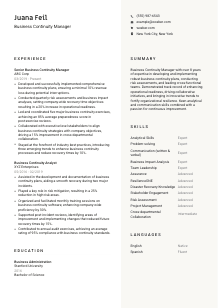
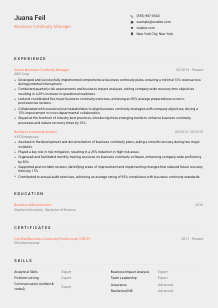
Navigating crises but your resume feels stranded? Check out this Business Continuity Manager resume example, built with Wozber free resume builder. It shows how to align your continuity expertise with job demands and chart a professional course that stays resilient through any business storm!
Business continuity hiring tends to move quickly past generic operations language. Teams want to see whether you can turn disruption risk into practical recovery plans, set realistic recovery objectives, and keep critical functions running when incidents hit. Your resume needs to make that operational judgment easy by showing planning depth, cross-functional coordination, and measurable continuity outcomes.
A tailored resume helps separate broad risk or compliance experience from hands-on continuity leadership. Using Wozber's free resume builder to align your wording with the posting and keep an ATS-compliant resume structure makes it easier to surface terms like business impact analysis, recovery time objectives, exercises, and post-incident improvement work. That gives hiring teams a faster read on whether you can build and maintain a continuity program that holds up under pressure.
This section does more than identify you. For a Business Continuity Manager, it also removes basic friction early, especially when the employer has location or communication requirements tied to incident response, stakeholder coordination, or on-site planning sessions.
Use your full name in a clean, readable format at the top of the page. Keep it more prominent than the body text so the resume is easy to reference during interview scheduling, panel reviews, and internal circulation.
Place "Business Continuity Manager" directly under your name when that matches the role you are pursuing. This immediately frames your background around continuity planning, recovery governance, and resilience work rather than leaving you to be interpreted as a broader risk, compliance, or operations candidate.
List a phone number you answer reliably and a professional email address. Business continuity roles often involve multiple interview rounds with HR, operations leaders, and risk stakeholders, so any typo or outdated contact detail can slow down an otherwise well-matched application.
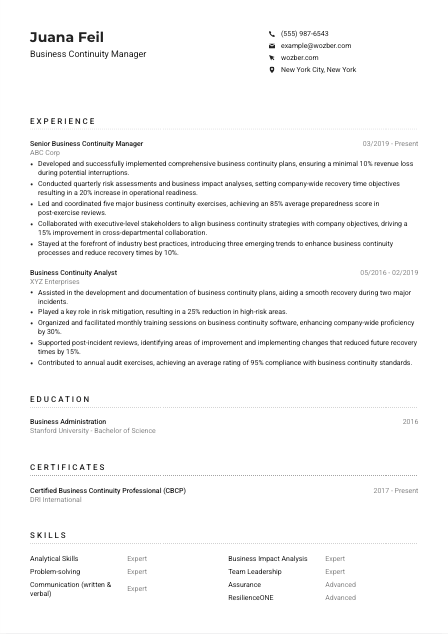
If the posting specifies a location, include it clearly. In the example, listing "New York City, New York" directly supports a stated requirement. Treat this as a tailoring choice based on the job ad, not a rule for every Business Continuity Manager resume.
Include a LinkedIn profile or professional website if it reinforces your continuity background with certifications, project scope, or related leadership experience. Make sure the information matches your resume, especially titles, dates, and credentials tied to resilience or disaster recovery work.
When your personal details are accurate, professional, and aligned with the posting, the reader can move straight to your continuity experience instead of pausing on avoidable questions.




This is the section hiring teams read most closely for continuity roles. They want proof that you have built plans, run analyses, led exercises, worked across departments, and improved readiness in ways that affected recovery performance or operational resilience.
Read the job description and mark the continuity tasks that appear repeatedly. For this role, that includes developing business continuity plans, running risk assessments and business impact analyses, defining RTOs and RPOs, leading exercises, and refining processes through post-exercise review. Those themes should shape which bullets you keep and which you cut.
List roles in reverse chronological order and keep the structure consistent with title, company, and dates. A progression from analyst work into program ownership or senior continuity leadership helps employers see that you have moved from supporting documentation and reviews into directing continuity strategy and readiness efforts.
Each bullet should show what changed because of your work. Instead of stopping at "responsible for business continuity planning," show what you built, how broadly it applied, and what result followed. The sample resume does this well by tying plan implementation to limited revenue loss and exercise leadership to preparedness scores.
Business continuity resumes benefit from numbers that reflect resilience performance. Include measures such as preparedness scores, reduction in recovery time, audit compliance rates, risk reduction, percentage improvement in operational readiness, number of exercises led, or scope of business units covered. These metrics make your planning work feel operational, not theoretical.
Trim bullets that do not support the target role. If you are applying for a manager position, keep experience that shows continuity plan development, BIA facilitation, stakeholder alignment, testing cadence, audit support, policy improvement, and incident review. Older bullets can stay if they show relevant foundations, but they should not crowd out recent leadership-level work.
The strongest experience section shows that you have done the core work of business continuity management and improved resilience in measurable ways. That is what moves you beyond a generic operations profile.
Education matters here because many continuity roles still use it as a baseline screen, especially when the posting names a business, IT, or related degree. Present it clearly, then let your experience and certifications carry the deeper proof of capability.
Check the posting for the exact academic requirement and mirror it when you meet it. Here, a bachelor's degree in Business Administration, IT, or a related field is requested, so a degree such as Business Administration should be easy to spot on the page.
List degree, field of study, school, and graduation year. That is usually enough for a mid-career Business Continuity Manager and keeps the section easy to scan alongside your experience, certifications, and software knowledge.
If your degree directly supports the role, name the field in full. "Bachelor of Science in Business Administration" is more useful than a shortened or vague entry because it connects clearly to the requirement and to the operational, planning, and governance aspects of continuity work.
Most experienced candidates do not need to list courses, but it can help if your degree title is broader or less obviously related. Subjects such as risk management, information systems, crisis management, or organizational planning can strengthen relevance without overloading the section.
Honors, research, or extra training belong here only if they reinforce your fit for continuity, resilience, or risk-focused work. Keep the emphasis on details that help explain your foundation for program planning, analysis, or cross-functional decision-making.
This section should quickly confirm that you meet the stated academic requirement, then stay out of the way while your continuity achievements and credentials do the heavier lifting.
For business continuity roles, certifications often carry real weight because they show formal grounding in continuity frameworks, planning discipline, and current professional practice. If a posting asks for a specific credential, make it unmistakable.
Place directly relevant certifications first, especially when the employer calls them out. In this case, CBCP appears in the requirements, so it should not be buried under unrelated training. That quick alignment matters in both recruiter review and ATS matching.
Choose certifications that support continuity planning, disaster recovery, operational resilience, or risk management. A short, relevant list is stronger than a long inventory of general professional development items that do not change the hiring decision.
Include the issuing body and the active or renewal period when relevant. For credentials that remain current through ongoing maintenance, a date range such as "2017 - Present" quickly tells the employer the certification is active and not historical only.
Continuity work changes with cyber risk, third-party dependencies, regulatory expectations, and resilience tooling. Additional training in exercise design, crisis management, incident response, or continuity software can strengthen your profile when it supports the level of role you are targeting.
Well-chosen credentials show that your continuity practice is backed by recognized standards, not just informal exposure. For a manager role, that added professional grounding matters.
A Business Continuity Manager skills section should read like the operating toolkit behind your experience. Focus on capabilities that support planning, analysis, testing, stakeholder coordination, and continuity technology rather than broad workplace traits alone.
Start with the posting and extract the tools and capabilities tied to the job itself. Here, that includes business continuity software, risk assessment, business impact analysis, communication, analytical problem-solving, and collaboration across departments. Those terms belong in your skills section if they reflect your actual experience.
Balance platform knowledge with continuity methods and management strengths. For example, software such as Assurance or ResilienceONE sits well alongside business impact analysis, disaster recovery knowledge, stakeholder engagement, and exercise leadership. That combination reflects how continuity work is actually delivered.
Put the most decision-relevant skills near the top. For a manager resume, continuity planning, BIA, risk assessment, crisis coordination, continuity software, and executive communication typically deserve more space than broad terms that could apply to almost any role.
Your skills list should confirm that you know the frameworks, tools, and coordination work behind a continuity program. Keep it specific enough that a hiring team can picture you running the function.
Language requirements are usually straightforward, but they still matter in continuity roles where documentation, incident communication, and stakeholder briefings need to be accurate. Present language ability in a way that supports how the work is actually done.
If the posting specifies a language requirement, list it clearly and use an honest proficiency level. In this example, high proficiency in English is mandatory, so English should appear first and be described precisely.
Order languages by relevance to the role, company footprint, and communication needs. If the business operates across regions or serves multilingual teams, additional languages can add value, but the required language should always remain most visible.
Extra languages can strengthen your profile when continuity work involves global teams, external vendors, or regional recovery coordination. A second language such as Spanish may be useful, especially in organizations with diverse operating environments, but it should complement rather than distract from core qualifications.
Choose straightforward ratings such as Native, Fluent, Advanced, or Conversational. Avoid vague wording. In continuity roles, interviewers may assume you can write incident communications or lead planning discussions in any language you claim.
If multilingual ability has helped you lead training, coordinate recovery activity, or communicate across business units, that context can also appear in your experience section. The language section itself should stay concise and factual.
List languages in a way that supports the communication demands of the role. Accuracy matters more than breadth, especially when continuity decisions depend on clear documentation and calm stakeholder communication.
For a Business Continuity Manager, the summary should quickly establish your level, your continuity scope, and the kind of resilience outcomes you have delivered. This is where you frame the rest of the resume before the reader gets into the detail.
Use the job description to identify the central work the employer needs done, then reflect that focus in your opening lines. If the role emphasizes plan development, BIA, exercises, and cross-functional strategy, those themes should appear before broader leadership language.
Start with a direct introduction such as your target title and total years in business continuity, disaster recovery, or risk management. A line like "Business Continuity Manager with 8+ years of experience" gives immediate context and helps the reader place your seniority fast.
Follow with specific strengths that match the role, such as implementing continuity plans, improving readiness, setting recovery objectives, leading exercises, or partnering with executives on resilience strategy. The sample summary is effective because it combines program work, measurable improvement, and collaboration without turning into a list.
Aim for a short paragraph of about three to five lines. Skip soft claims that are already implied elsewhere and use the space for continuity-specific information, tools, or outcomes that give hiring teams a reason to read your experience section closely.
A focused summary tells the reader, in a few lines, that your background is built around continuity planning, resilience improvement, and cross-functional execution. That context should carry cleanly into the rest of the resume.
A Business Continuity Manager resume works best when every section points back to real resilience work: plans built, risks assessed, exercises led, recovery targets defined, and readiness improved. Keep your language close to the posting, especially around business impact analysis, continuity software, disaster recovery, and cross-functional coordination.
Wozber's AI resume builder can help you tighten that alignment, surface missing requirements, and refine your wording into an ATS-friendly resume format that stays easy to scan. Use the ATS resume scanner to check how well your experience, certifications, and skills match the target role, then revise until the resume clearly shows you can lead continuity planning with confidence and operational discipline.




