



Use Wozber and land your dream job
Create Resume
No registration required
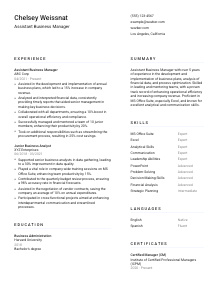
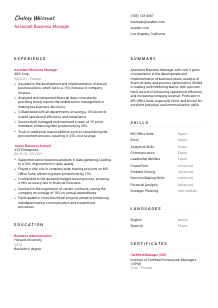
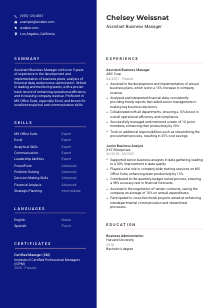
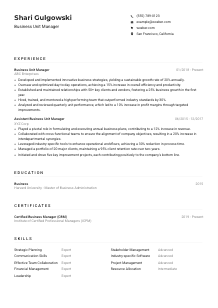
Coordinating company affairs, but your resume feels like a disorganized merger? Check out this Assistant Business Manager resume example, created with Wozber free resume builder. It shows how to highlight your operational flair and fiscal acumen to match job specifications, turning your profile into a corporate success story!
Assistant Business Managers sit close to the numbers and close to the day-to-day operation. Hiring teams want to see someone who can help turn business plans into workable actions, keep reporting accurate, support cross-functional coordination, and step in when the Business Manager needs another reliable decision-maker. Your resume should make that operating range visible, not bury it under vague management language.
A tailored resume quickly separates business support experience from true business management support. When your bullets reflect the posting's language around budgeting, financial reporting, operational efficiency, and team guidance, Wozber's free resume builder helps shape that into an ATS-compliant resume that reads clearly to both screening systems and hiring managers looking for someone who can contribute from day one.
This section should confirm that you are easy to contact and already aligned with the basic logistics of the role. For an Assistant Business Manager, that means presenting your professional identity cleanly and, when the posting asks for it, removing obvious friction such as location mismatch.
Use your full name in the most visible text on the page. Keep the styling clean and professional so it reads like the header of a business document, not a design exercise. Assistant Business Manager roles are built around accuracy and judgment, and your formatting should reflect that standard.
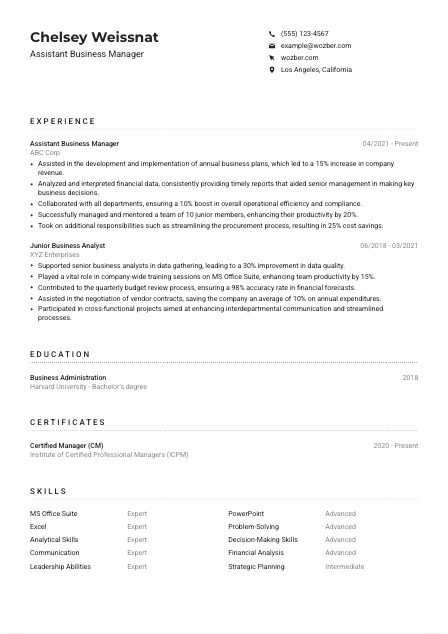
Place "Assistant Business Manager" directly beneath your name if that is the role you are pursuing. This instantly frames your background around budget support, reporting, operations, and team coordination. In the example resume, using the exact title helps connect prior experience to the opening without making the reader infer your direction.
List a reliable phone number and a professional email address. Double-check both. Administrative and managerial support roles depend on precision, so even small errors here can create doubt about your attention to detail. If you include a website or LinkedIn profile, make sure it supports your business background and is current.
If a posting specifies a location requirement, include your city and state clearly. Here, Los Angeles, California is a stated requirement, so showing it in your header immediately removes a basic screening barrier. Treat location as a tailoring move for that opening, not a universal rule for every Assistant Business Manager application.
A LinkedIn profile can reinforce your resume when it shows the same titles, dates, and business-focused accomplishments. If it includes endorsements or additional project detail around budgeting, reporting, vendor coordination, or team supervision, it can strengthen your profile. Leave it out if it is outdated or inconsistent.
Your personal details should tell a hiring manager that the basics are in order: who you are, how to reach you, and whether you meet any practical requirement such as location. Keep it tight, accurate, and businesslike.




Assistant Business Manager hiring is heavily driven by proof of execution. Employers want to see where you supported planning, handled financial information, improved operations, and helped people work more effectively, especially when those contributions show measurable business results.
Read the job description line by line and identify the work themes that matter most. In this case, those include business plans, budgets, financial reporting, operational efficiency, compliance, and mentoring junior staff. Build your experience section around those themes so the reader sees direct overlap instead of a generic management profile.
Start with your most recent role and work backward. For each job, include title, company, and dates in a format that is easy to scan. That simple structure matters in business-facing roles because it lets the reviewer quickly track progression from analyst or coordinator work into broader operational and managerial support.
Each bullet should show a responsibility plus the result it produced. For Assistant Business Manager roles, that often means revenue growth, forecast accuracy, cost reduction, reporting cadence, process efficiency, or team productivity. The example resume does this well with outcomes such as a 15% revenue increase, a 10% efficiency gain, and 25% procurement cost savings.
Numbers matter here because much of the role touches budgets, reporting, and performance tracking. Use metrics that fit the work you actually did, such as savings achieved, forecast accuracy, turnaround time for reports, efficiency improvements, or team output. Even one well-chosen figure makes a bullet more credible than broad claims about leadership or strategy.
Prioritize positions and bullets that support your case for this kind of work. Experience in financial analysis, departmental coordination, process improvement, executive reporting, or supervising junior staff carries more weight than unrelated tasks. If earlier roles are less directly connected, trim them to the parts that show business judgment, analytical work, or operational support.
Your experience section should read like a record of business support that produced real results. When the bullets show planning, reporting, operational follow-through, and measurable improvement, the move into an Assistant Business Manager role feels credible.
Education matters here because the role sits at the intersection of business operations and financial judgment. A degree in business, finance, or a related field supports the analytical and planning side of the job, especially when the posting explicitly asks for it.
If you have a bachelor's degree in Business Administration, Finance, or a closely related field, make that easy to find. This posting asks for exactly that background, so the degree should be stated clearly without forcing the reader to interpret abbreviations or hunt for relevance.
List your degree, field of study, school, and graduation year. Straightforward formatting works best because this section is usually reviewed quickly as a qualification check before attention returns to your business experience and reporting scope.
When your degree lines up directly with the role, say so through clear wording. The sample resume's "Bachelor's degree" in "Business Administration" is a clean match for the requirement and strengthens the case for readiness in budgeting, planning, and operational analysis.
If you are early in your career, relevant coursework can help, especially subjects like accounting, corporate finance, operations management, business analytics, or strategic planning. Once you have several years of directly relevant experience, coursework usually becomes secondary unless it fills a clear gap.
Honors, leadership roles, or relevant student projects can be useful if they connect to business analysis, financial modeling, presentations, or team leadership. Keep them if they strengthen your case. Leave them out if your work history already provides stronger proof.
For this role, education works best as a clear qualification check. Show the degree, show the field, and make it easy to confirm that your academic background supports business planning, financial analysis, and operational work.
Certifications are not always required for Assistant Business Manager positions, but they can add weight when they reinforce leadership, finance, operations, or process improvement. The key is relevance, not volume.
Start with the job ad. If no certification is required, do not treat this section as mandatory proof. Use it to strengthen your profile with credentials that support managerial judgment, financial oversight, or business operations. The Certified Manager credential in the example is one such fit.
Choose certifications that connect to the actual work, such as management, project coordination, financial analysis, compliance, or operational improvement. A short list of well-matched credentials is far more persuasive than a long list of unrelated course completions.
Add the issue date and, if relevant, the active period or expiration date. That helps the employer see whether the credential is current, which matters more when the certification relates to active management practice or regulatory knowledge.
Assistant Business Managers often grow into larger operational or financial leadership roles, so current learning matters. If you are building toward stronger budgeting, reporting, or supervisory scope, certificates can show that progression in a practical way.
A certificate section should reinforce the kind of business responsibility you are ready to handle. Keep it focused on credentials that support management, analysis, operations, or leadership.
The skills section should mirror how the job is actually performed. For an Assistant Business Manager, that usually means a blend of analytical tools, financial and operational capabilities, and people-facing strengths needed to coordinate across departments and support senior leadership.
Start with the language in the posting. Here that includes MS Office Suite, especially Excel and PowerPoint, along with analytical, problem-solving, decision-making, communication, and leadership abilities. These are not filler keywords. They reflect the day-to-day work of reporting, presenting findings, coordinating teams, and supporting business decisions.
List the skills most central to the role first. If reporting and analysis are major parts of the job, Excel, financial analysis, budgeting, and data interpretation should appear high on the list. If the role also includes mentoring staff, leadership and communication belong near the top as well. The example resume balances both tool-based and managerial strengths effectively.
Do not overload this section with every skill you have ever used. Focus on capabilities that map to business plans, budgets, reporting, operational efficiency, compliance, and team support. Specific entries like "Financial Analysis" or "Strategic Planning" say much more than broad labels like "Business" or "Office Work."
This section should make your working toolkit obvious at a glance. When the list reflects the real demands of the role, from Excel-based analysis to communication with cross-functional teams, it supports everything claimed elsewhere in the resume.
Language ability matters when the role depends on clear reporting, team guidance, and communication with managers or clients. In many Assistant Business Manager openings, English proficiency is essential because financial updates, presentations, and operational instructions need to be precise.
If the posting names a required language, list it first and state your level clearly. Here, English fluency is mandatory, so it should be visible without the reader having to search for it. "Native" or "Fluent" both work when they are accurate.
Use straightforward labels such as Native, Fluent, Advanced, or Conversational. Business-facing roles depend on clear communication, so vague descriptions can create uncertainty, especially when the work includes presentations, reporting, and collaboration across departments.
Additional languages can strengthen your profile, particularly in organizations that serve diverse teams, vendors, or customers. In a market like Los Angeles, a second language such as Spanish may be an advantage, though it should be presented as an added asset rather than assumed requirement unless the employer states otherwise.
Do not overstate what you can do. If a role includes explaining budget updates, preparing presentations, or mentoring staff, weak language skills become visible quickly. Honest proficiency labels help avoid mismatched expectations.
If the position involves cross-regional coordination, customer-facing operations, or support for multilingual teams, language skills can make your resume more versatile. Keep the emphasis on business usefulness, not just on listing languages for their own sake.
For an Assistant Business Manager, language skills are most useful when they strengthen communication in reporting, operations, and team support. Lead with the required language, then add others that broaden your effectiveness.
Your summary should quickly establish the scale and type of business support work you have handled. In a few lines, it should connect your experience to planning, reporting, operational improvement, and team coordination so the reader immediately understands your level.
Before writing, identify the main threads of the job. For this role, that means supporting business plans, analyzing financial data, improving operations, and guiding junior staff. Those themes should shape the summary so it reads like a match for the position rather than a generic business profile.
Start with a direct introduction such as "Assistant Business Manager with 5+ years of experience" if that is accurate. This quickly sets your level and anchors the rest of the paragraph. The sample summary does this well by combining title, years of experience, and core functional areas in the first sentence.
Follow with the kinds of strengths that matter in the work itself: budgeting support, financial reporting, process improvement, cross-functional coordination, or mentoring junior staff. If you have measurable results, fold in one concise outcome such as revenue growth, cost savings, or efficiency gains to make the summary more concrete.
Aim for a short paragraph, not a biography. Every phrase should earn its place by connecting to the target role. A concise summary with real business language is far more effective than a broad statement about being motivated, strategic, and results-driven.
A well-written summary tells the reader, within seconds, that you understand the business side of the role and have already contributed in similar ways. It should frame the rest of the resume around planning support, sound analysis, and operational follow-through.
Your resume should now show the business mechanics behind your work: how you supported planning, handled financial reporting, improved operations, and helped teams perform better. That is the combination employers are trying to identify when they hire an Assistant Business Manager.
Before you apply, run a final tailoring pass against the posting. Wozber's free resume builder and ATS resume scanner can help you tighten wording, surface missing requirements, and present everything in an ATS-friendly resume format that makes your relevant experience easy to read. The finished resume should make one point clear fast: you can support the business manager with sound analysis, dependable coordination, and measurable operational results.




