




Use Wozber and land your dream job
Create Resume
No registration required
Orchestrating operations, but your resume seems out of sync? Sync up with this Business Operations Manager resume example, created with Wozber free resume builder. Learn how to present your managerial prowess so it matches job requisites, leading your career in perfect time with organizational success.
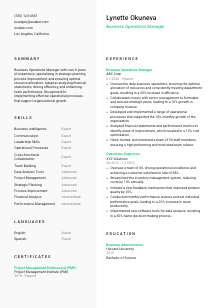
Business Operations Managers are hired to keep execution steady while improving how the business runs. That usually means balancing process design, resource allocation, performance reporting, and people management without losing sight of revenue, cost, or growth targets. Your resume needs to make that operating range visible quickly, especially through examples of process improvement, KPI ownership, and cross-functional leadership.
When a resume is tailored well, hiring teams can see whether your background matches the actual operating problems they need solved, from cost optimization to scaling workflows across departments. Wozber's free resume builder helps shape that story into an ATS-compliant resume by aligning your language with the job description and keeping structure clean, so your experience reads clearly as business operations leadership rather than general administration.
For a Business Operations Manager, the header should communicate credibility and practicality right away. Keep it clean, professional, and aligned with the posting so there is no confusion about who you are, what role you are pursuing, and whether basic logistics such as location and contactability line up.
Place your full name at the top in a readable format that stands out from the rest of the page. This is basic, but it matters. Business Operations Managers are expected to bring order and clarity, and even the top of the resume should reflect that organized approach.
Add "Business Operations Manager" directly under your name if that is the role you are targeting and your background supports it. Matching the title used in the posting helps position you correctly in ATS searches and makes your operational leadership focus immediately clear.
Include a phone number you answer, a professional email address, and if relevant, a LinkedIn profile or personal site with career history that matches the resume. For a role that involves cross-functional communication and leadership presence, inconsistent or casual contact details can undermine the impression you want to create.
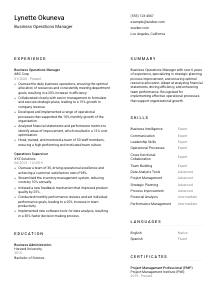
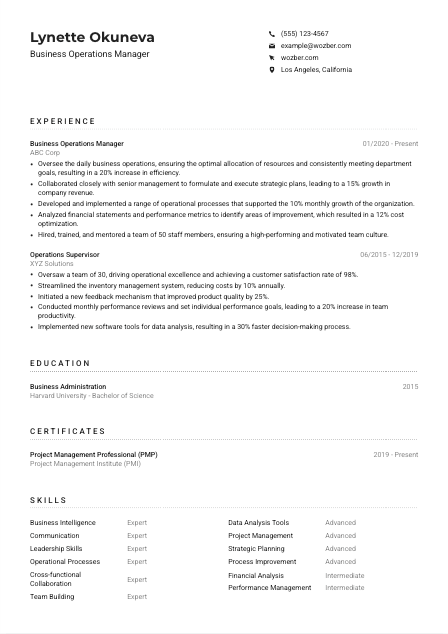
If a posting specifies a location requirement, address it directly in this section. Here, listing Los Angeles, California would help remove doubt because the employer explicitly asks candidates to be based there. If you are relocating, make that clear rather than leaving the hiring team to guess.
A LinkedIn profile can strengthen your application when it shows the same career progression, scope, and achievements as your resume. For operations roles, that may include team size, process improvement work, systems implementation, or measurable gains in efficiency and cost control. Skip links that are outdated or thin.
This section should answer a few practical questions fast: who you are, what role you do, how to reach you, and whether you meet any stated location requirement. That level of clarity suits the role you are aiming for.




This section carries the most weight for a Business Operations Manager. Hiring teams want to see where you improved performance, how you managed resources, what decisions you informed with data, and whether you led teams or systems at a scale relevant to their business.
Start by marking the parts of the posting that define the role's real workload. In this case, the priorities include daily operations oversight, process development, financial and performance analysis, strategic planning with senior leadership, and team management. Those themes should shape which bullets you keep and how you phrase them.
List your most recent role first and make the progression toward broader operational responsibility easy to follow. Moving from an operations supervisor position into a Business Operations Manager role, as shown in the example, tells a stronger story when the increase in scope, decision-making authority, and team leadership is visible.
Operations work is judged by what changed under your management. Replace routine descriptions with results tied to efficiency, revenue, cycle time, cost, quality, team output, or growth support. A bullet such as increasing efficiency by 20% or reducing costs by 12% gives far more hiring value than saying you "managed operations".
Metrics are especially persuasive in this field because so much of the work is measured through performance indicators. Use percentages, dollar impact, team size, reporting cadence, turnaround time, or growth figures where they are accurate. The sample resume does this well with examples like supporting 10% monthly growth, mentoring 50 staff members, and improving decision-making speed by 30% through better analysis tools.
Choose achievements that match business operations leadership rather than unrelated wins. Prioritize process redesign, KPI tracking, cross-functional coordination, budgeting or financial review, staff development, systems improvement, and strategic execution. Even strong accomplishments should be cut if they do not support that operating profile.
By the time someone finishes your experience section, they should understand the scale you have managed, the business problems you improved, and the results you delivered. That is the clearest case you can make for an operations leadership hire.
Education is often a straightforward section for Business Operations Manager roles, but it still plays an important screening role. Many postings use degree requirements to narrow the field early, especially when the role combines operations, analysis, and management responsibility.
If the employer asks for a bachelor's degree in Business Administration, Operations Management, or a related field, make that connection easy to spot. A Bachelor of Science in Business Administration, like the one in the example, directly satisfies the stated requirement and should appear clearly without extra clutter.
List degree, field of study, school, and graduation year in a consistent structure. This section does not need creative formatting. For an operations role, straightforward presentation reinforces the same organizational discipline expected on the job.
Use the official wording of your degree rather than abbreviations that could create ambiguity. If your academic background is adjacent rather than exact, such as economics, industrial engineering, or management, the field name should still help the reader connect it to operational and business analysis work.
Most candidates with 5+ years of experience do not need coursework, but it can help if you are lighter on direct operations titles or if your studies included areas like process design, financial analysis, supply chain, statistics, or organizational management. Keep it selective and relevant.
Honors, capstone projects, or leadership roles are worth mentioning when they reinforce analytical ability, project leadership, or business decision-making. For seasoned applicants, keep this brief. The priority is still your operating track record.
This section should quickly confirm that you meet the formal academic threshold and that your studies support the business and operational side of the role. Once that is clear, the rest of the resume can do the heavier lifting.
Certifications matter most when they reinforce how you run projects, improve processes, or manage change across teams. In business operations, they are rarely a substitute for experience, but they can sharpen your profile when they line up with the employer's workflow and improvement priorities.
If the employer calls out credentials such as PMP or CBPP, place those at the top of this section when you hold them. That kind of alignment is useful for both ATS matching and human review because it connects your training directly to project execution and process management.
List credentials that support operational planning, process improvement, business analysis, change management, or program delivery. In the example, PMP and CBPP both strengthen the case for someone leading cross-functional initiatives and refining operating systems.
Show when the certification was earned and whether it is current if that matters for the credential. This gives the hiring team context on recency and maintenance. For certifications tied to standards and frameworks, staying current can carry weight.
Operations leaders are often expected to improve systems continuously, and your certifications can reflect the same mindset. Add recent or active credentials that genuinely support your target role, but avoid padding the section with unrelated courses or expired badges that add little value.
A focused certification section tells the employer that your methods are backed by recognized training in project execution, process improvement, or operational discipline. Keep it relevant and current.
The best skills sections for Business Operations Managers are selective and role-specific. They should reflect the tools, management capabilities, and analytical strengths you actually use to improve performance, guide teams, and support strategic decisions.
Pull skill language from the posting, then keep only the items you can support elsewhere in the resume. Here, that includes business intelligence, data analysis tools, communication, leadership, and cross-functional collaboration. Those are not generic traits in this context. They point to dashboard use, performance review, planning conversations, and execution across departments.
Lead with capabilities that are central to business operations management, such as process improvement, strategic planning, KPI analysis, resource allocation, financial analysis, project management, and team leadership. The example skill list works because it stays close to the actual responsibilities instead of drifting into broad corporate language.
Group or order skills so the reader can scan them quickly. A hiring manager should be able to spot your operational toolkit in seconds, whether that is BI platforms, process mapping, forecasting, performance management, or stakeholder communication. Long lists of loosely related skills dilute the message.
Your skills should echo the operating strengths already shown in your experience, not introduce a different profile. When the wording matches the job description and the claims are backed by results, this section becomes a fast credibility check.
Language ability is usually a supporting section for Business Operations Manager roles, but it can still matter. Clear communication affects reporting, team leadership, training, and coordination across departments, so list languages in a way that is accurate and useful.
If the posting specifically requires English speaking and comprehension, list English at the top with an honest proficiency level. That removes a basic question early and aligns directly with the stated requirement.
Include additional languages if you can use them in meetings, documentation, training, or stakeholder communication. Spanish, for example, may be useful in some operations environments, but it should be presented as an added capability rather than a substitute for the required language.
Choose standard terms such as native, fluent, advanced, or conversational. Operations roles rely on precise communication, so vague labels can create doubt. Be accurate about what you can handle in real working situations.
If the company operates across regions, supports multilingual teams, or serves a diverse customer base, language skills can strengthen your profile. If not, keep the section brief and factual rather than overstating its importance.
When it is relevant, language proficiency can support smoother staff communication, clearer process training, and better coordination with external partners. Keep the emphasis practical. For most operations roles, this section supports the application rather than defines it.
List required language capability clearly, then add any extra languages that could help in team leadership or cross-functional communication. Accuracy matters more than quantity here.
Your summary should immediately place you in the right lane. For a Business Operations Manager, that means combining years of experience with the kind of operational impact you have delivered, whether through efficiency gains, process redesign, cost control, growth support, or team leadership.
Review the job description and identify the few themes that matter most. In this case, those include operations oversight, process and systems improvement, financial and performance analysis, strategic planning, and people leadership. Your summary should reflect that mix without turning into a list of keywords.
Start with a line that states who you are professionally and how long you have worked in the field. "Business Operations Manager with 6+ years of experience" is clear and useful because it immediately matches the target level and function.
Follow with a few areas where you consistently deliver results, such as optimizing resource allocation, improving operational processes, analyzing financial performance, or leading teams through growth. The example summary works because it connects strategic planning and process improvement to tangible organizational performance.
Aim for a compact paragraph that can be read quickly by a recruiter or hiring manager. Every phrase should earn its place. If a point is already shown more clearly in the experience section, do not repeat it here unless it sharpens your positioning.
A well-written summary tells the reader, within a few lines, that you understand how to run operations, improve performance, and lead people through change. That is the standard this role calls for.
A Business Operations Manager resume should read like the profile of someone who can improve how the company runs, not simply maintain activity. When your experience, skills, education, and certifications all point to process improvement, performance analysis, cost control, and team leadership, the hiring team can place you much faster.
Use Wozber's free resume builder to shape that story into an ATS-friendly resume format, and apply its ATS resume scanner and AI resume builder features to align your wording with the posting's operational priorities. The finished resume should make it easy to judge your scope, your results, and your readiness to lead business operations from day one.