



Use Wozber and land your dream job
Create CV
No registration required
Guiding sprinters, but your CV hits a hurdle? Dash through this Track Coach CV example, created with Wozber free CV builder. Learn how to showcase your pace-setting prowess to match job standards, putting your career on the fast track to success!
Track coaching is judged in motion. Schools want to see how you build event-specific training plans, improve technique over a season, keep athletes healthy, and manage the practical work around practices, meets, and facilities. Your CV should make that coaching range visible quickly, from sprint mechanics and conditioning plans to athlete feedback and team oversight.
A tailored CV helps separate general sports experience from actual track and field coaching depth. When your wording reflects the posting's language around training programs, performance evaluation, athlete well-being, and meet coordination, hiring teams can connect your background to the role faster, and Wozber's free CV builder supports that ATS optimisation by helping you present those coaching results in a clean, ATS-friendly CV format. That makes it easier to see whether you can step in and run a disciplined, athlete-centered program.
For a Track Coach role, the header needs to confirm availability and professionalism without taking up space better used for coaching results. Keep it clean, accurate, and aligned with any practical requirement in the posting.
Use your full name as the most visible text in the header. Schools and athletic departments often review many applications at once, so your name should be easy to identify, with no extra labels or slogans competing with it.
If you are applying for a Track Coach position, state "Track Coach" directly under your name. This keeps your target role clear and helps align your CV with the posting language, especially when coaching titles can vary across programs.
Include a phone number and professional email address you actually monitor. If a hiring manager wants to discuss practice schedules, season planning, or athlete development experience, you do not want outdated contact information slowing that down.
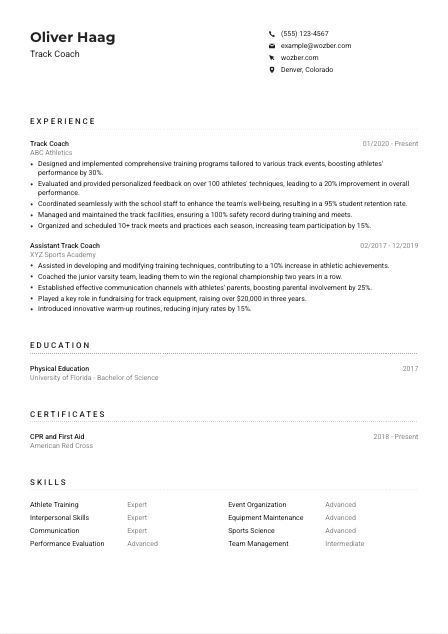
If the posting calls for a specific location, show it clearly in your header. Here, listing Denver, Colorado supports a stated requirement and removes an immediate question about availability. Only do this when location matters to the opening.
A LinkedIn profile or coaching website can strengthen your application if it includes relevant material such as coaching history, certifications, meet results, or program achievements. Skip it if the profile is sparse or outdated.
This section should answer basic access questions fast: who you are, what role you are targeting, and whether you meet any location requirement tied to the job.




This section carries the most weight for Track Coach hiring. Schools want to see what kinds of athletes you coached, how you structured training, how you measured improvement, and whether you handled the operational side of a team with discipline and consistency.
Read the posting closely and pull out the work that defines success in the role. For a Track Coach, that often means event-specific programming, technique feedback, athlete progress tracking, coordination with staff, facility safety, and meet scheduling. Then make sure those exact themes appear in your recent experience instead of relying on generic coaching language.
List your positions in reverse chronological order so hiring teams see your current level first. Include the school, club, academy, or athletics organisation, your title, and dates. If you coached at the high school or college level, make that context easy to spot because level of competition matters in this field.
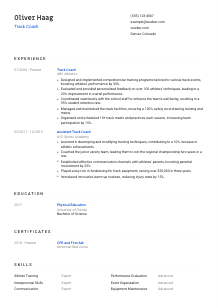
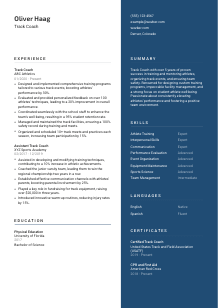
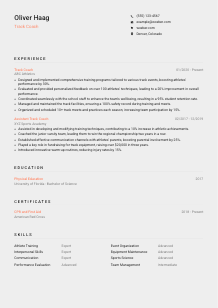
Each bullet should show what you coached, what you changed, and what happened next. Strong Track Coach bullets usually cover training design, event preparation, technique correction, athlete development, team management, and safety oversight. The sample CV does this well by tying training plans and athlete feedback to measurable performance gains rather than listing duties alone.
Numbers make coaching work more concrete when they reflect real performance markers. Useful examples include athlete improvement percentages, injury reduction, retention, participation, meet volume, qualification rates, or championship results. A line such as improving athlete performance by 30% or organising 10+ meets in a season gives hiring teams a clearer read on your scope and effectiveness.
Cut bullets that do not help explain your work as a track coach. Prioritise achievements that show event knowledge, training adjustments, athlete communication, and program operations. If you have broader sports experience, frame it around transferable coaching outcomes like conditioning design, performance review, or team supervision only when it genuinely supports the track role.
Your experience section should make it clear that you can coach athletes, run practices, support student well-being, and keep the program organised from training block to meet day.
Education matters here because it helps explain your grounding in physical training, athlete development, and sports science. For coaching roles in schools or colleges, the degree line often works as an early qualification check.
When a posting asks for a bachelor's degree in Physical Education, Sports Science, or a related field, make sure that credential is easy to find. If your degree directly matches, list it clearly near the top of the education section rather than relying on a related major to speak for itself.
Include degree, field of study, school name, and graduation year or date. Hiring teams do not need a complicated layout here. They need to confirm that your academic background supports the coaching and athlete-development work in the role.
If your degree aligns closely with the posting, use the full wording. "Bachelor of Science in Physical Education" directly answers the requirement in this example and removes ambiguity. Similar precision helps when your degree is in Sports Science, Kinesiology, or another closely related area.
Most experienced coaches can keep this section brief. If you are earlier in your career, a short mention of coursework like exercise physiology, biomechanics, coaching theory, or athletic training can help connect your academics to track performance work and injury prevention.
Athletic department leadership, varsity participation, coaching internships, or sports science projects can add value when they support your coaching story. Keep these details selective and relevant to athlete development, training knowledge, or team leadership.
For this kind of opening, education should quickly confirm that your formal training supports the coaching methods and athlete care expected in the role.
Certifications matter in track coaching for two reasons. They show you can handle athlete safety responsibly, and they often signal continued involvement with current coaching standards and methods.
Place CPR and First Aid certification prominently when the posting asks for it. For school-based coaching, this is not a minor detail. It shows you are prepared for the health and safety responsibilities that come with practices, meets, and supervision of student-athletes.
Relevant coaching certifications, such as a recognized track and field credential, help show formal commitment to the discipline. In the example, the USATF certification adds useful depth because it supports event knowledge and coaching specialization beyond the basic requirement.
Include the issuing organisation and dates so reviewers can see whether a credential is active. This is especially important for certifications with renewal cycles, where current status matters as much as the original completion date.
If you have recent certifications or continuing education in performance training, injury prevention, youth athlete development, or sports safety, include them when relevant. Ongoing development matters in a sport where training methods, recovery practices, and compliance expectations continue to evolve.
For Track Coach roles, safety credentials should be impossible to miss, and added coaching certifications should strengthen your authority in the events and athletes you train.
A Track Coach skills section should do more than list personality traits. It should reflect the technical and interpersonal parts of the job, including training design, athlete assessment, communication, and the day-to-day running of a team program.
Start with the capabilities the role emphasizes, then keep only the ones you can support elsewhere in the CV. In this case, that includes training techniques, performance measurement, communication with athletes and parents, event organisation, equipment oversight, and athlete evaluation. These terms help connect your skills section to your experience instead of floating as unsupported claims.
Order matters. Lead with the coaching skills most central to the role, such as athlete training, performance evaluation, interpersonal communication, and event-specific development. Secondary strengths like fundraising or general team support can appear later if they add value.
You can separate technical coaching skills from people and program skills if that improves clarity. For example, training methods, performance analysis, and sports science can sit alongside communication, team management, and event coordination. The goal is to show the full operating range of a coach, not a random word bank.
The best skills section sounds consistent with the rest of the CV. If you list athlete training, performance evaluation, or facility management, your experience bullets should show where you actually used them.
Language matters in coaching because instruction has to be understood quickly and clearly, whether you are correcting form, discussing progress with parents, or coordinating with school staff. Include languages when they support the communication demands of the role.
If the job specifies that you must work effectively in English, list English clearly with an honest proficiency level. For school and team environments, this matters for practice instruction, safety communication, scheduling, and academic coordination.
Extra language ability can be valuable when working with athletes and families from different backgrounds. If you speak another language well enough to support coaching, parent communication, or team inclusion, include it as an added strength rather than a headline feature.
Even when a second language is not required, it can improve relationship-building and day-to-day communication across a diverse roster. The sample CV's Spanish entry is a good example of a useful addition that broadens communication range without distracting from core coaching qualifications.
Choose clear levels such as Native, Fluent, Intermediate, or Basic. Overstating proficiency can become obvious quickly in a role where spoken communication, safety instructions, and parent conversations matter.
For most Track Coach applications, languages are a supporting section, not the centerpiece. Include them cleanly, but let your coaching experience, certifications, and athlete results carry the main argument.
For this role, language skills are most useful when they support instruction, athlete trust, parent conversations, and smooth coordination with school staff.
Your summary should read like a quick professional profile, not a slogan. In a few lines, show your coaching level, your track-specific strengths, and the kind of athlete and program outcomes you have delivered.
Start with your title, years of experience, and the environment you have coached in, such as high school, college, academy, or club track and field. This gives immediate context for your background and helps hiring teams place your experience at the right competitive level.
Mention two or three strengths that match the role closely, such as designing event-specific training programs, evaluating technique, improving athlete performance, coordinating with staff, or maintaining safe facilities. The sample summary works because it stays close to the actual demands of the job instead of drifting into broad leadership language.
Aim for 3 to 5 lines with specific wording and no filler. A summary that mentions 5+ years of coaching, athlete development, event organisation, and team safety tells a hiring manager far more than generic claims about passion or dedication.
Close with the value you offer the next program, such as building disciplined training environments, helping student-athletes progress, or supporting both performance and well-being across a season. Keep the focus on what you can deliver, not on vague career wishes.
A well-written summary should set up the rest of the CV by showing that you understand training, athlete development, and the operational demands of running a track program.
A Track Coach CV should show more than enthusiasm for sport. It should connect your training plans, athlete improvement, communication style, safety credentials, and program management into one clear hiring story.
Use Wozber's free CV builder to shape that story into an ATS-compliant CV, refine your wording with role-specific terms, and check alignment with an ATS CV scanner before you apply. The finished CV should make it easy to judge whether you can develop athletes and run the day-to-day demands of a track program.




