



Use Wozber and land your dream job
Create CV
No registration required
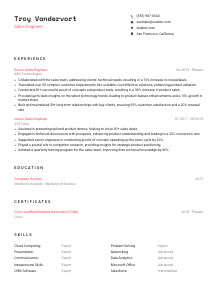
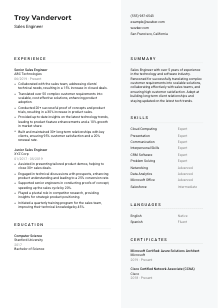
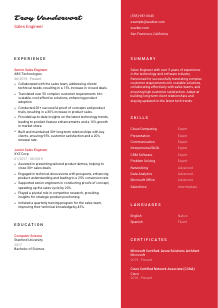
Bridging tech and sales, but your CV needs some integration? Check out this Sales Engineer CV example, created with Wozber free CV builder. Learn how to blend your product knowledge and market savvy to meet job criteria, putting your career in the tech selling fast lane!
Sales engineering sits at the point where technical credibility meets revenue pressure. Hiring teams want to see that you can understand a prospect's architecture, ask sharp discovery questions, run a convincing demo or proof of concept, and help move complex deals forward without losing the customer's trust. Your CV should make that blend visible early.
When a Sales Engineer CV is tailored well, the reader can quickly connect your technical background to the sales cycle you support, from discovery and solution design to demos, trials, and renewals. Wozber's free CV builder helps shape that story into an ATS-compliant CV by aligning your wording with the job description, so your experience reads clearly for both screening systems and the people deciding whether you can handle customer-facing technical conversations.
This section is brief, but it still sets the tone. For a Sales Engineer, clean contact details and the right location signal matter because the role often involves client meetings, cross-functional coordination, and quick follow-up during active deals.
Use your full name in the largest text on the CV so it anchors the page immediately. Sales Engineers spend a lot of time presenting clearly and reducing friction for buyers, and your header should reflect that same clarity.
Place "Sales Engineer" under your name unless a close variation better matches your background and the posting, such as "Senior Sales Engineer" or "Solutions Engineer." If the job uses "Sales Engineer," mirroring that wording helps connect your profile to the role right away and supports ATS matching.
Include a current phone number and a professional email address. If you have a LinkedIn profile or personal website, add it only if it reinforces your value with product-facing work, technical presentations, customer success stories, or solution-focused project experience.
Some Sales Engineer jobs are flexible, while others need you near customers, the field team, or a specific office. Here, the San Francisco requirement should be handled directly in your header, either by listing that location or making relocation clear, so no one has to guess about a logistical filter.
A polished LinkedIn profile can strengthen your CV if it reflects the same titles, dates, and achievements. For this profession, useful extras might include webinar clips, technical enablement work, implementation case studies, or product content that shows you can communicate complex systems to buyers.
Your personal details do not need flair. They need accuracy, professionalism, and the practical information a hiring team uses to decide whether to move you into the next conversation.




This is the section most likely to decide whether you get an interview. Sales Engineer experience should show how you supported the sales process, handled technical objections, mapped product capabilities to customer requirements, and influenced outcomes such as conversion, deal velocity, adoption, retention, or expansion.
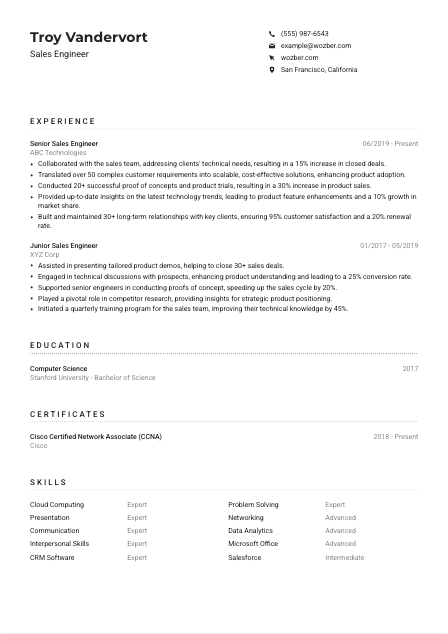
Read the job description closely and pull out the work patterns behind it. In this case, that means collaboration with account executives, tailored product demos, solution design, proof of concepts, technical discussions, and long-term client relationships. Then make sure your bullets show where you did those things, not just that you "supported sales." The example CV does this well by tying technical collaboration directly to closed deals and product sales.
List roles in reverse chronological order with company, title, and dates, then use bullets for outcomes and responsibilities. Focus each position on the parts of the role that matter in sales engineering, such as pre-sales support, demo ownership, customer discovery, technical validation, CRM coordination, or post-demo follow-through.
A hiring manager already knows a Sales Engineer presents solutions. What they need to know is how well you did it. Replace generic bullets with results tied to the buying process, like increasing close rates, improving trial success, shortening evaluation cycles, or lifting renewals. "Conducted 20+ successful proof of concepts and product trials, resulting in a 30% increase in product sales" works because it connects technical execution to revenue impact.
Numbers matter here because Sales Engineers are judged on both customer-facing execution and business results. Use metrics such as number of demos delivered, POCs run, conversion rate, pipeline influenced, renewal rate, customer satisfaction, time-to-value, or adoption growth. The sample CV gives several native examples, including 50+ customer requirements translated into scalable solutions and 95% customer satisfaction across key accounts.
Keep the focus on experience that proves you can explain technical products, navigate customer infrastructure questions, and help sales teams win. Older or unrelated work can stay brief unless it adds something useful, such as vertical expertise, domain knowledge, or a history of customer-facing technical problem solving. Relevance matters more than volume in this section.
Your experience section should leave no doubt that you can handle the technical side of the sales cycle and contribute to results. If the reader can picture you in discovery calls, demos, POCs, and customer discussions, this section is doing its job.
For Sales Engineers, education usually establishes technical grounding rather than carrying the whole CV. A relevant degree helps confirm that you can understand product architecture, infrastructure questions, and customer requirements without needing to overexplain your academic background.
If the posting asks for a bachelor's degree in Engineering, Computer Science, or a related technical field, make that easy to find. The sample CV's Bachelor of Science in Computer Science is a direct match, which works well because it supports the candidate's cloud, networking, and solution-design credibility.
List your degree, school, field of study, and graduation year in a clean format. Recruiters and hiring managers typically scan this section quickly, so clarity matters more than decorative formatting. A straightforward layout also helps ATS parsing.
For this profession, the field of study often matters as much as the degree level. Computer Science, Electrical Engineering, Information Systems, or similar programs can reinforce your ability to discuss integrations, data flow, cloud architecture, or networking topics with confidence.
Most experienced Sales Engineers do not need a long coursework list. Add a few items only if they directly support the role, such as cloud systems, networking, databases, data analytics, or software engineering. This is most useful early in your career or when your experience is still growing.
Student projects, engineering competitions, or technical clubs can be worth mentioning if they show presentation skills, applied problem solving, or hands-on exposure to tools and systems you now discuss with customers. Keep it concise and tie it to the job's technical domain when possible.
A relevant degree strengthens your technical foundation. Once that is clear, let your experience, certifications, and customer-facing results carry the heavier weight on the page.
Certifications are especially useful in sales engineering because they can validate technical range in areas customers ask about during evaluations. They are most effective when they support the product environment you sell into, whether that is cloud infrastructure, networking, data platforms, or business applications.
Start with credentials tied to the solutions or environments named in the job description. Here, certifications such as CCNA or Microsoft Certified: Azure Solutions Architect fit naturally because the role values knowledge in networking and cloud computing. If you work in CRM-heavy or SaaS roles, a platform credential like Salesforce can also strengthen your case when it reflects the actual product context.
A short list of targeted certifications is stronger than a long catalogue of loosely related badges. Hiring teams want to know whether you can speak credibly about the systems their customers use, so keep the section focused on certifications that support technical sales conversations, architecture discussions, or implementation trust.
Technology certifications age differently. If a credential is current, active, or recently renewed, show the date range or issue date so the reader knows your knowledge is up to date. That matters in fast-moving areas like cloud platforms, security, and networking.
Sales Engineers need to keep pace with product updates, competitor shifts, and new infrastructure patterns. Active certification work signals that you are staying current enough to guide prospects through modern technical decisions, not relying on outdated product knowledge.
Well-chosen certifications add another layer of credibility to your CV. They are not a substitute for customer-facing results, but they can strengthen your authority in the technical conversations that shape buying decisions.
A Sales Engineer skills section should read like the toolkit behind successful demos, discovery calls, and solution mapping. That means balancing technical knowledge with communication, presentation, and relationship skills that affect whether prospects understand and trust the solution.
Start with the capabilities the role repeatedly points to. In this posting, those include cloud computing, networking, data analytics, presentation, communication, interpersonal skill, and the ability to explain technical concepts to non-technical audiences. That mix tells you exactly how the employer defines the role.
Choose skills that reflect your real experience in the kinds of customer conversations the job involves. For example, cloud architecture, networking fundamentals, CRM systems, demo delivery, requirements gathering, and solution design all make sense for many Sales Engineer roles. The sample CV balances technical depth with commercial communication by pairing items like Cloud Computing and Networking with Presentation and Communication.
Lead with the highest-value skills for the job, then group the rest in a logical order. You might separate technical domains from customer-facing strengths if your format allows it, or simply list them in priority order. Either way, make sure the top of the section reflects the product environment and the buying conversations you are expected to handle.
A useful skills section should line up with the conversations, systems, and outcomes in your experience section. If the listed skills clearly support demos, technical discovery, and solution design, the section is doing real work.
Language ability matters in sales engineering when it affects demos, technical workshops, account coverage, or support across regions. Even when a posting names only English, list languages carefully because communication quality is central to this profession.
If the job asks for strong English proficiency, list English prominently and use an accurate level such as Native, Fluent, or Professional. This matters in a role where you may be translating product capabilities, answering technical objections, and presenting to mixed technical and business audiences.
If you speak more than one language, place the most relevant ones first after the required language. For customer-facing roles, this helps the reader quickly see where you may add value with regional accounts, multilingual demos, or smoother relationship management.
Extra languages can be valuable when the company sells across regions or supports diverse customer teams. In the example, Spanish strengthens the profile because it suggests wider communication range, though it is an advantage rather than a universal requirement for every Sales Engineer role.
Choose labels that reflect what you can actually do in meetings, presentations, and technical discussions. If you can hold a sales conversation but would struggle in a deep architecture workshop, do not overstate your level.
List languages when they support the kind of client interaction the job involves. If the territory, customer base, or internal team structure is multilingual, this section can add real value. If not, keep it concise and factual.
For Sales Engineers, language skills are most useful when they strengthen customer conversations. Present them clearly, rate them honestly, and let them support the broader story of how you communicate technical value.
Your summary should quickly establish what kind of Sales Engineer you are and where you create value. In a few lines, connect your technical background to sales outcomes so the reader immediately understands the level of deals, customers, and solution work you can handle.
Before writing the summary, identify the overlap between the job and your background. For Sales Engineers, that often includes translating technical requirements, leading demos or trials, partnering with account executives, and helping customers evaluate fit. Build the summary around those themes rather than broad claims about being "results-driven."
Your first line should establish your professional identity in concrete terms. The sample summary does this effectively with "Sales Engineer with over 5 years of experience in the technology and software industry." That gives the reader role fit, experience level, and market context in one sentence.
Follow with strengths that matter in this profession, such as solution mapping, proof of concept execution, technical presentations, stakeholder communication, or long-term account support. Phrases like "translating complex customer requirements into scalable solutions" work well because they describe a core sales engineering function in business terms.
Aim for three to five lines. That is enough space to cover experience level, technical domain, and a few differentiators without repeating bullets from the experience section. Every sentence should add something the hiring team can use to place you in their sales motion.
A focused summary helps the reader understand your profile before they reach the detail. When it clearly connects technical depth, customer communication, and commercial impact, the rest of the CV lands faster.
Your CV should show that you can do the real work of sales engineering: understand customer requirements, explain technical products clearly, run evaluations with confidence, and support revenue outcomes. When each section points to that combination of technical judgment and customer-facing execution, your application becomes much easier to trust.
Use Wozber to refine the language, improve ATS optimisation, and build an ATS-friendly CV format that reflects the job you are targeting. The final document should make one thing clear at a glance: you can help customers understand the solution and help the sales team win the business.




