



Use Wozber and land your dream job
Create CV
No registration required
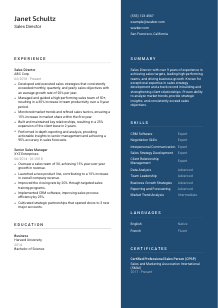
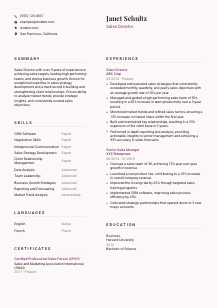
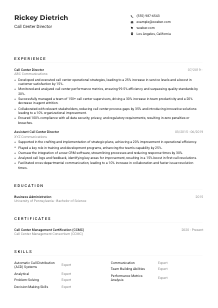
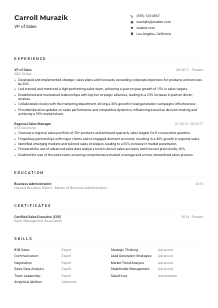
Closing high-value deals, but your CV isn't sealing the deal? Check out this Sales Director CV example, created with Wozber free CV builder. Learn how to present your sales mastery to align with job goals, helping your career hit record-breaking quotas!
Sales Director hiring starts with one practical question: can this person turn a revenue target into a working sales plan and lead a team to hit it. Titles alone do not answer that. Your CV needs to show how you set strategy, managed pipeline performance, coached reps, expanded accounts, and adjusted tactics when market conditions changed.
When those results are tailored to the role, hiring teams can quickly connect your background to forecast ownership, team leadership, and customer growth. Wozber's free CV builder helps you shape that story in an ATS-friendly CV format, so the language around quotas, CRM reporting, market analysis, and sales execution is easy to read both in screening systems and by the leaders reviewing your commercial track record.
For a Sales Director, the top of the CV should read like a clear business card, not a crowded profile. Keep it professional, easy to scan, and aligned with the role you want so the hiring team can move straight into your revenue and leadership experience.
Use your full name in a slightly larger font than the rest of the header. Sales leadership roles often involve external visibility with customers, partners, and executives, so your CV should open with the same level of professional clarity you would bring to a board update or client introduction.
Place "Sales Director" directly under your name when that matches the job you are pursuing. This immediately frames your background around team leadership, quota ownership, and commercial strategy rather than leaving the reader to infer whether you are targeting an individual contributor or senior leadership track.
Include a reliable phone number and a professional email address. Errors here create avoidable friction. In sales hiring, responsiveness matters, and clean contact details reinforce that you operate with discipline and attention to follow-through.
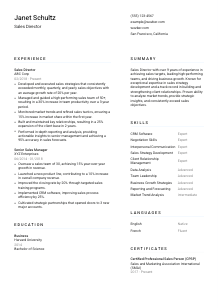
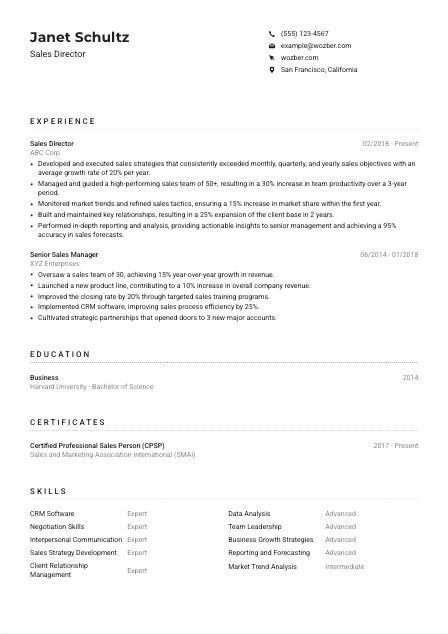
If a posting specifies a city or region, include it in your header when you meet that requirement. In the example, listing San Francisco, California directly addresses the employer's stated location need and removes early uncertainty about availability for local leadership, customer meetings, or in-person team management.
A LinkedIn profile or personal site can support your candidacy if it reflects your current leadership scope, industry focus, and achievements. Make sure the information matches your CV, especially around job titles, dates, and headline accomplishments such as revenue growth, team size, or market expansion.
Your header should confirm who you are, what role you are pursuing, and whether you meet any immediate practical requirements. Then the CV can stay focused on the commercial results that matter for Sales Director hiring.




This is the section most likely to decide whether you move forward. For a Sales Director, employers are looking for proof of sales growth, forecast ownership, team performance, customer expansion, and the ability to translate market information into action.
Before revising your bullets, identify the responsibilities the employer repeats or weights heavily. Here, the priorities are sales strategy, growth against monthly, quarterly, and yearly objectives, team management, customer relationships, market analysis, and reporting. Those themes should shape your wording so your CV reflects the actual operating scope of the job rather than a generic sales leadership profile.
List positions in reverse chronological order and give the strongest space to roles where you owned revenue outcomes, managed teams, or drove business development. A title like Sales Director or Senior Sales Manager already helps, but the bullet points need to show what that meant in practice, such as team size, account growth, territory impact, or strategic initiatives launched.
Each bullet should connect an action to a measurable commercial result. The example does this well by pairing strategic work with numbers, such as exceeding sales objectives with average annual growth of 20%, lifting team productivity by 30%, or improving forecast accuracy to 95%. Those metrics tell a hiring leader how you performed, not just what you were responsible for.
Revenue growth matters, but so does scope. Include figures that show the size of the team you led, the number of accounts expanded, the market share gained, the closing rate improved, or the efficiency lift after CRM adoption. Sales Director CVs stand out when the reader can quickly understand both impact and operating scale.
Prioritise achievements tied to strategy, people leadership, customer growth, reporting, and execution against target. A Sales Director CV does not need space spent on minor administrative tasks or general duties that do not show commercial judgment. Keep the section centered on revenue, leadership, and market-facing results.
Your experience section should make it easy to trace a line from past performance to future sales leadership. If the reader can see growth delivered, teams led, forecasts managed, and customers expanded, you have given them the core case for moving you forward.
Education usually plays a supporting role for experienced Sales Directors, but it still matters when a posting names a degree requirement. Keep this section straightforward and make it easy to confirm that your academic background fits the position.
When a job asks for a Bachelor's degree in Business, Marketing, or a related field, list your degree in a way that makes that connection obvious. In the example, "Bachelor of Science in Business" aligns cleanly with the requirement and does not force the reader to interpret whether the education qualifies.
Include the degree, field of study, school, and graduation year. Sales leadership CVs benefit from clarity throughout, and there is no advantage in overdesigning this section. The hiring team should be able to confirm the credential in a few seconds and return to your revenue record.
If your degree is directly related to commercial work, keep the field visible rather than burying it. Business, marketing, economics, or related areas help support your credibility in sales strategy, market analysis, and customer growth planning.
For a candidate with 8+ years in sales, coursework is usually unnecessary unless it directly strengthens a niche industry move. Honors or distinctions can be included, but they should stay secondary to your leadership results and sales performance.
If you have completed recent executive education, sales leadership training, or courses in forecasting, analytics, or CRM platforms, those can reinforce that your skills are current. They are especially useful when they support responsibilities in the target role such as reporting, market analysis, or team development.
For this level of sales role, education is mainly a confirmation point. Present the required credential clearly, then let your experience carry the weight of the application.
Certifications are not always required for Sales Director roles, but relevant ones can strengthen your profile when they support sales methodology, leadership, negotiation, or account growth. Keep this section selective and clearly tied to commercial work.
Start with certifications that relate to selling, business development, leadership, or customer management. A credential such as "Certified Professional Sales Person (CPSP)" works because it directly supports the candidate's sales background, even though the posting itself does not require a certification.
A short list of certifications tied to sales performance and leadership reads better than a long catalogue of loosely related courses. Choose credentials that strengthen your case around strategy execution, negotiation, team coaching, or client relationship management.
For each certification, give the full name, issuing organisation, and date earned or active period. That level of detail keeps the section credible and easy to verify, especially for certifications that require renewal or ongoing standing.
Sales teams work in changing markets, and leaders are expected to stay current on tools, buying behaviour, and execution methods. Add newer certifications when they genuinely support your target role, particularly in areas such as CRM use, sales operations, forecasting, or leadership development.
Relevant certifications can sharpen your profile, but only when they support the actual demands of the role. Treat them as reinforcement for your commercial leadership, not as a substitute for a strong experience section.
A Sales Director skills section should reflect how the job is actually run: strategy, team leadership, customer growth, reporting, negotiation, and command of the tools used to track performance. Keep the list focused enough that every item supports the target position.
Start with the wording used in the posting and map it to your real strengths. Here, that includes CRM software, data analysis, communication, negotiation, interpersonal skill, sales strategy, and business growth. Using employer language where it truthfully matches your background improves alignment without turning the section into a keyword dump.
Lead with the abilities most tied to Sales Director performance. Skills such as Sales Strategy Development, Client Relationship Management, CRM Software, Reporting and Forecasting, Team Leadership, and Negotiation should usually appear before broader or less central items. The example skills list works because it stays anchored in commercial execution rather than generic workplace traits.
Choose skills that reflect how you actually work and that support ATS optimisation through accurate, role-specific terminology. Wozber can help surface missing keywords and improve alignment, but the final list should still read naturally to a hiring executive reviewing pipeline management, team performance, and forecast discipline.
This section should give a quick, accurate view of the tools and capabilities behind your results. If the list reflects how you drive revenue, lead teams, and manage performance, it supports the rest of the CV instead of repeating it.
Language skills matter in sales when they support customer communication, regional coverage, or cross-border work. Even when only one language is required, listing proficiency clearly helps the employer confirm you can operate effectively in the role's communication environment.
If the job specifies English proficiency, list English clearly and prominently. In this posting, that requirement is explicit, so there should be no ambiguity about your ability to lead meetings, negotiate terms, prepare reports, and communicate with senior management in English.
Order languages by job relevance, not personal preference. English should appear first here because it is required for the role. Additional languages can follow if they support client development, regional sales work, or international account management.
Extra languages are valuable when they expand your ability to build relationships with customers or partners. In the example, French adds a useful secondary capability, especially for organizations with international accounts or multilingual stakeholder groups, though it is an advantage rather than a universal requirement.
Stick to clear levels such as Native, Fluent, Intermediate, or Basic. Sales leadership depends on precise communication, so overstating language ability can quickly create problems in interviews or on the job.
If language ability has helped you grow accounts, manage regional teams, or navigate specific customer segments, that value can also appear elsewhere in the CV. The language section itself should stay concise, but it can point toward broader commercial range when the role calls for it.
List the languages that support the job, label proficiency accurately, and avoid overexplaining. For a Sales Director, the real value is clear business communication and stronger customer reach.
The summary sits near the top of the page, so it needs to establish your level quickly. For a Sales Director, that means years of experience, leadership scope, and the kind of growth or sales performance you are known for.
Read the posting and identify the few themes that deserve space in the opening paragraph. In this case, those are sales growth, leadership, strategy, reporting, and customer relationship development. Your summary should reflect that mix instead of offering a vague statement about being results-driven.
Start with a direct line that tells the reader who you are professionally. The example uses "Sales Director with over 9 years of experience," which works because it establishes seniority immediately and fits a role asking for 8+ years in sales with leadership experience.
Follow with concrete strengths that match the target role, such as exceeding sales targets, leading high-performing teams, improving forecasting, or expanding client relationships. These points should sound like an executive snapshot of the achievements supported later in your experience section.
Aim for a short paragraph of about 3 to 5 lines. Every phrase should pull its weight. If a sentence does not clarify your leadership scope, sales performance, or strategic value, cut it and replace it with something tied to revenue, team results, or market impact.
By the time someone finishes this section, they should understand your seniority, your sales leadership focus, and the business results you are likely to deliver. That gives the rest of the CV a clear frame.
A Sales Director CV should make four things easy to judge: whether you can grow revenue, lead a team, manage performance through data, and build durable customer relationships. When those points come through clearly in your experience, skills, and summary, the document starts working like a commercial case for your leadership.
Use Wozber's free CV builder to tighten that case with stronger tailoring, ATS optimisation, and an ATS-friendly CV template that keeps your sales metrics, CRM expertise, and leadership scope easy to review. The finished CV should leave little doubt that you can step into target ownership and lead sales growth with control and consistency.