



Use Wozber and land your dream job
Create CV
No registration required
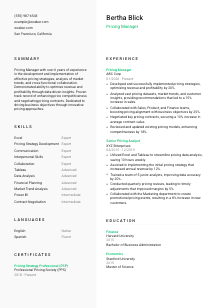
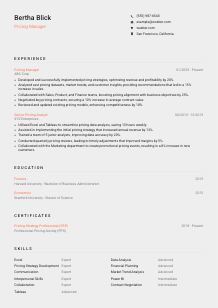
Weighing margins and discounts, but your CV isn't selling? Check out this Pricing Manager CV example, created with Wozber free CV builder. It shows how to clearly price your credentials to align with job expectations, ensuring your career trajectory swings upwards, without dents in your profitability.
Pricing Managers sit at the point where analytics meets commercial judgment. Hiring teams want to see how you turn margin pressure, market movement, and customer behaviour into pricing decisions that improve revenue without losing competitiveness. Your CV should make that business impact visible, not hide it behind generic finance language.
When pricing work is described in the employer's terms, the first read changes fast. Wozber's free CV builder helps you shape an ATS-compliant CV around the pricing models, BI tools, negotiation work, and cross-functional decisions the role actually calls for, so a reviewer can quickly understand how you influence pricing strategy and profitability.
This section is straightforward, but it still does real screening work. For a Pricing Manager, the header should immediately confirm who you are, what role you do, and whether you meet basic contact and location requirements without forcing the reader to hunt for them.
Use your full name in a clear, slightly larger font so the CV opens cleanly. This is a practical formatting choice, especially when your CV may be reviewed quickly by recruiters, finance leaders, or sales stakeholders moving through multiple applications.
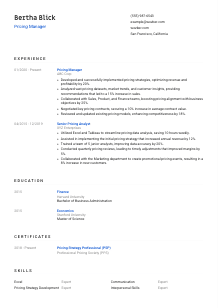
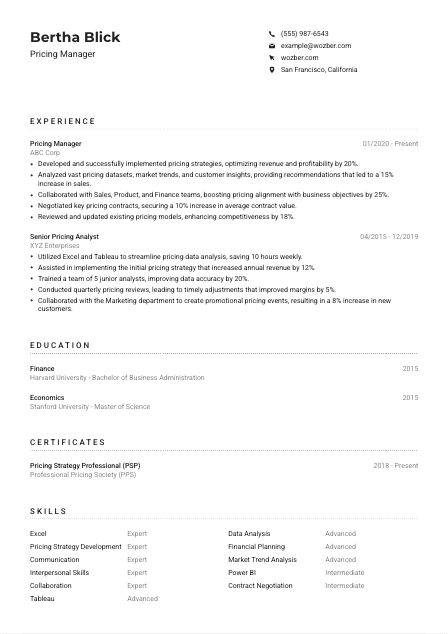
Place "Pricing Manager" under your name when that matches the role you are targeting. It removes ambiguity, especially if your recent title was something adjacent like Senior Pricing Analyst, Revenue Analyst, or Commercial Finance Manager. The sample CV does this well by aligning the headline with the opening right away.
Include a reliable phone number and a professional email address. Pricing roles often involve presentations to senior management and coordination across Sales, Product, and Finance, so even basic details should reflect accuracy and professionalism. Double-check every field before sending.
If a role names a location requirement, reflect it clearly in your header. In this example, listing San Francisco, California directly addresses the employer's stated need and avoids unnecessary questions about relocation or availability.
A LinkedIn profile or personal website can strengthen the top of the CV if it supports your candidacy. For Pricing Managers, that usually means a polished LinkedIn presence with consistent titles, business analytics experience, and tool exposure such as Excel, Tableau, or Power BI. Only include links that are current and aligned with the CV.
Your personal details should confirm the basics in seconds: identity, role focus, contact information, and any location requirement. Once that is clear, the rest of the CV can stay focused on pricing strategy, analytics, and commercial results.




This is the section that carries the most weight for a Pricing Manager. Hiring teams look for proof that you have shaped pricing strategy, worked through data, influenced commercial decisions, and delivered measurable gains in revenue, margin, contract value, or market competitiveness.
Start by isolating the work themes in the posting: pricing analytics, financial planning, pricing strategy, BI tools, cross-functional collaboration, contract review, and negotiation. Those priorities should guide which bullets you keep, expand, or cut. If a role emphasizes customer pricing negotiations and model updates, your experience should not read like a general FP&A CV.
Present your most recent position first and make each entry easy to scan with title, employer, and dates. For pricing work, title progression matters. A move from Senior Pricing Analyst to Pricing Manager, like in the sample, tells a useful story about increased ownership over pricing models, recommendations, and commercial decisions.
Focus each bullet on what you changed, analysed, negotiated, or implemented. Strong Pricing Manager bullets show work such as developing pricing strategies, reviewing customer contracts, adjusting models based on market trends, or aligning pricing with sales targets. The sample bullet about optimising revenue and profitability by 20% works because it ties strategic pricing work to a clear commercial result.
Numbers matter most when they reflect how pricing performance is actually measured. Revenue lift, margin improvement, average contract value, win rate, pricing accuracy, analysis time saved, and competitiveness gains all make sense here. The example CV uses several of these naturally, including a 10% increase in average contract value and 10 hours saved weekly through better analysis workflows.
Every bullet should help the reader understand your pricing scope and level. If an accomplishment does not connect to pricing analysis, profitability, commercial alignment, forecasting, tooling, or negotiation, it probably belongs off the page. Relevance is especially important when your background includes broader finance or analytics work and you need to keep the focus on pricing leadership.
A Pricing Manager CV should leave no doubt about the decisions you influenced and the results that followed. If your bullets show pricing strategy, analytical depth, cross-functional execution, and measurable revenue or margin impact, this section is doing its job.
Education is rarely the deciding factor for an experienced Pricing Manager, but it still matters because it confirms the analytical and commercial foundation behind your work. Degrees in business, finance, economics, or related fields support the mix of quantitative reasoning and business judgment the role requires.
If the posting asks for a bachelor's degree in Business, Finance, Economics, or a related field, make that qualification easy to find. A finance, economics, accounting, statistics, or business degree immediately supports work in pricing analytics and profitability analysis.
List each degree with the institution, degree type, field of study, and graduation year. Keep the structure simple so a reviewer can confirm your credentials quickly. The sample CV handles this well with direct entries for both the bachelor's and master's degrees.
For this profession, the field often matters as much as the degree itself. Finance and economics are especially useful because they connect naturally to price elasticity, forecasting, profitability, and market analysis. If your degree is in a related area, name it clearly rather than assuming the connection will be obvious.
Relevant coursework can help if you are early in your career or moving into pricing from a nearby function. Classes in econometrics, business analytics, statistics, corporate finance, or market research can support that transition. If you already have several years of pricing experience, your work history should stay in the foreground.
Projects, research, or extracurricular work belong here when they reinforce your commercial and analytical profile. For example, a capstone on pricing optimisation, demand analysis, or revenue forecasting can add substance for less experienced candidates. Keep it brief and tied to business application.
Your education section should confirm that you have the academic base for pricing analysis and business decision-making. Keep it clear, relevant, and proportional to your level of experience.
Certifications are not always required for Pricing Manager roles, but the right one can strengthen your profile, especially when it reflects structured expertise in pricing strategy, analytics, or commercial decision-making. They are most useful when they reinforce the work already shown in your experience section.
Review the job posting first. If no certification is required, include only those that still add value to your candidacy. A credential such as Pricing Strategy Professional can support your positioning because it speaks directly to pricing methodology and strategic decision-making.
A short, focused certification section is better than a long list of loosely related courses. Give space to credentials that strengthen your profile in pricing, analytics, revenue management, contract strategy, or business intelligence tools, rather than listing every training completion you have ever earned.
Show the year earned and, if applicable, whether the certification is still active. That helps employers understand whether your knowledge is current, particularly in fields that evolve through new pricing methods, changing software, or updated market practices.
Pricing teams increasingly rely on analytics platforms, scenario modeling, segmentation, and BI dashboards. Continued learning in pricing strategy, Tableau, Power BI, Excel modeling, or revenue optimisation can sharpen your CV over time and support advancement into broader commercial leadership roles.
Certifications should strengthen your pricing profile, not distract from it. If they add recognizable expertise in strategy, analytics, or pricing operations, they earn their place on the page.
The skills section should read like the toolkit of someone who can run pricing analysis and influence business decisions. For Pricing Manager roles, that usually means a blend of quantitative tools, commercial judgment, and communication strong enough to work across Sales, Product, Finance, and leadership teams.
Pull skills from the posting with care. Here, the employer names pricing software, Excel, Tableau, Power BI, data analysis, communication, and cross-functional collaboration. Those terms belong on the CV when they reflect your real background, because they match both ATS filters and the language decision-makers expect to see.
Prioritise skills that explain how you do the work. Technical tools such as Excel, Tableau, Power BI, and pricing analytics matter, but so do contract negotiation, market trend analysis, financial planning, and pricing strategy development. The sample CV gets this balance right by combining BI tools with business-facing capabilities.
Keep the section clean enough to scan in seconds. You can group tools, analytical skills, and interpersonal capabilities if your format allows, or simply order the strongest, most relevant items first. However you present them, make sure the list supports the experience section rather than repeating generic strengths.
A Pricing Manager skills section should tell a clear story about how you analyse data, build recommendations, and influence pricing decisions. Keep the mix practical, role-specific, and closely tied to the job description.
Language skills matter most when the role names a requirement or the business works across regions, customer groups, or international teams. For Pricing Managers, communication often includes presenting pricing recommendations, discussing contract terms, and translating analysis into decisions that commercial teams can act on.
If the job description specifies English, list it clearly with your proficiency level. In this case, English is an explicit requirement, so it should appear in the section without ambiguity.
Additional languages can be useful when the company serves multilingual customer bases or runs pricing discussions across regions. They are not always central to the job, but they can broaden your value in negotiations, account management support, or market analysis. The sample CV includes Spanish as an extra strength without overplaying it.
Use clear labels such as Native, Fluent, Intermediate, or Basic. Hiring teams need an honest read on whether you can handle meetings, written communication, or contract-related discussions in that language.
For most Pricing Manager positions, language skills are supportive rather than central unless the employer states otherwise. That means one required language and one or two additional ones are usually enough. Let pricing strategy, analytics, and commercial results stay at the centre of the CV.
If you can hold a conversation but cannot present analysis or review business terms comfortably, choose a lower proficiency level. Accuracy matters, especially in roles where communication with leadership, customers, or cross-functional partners affects pricing decisions.
This section works best when it is honest, concise, and tied to real communication needs. Cover the required language clearly, then include any additional fluency that could support customer, market, or internal collaboration.
The summary sits at the top of the CV and shapes how the rest is read. For a Pricing Manager, it should quickly establish your years of experience, your command of pricing strategy and analytics, and the business outcomes you tend to influence.
Start with a direct description of who you are professionally. A line such as "Pricing Manager with 6+ years of experience in pricing strategy and analytics" works because it immediately answers the role level question and aligns with the experience requirement in the posting.
Choose two or three themes that match the opening, such as revenue optimisation, pricing model development, market trend analysis, BI tools, or cross-functional partnership. The sample summary points to pricing strategies, market trends, and collaboration, which gives the reader a fast picture of the candidate's operating range.
A summary should be brief, but it should still say something concrete. Three to five lines are enough if they include your scope and one or two credible outcomes, such as improving profitability, increasing sales, or strengthening price competitiveness. Avoid vague claims that could apply to any business role.
Close with the value you offer the employer, framed in terms that belong to pricing work. That might be stronger pricing discipline, better revenue management, sharper negotiation outcomes, or clearer strategic recommendations for leadership. Keep the tone confident and grounded.
Your summary should make the reader expect a CV full of pricing decisions, analytical depth, and commercial impact. If it clearly frames your experience and business contribution, the rest of the document has a strong opening to build on.
A Pricing Manager CV works when each section points to the same conclusion: you know how to analyse pricing data, shape strategy, work across commercial teams, and improve revenue or margin outcomes. Keep the language close to the job description, use metrics that reflect pricing performance, and make your tool knowledge easy to find.
Wozber's free CV builder can help you turn that experience into an ATS-friendly CV template with strong ATS optimisation, while the ATS CV scanner helps you spot missing requirements and align your wording with the role. The finished CV should make one thing easy to judge: your ability to lead pricing decisions that support profitability and growth.