



Use Wozber and land your dream job
Create CV
No registration required
Answering calls, but your CV is on hold? Get connected with this Customer Service Agent CV example, created with Wozber free CV builder. Learn how to weave your assistance skills and problem-solving right into the job requirements, ensuring your career journey has no lengthy hold times!
Customer service hiring moves quickly because the work itself does. Teams need people who can answer questions accurately, calm frustrated customers, document every interaction cleanly, and keep service quality steady when volume spikes. Your CV should make that operating standard visible from the first few lines, especially how you communicate, resolve issues, and keep customer records reliable.
A tailored CV also helps hiring teams separate general front-line experience from support work that truly matches their workflow. Using Wozber's free CV builder to align your wording with the posting and keep an ATS-compliant CV structure makes it easier to surface the right details, such as CRM use, complaint handling, and customer satisfaction results. That gives the employer a clearer read on how you would perform in a live service environment.
Customer service teams need accurate contact details for interviews, scheduling, and often fast hiring turnarounds. Keep this section clean, current, and aligned with any practical requirement the employer has stated.
Place your name at the top in a clear, readable format. In customer-facing roles, presentation matters, and a tidy header sets the tone for the organised communication expected throughout the CV.
Add the job title directly under your name when it matches the role you are pursuing.
Accuracy here matters as much as accuracy in a customer account record. Use a phone number you answer regularly and a professional email address that looks appropriate in a client-facing environment.
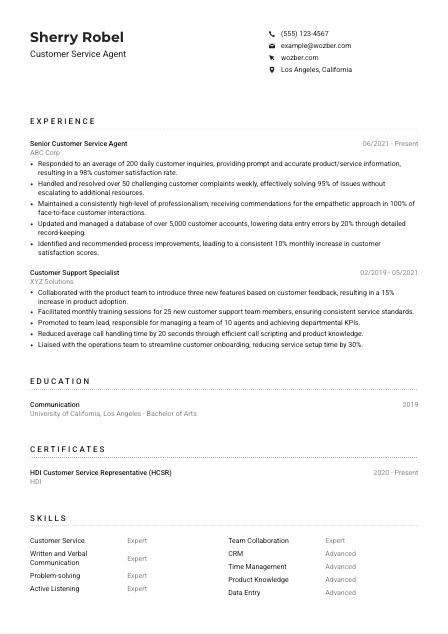
If the posting asks for a specific location or relocation readiness, reflect that in your header. In the example, listing Los Angeles, California immediately supports the employer's location requirement without taking up extra space elsewhere.
Include LinkedIn or a professional website only if it reinforces your customer service background. A profile that shows support roles, service metrics, training experience, or multilingual ability can add useful context.
Skip details such as age, marital status, or a full street address. Customer service CVs work best when attention stays on communication, service history, system familiarity, and job readiness.
This section should confirm that you are easy to contact, professionally presented, and logistically aligned with the opening. Keep it simple and accurate.




For Customer Service Agent roles, experience is where employers look for proof that you can manage volume, resolve problems, and keep customers informed without losing accuracy. Focus less on generic duties and more on the pace, tools, and results behind your work.
Read the job description closely and identify the work patterns behind it. For this kind of role, that usually means fast response times, confident handling of complaints, CRM or ticketing accuracy, strong written and verbal communication, and a calm approach with difficult customers. Build your bullets around those priorities so your background maps naturally to the employer's service environment.
Show your work history in reverse chronological order and keep the basics easy to scan. Recruiters should be able to see your title, employer, and dates in seconds, then move straight into the service outcomes you delivered.
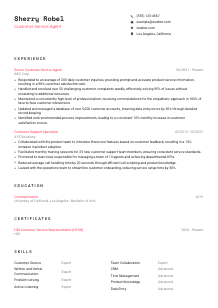
Replace task lists with results tied to customer operations. Good bullets show what you handled, how you handled it, and what changed because of your work. The sample CV does this well by pairing responsibilities with outcomes, such as responding to 200 daily inquiries, resolving most complaints without escalation, and maintaining detailed records across thousands of accounts.
Numbers give hiring teams a much clearer picture of your pace and effectiveness. Include measures that belong naturally to customer support work, such as inquiry volume, customer satisfaction scores, complaint resolution rates, escalations avoided, account volume managed, call handling improvements, or onboarding time reduced.
Trim older or unrelated experience that does not strengthen your case for front-line customer support. Prioritise examples that show product knowledge, customer communication, issue resolution, CRM discipline, cross-team coordination, or process improvements that raised satisfaction.
Your experience section should make it easy to picture you managing a live customer queue, resolving issues professionally, and keeping service standards high. Specific results carry the most weight here.
Education usually plays a supporting role in customer service hiring, but it still adds context. It can reinforce communication ability, training discipline, and subject matter that supports customer-facing work.
Some customer service jobs do not require a specific degree, while others prefer coursework tied to communication, business, or psychology. If the posting is light on education requirements, keep the section concise and accurate rather than trying to make it carry more weight than your service experience.
Present your education in a simple structure that is easy to scan. The key details should appear in a predictable order so the reader can absorb them quickly.
If your coursework genuinely supports the role, reference it briefly. Subjects such as communication, conflict resolution, writing, psychology, or business communication can reinforce customer-facing strengths without overwhelming the section.
Add honors, projects, or student leadership only when they connect to customer service strengths. For example, training peers, leading student groups, or presenting to diverse audiences can support your communication profile.
Short courses, workshops, or online learning in service operations, communication, or support tools can be useful if they relate to the role you want. Keep the focus on learning that improves customer interactions or service delivery.
Education should support the story your experience already tells. For most Customer Service Agent CVs, a clean, relevant entry is enough.
Customer service certifications can give employers extra confidence in how you approach communication, resolution practices, and customer experience. They are especially useful when a posting explicitly mentions recognized credentials.
Start with any credentials the employer names or strongly implies. In the example job description, HDI Customer Service Representative and CCXP are clear signals that formal customer service training is valued, so those should be easy to spot on the CV if you hold them.
Feature certifications that relate directly to customer interaction, service quality, help desk practices, customer experience, or complaint resolution. Leave off certificates that do not strengthen your case for this kind of support role.
Show when the credential was earned and whether it remains current when that information matters. Recent or active certifications can signal that your service methods and customer care standards are up to date.
If you continue to build skills through additional training, that can strengthen your CV, especially when the role values best practices and professionalism. Customer service teams notice candidates who keep refining how they handle communication, conflict, and customer experience.
Relevant certifications help confirm that your service approach is grounded in recognized standards, not just experience alone. Put the most job-relevant ones first.
A Customer Service Agent skills section should reflect how the work actually gets done. That means balancing people skills with system skills, and showing you can communicate well while keeping records, handling complaints, and moving cases forward efficiently.
Start with the posting and identify the capabilities tied to daily execution. Here, that includes CRM and ticketing software, written and verbal communication, handling irate customers professionally, account maintenance, and customer satisfaction improvement. Mirror that language where it matches your real experience.
Lead with the skills that are hardest to overlook in hiring for this role. Customer communication, conflict resolution, active listening, CRM proficiency, documentation accuracy, product knowledge, and time management usually deserve priority over broader soft skills.
Choose skills you can support elsewhere in the CV through examples or results. The sample CV is a good model here, pairing service skills with operational ones like CRM, data entry, and process improvement, which helps the section feel grounded in actual work.
Your skills should reflect the real mix of customer interaction, system use, and service discipline the role requires. If a hiring manager scans this section, they should immediately see how you would operate on the team.
Language ability matters in customer service because every interaction depends on clarity, tone, and comprehension. When language requirements appear in the posting, this section becomes more than a nice extra.
If the employer specifies a language requirement, list it clearly and use an honest proficiency level. In this case, strong English is mandatory, so that should appear first if it is your primary working language.
Put the required language at the top of the section so the recruiter does not have to search for it. That small placement choice helps when screenings move quickly.
Additional languages can strengthen your value, especially in customer-facing environments serving diverse communities. For example, Spanish can be a practical asset in many support settings because it broadens the range of customers you can assist directly.
Terms such as Native, Fluent, Advanced, Intermediate, and Basic are easy to understand and set realistic expectations for calls, emails, and live customer conversations.
If another language helps you resolve issues faster, explain products more clearly, or reduce handoffs, it is worth including. Language skills are most persuasive when they support service quality, not just résumé decoration.
For customer service, language entries should clarify how well you can support real conversations and written communication. Keep the list honest and practical.
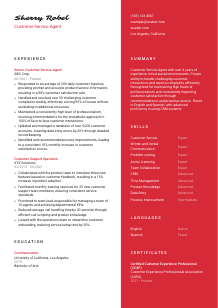
Your summary should quickly establish the kind of service professional you are. For a Customer Service Agent, that means showing pace, communication strength, complaint-handling ability, and any service results or systems knowledge that set you apart.
Pull the most important themes from the job description and reflect them in a few tight lines. For this role, that would include experience in fast-paced service, strong communication, professionalism with difficult customers, CRM familiarity, and a track record of improving customer satisfaction.
Start with a direct description of who you are professionally. A line such as
Include a couple of concrete outcomes that back up your service profile. The example summary works because it mentions handling challenging interactions efficiently and improving satisfaction, which are both central to the role.
Aim for a compact paragraph that makes the reader want to check your experience section next. Three to five lines are usually enough to establish your service style, core strengths, and tools without repeating every bullet below.
A good summary should quickly tell the employer that you can communicate well, manage pressure, and support customers with professionalism. Keep it specific enough to sound credible from the first read.
A Customer Service Agent CV works best when it reflects the pace and accountability of the job itself. Show how you communicate with customers, manage records in CRM or ticketing systems, resolve complaints, and improve satisfaction with measurable results.
Use Wozber to build an ATS-friendly CV template, tailor the language with role-specific terms, and check alignment with an ATS CV scanner before you apply. The finished CV should make it easy to judge how you will perform in a real customer support queue.




