



Use Wozber and land your dream job
Create CV
No registration required
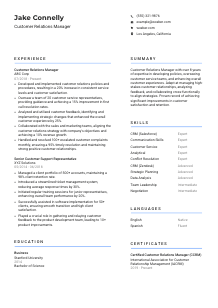
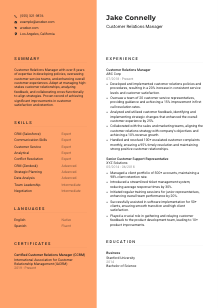
Resolving issues with zeal, but your CV feels stuck on hold? Pick up this Customer Relations Manager CV example, built with Wozber free CV builder. Learn how to align your relationship expertise with job specifics, helping your career dial up to an optimal service level!
Customer relations managers are brought in when service quality, retention, and trust are all on the line at once. A CV for this role needs to show more than friendly communication. It should make clear that you can steady difficult customer situations, improve service operations, and lead teams through measurable changes in satisfaction, resolution speed, or retention.
When the CV is tailored well, hiring teams can quickly separate broad customer service experience from real ownership of escalations, policy development, and cross-functional strategy. Wozber's free CV builder helps shape that into an ATS-compliant CV by aligning your language with the posting and keeping the structure clean, so the CV shows where you've improved customer outcomes and managed service performance.
This section is brief, but it still sets a professional standard. For a Customer Relations Manager, it should immediately confirm who you are, what role you are targeting, and whether basic practical requirements are already covered.
Place your full name at the top in a clear, readable font that stands out from the rest of the page. Customer relations leadership depends on credibility and polish, so even small presentation choices should feel organised and deliberate.
Add the job title directly under your name when it matches the role you are pursuing. If the posting says "Customer Relations Manager," use that phrasing rather than a broader label like "Customer Service Professional." It helps position your background around team oversight, escalations, and service strategy from the first line.
List a phone number you answer regularly and a professional email address. Accuracy matters here. In customer-facing leadership roles, employers notice details, and a typo in your contact information undercuts the care and consistency the role itself requires.
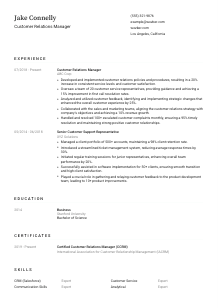
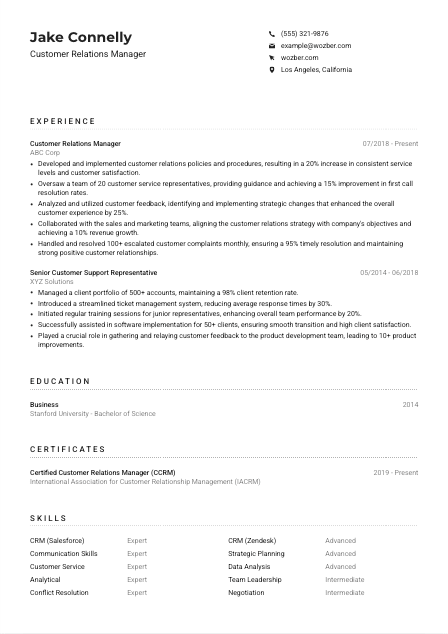
If the employer specifies a location requirement, show it clearly in your contact section. In the example here, listing Los Angeles, California addresses a stated requirement right away and avoids unnecessary questions about availability or relocation.
Include LinkedIn or a professional website if it reinforces your leadership background, customer success results, or industry presence. Make sure the titles, dates, and achievements match your CV. For a management role, inconsistency across profiles can raise doubts quickly.
Keep this section lean and accurate. For a Customer Relations Manager, the best outcome is simple: the employer can immediately confirm role alignment, contact access, and any location requirement without digging.




Experience carries the most weight in customer relations management hiring. Employers want to see how you handled escalations, improved service performance, coached teams, and worked across departments to protect revenue and customer trust.
Read the job description closely and mark the recurring themes. For this kind of role, those often include handling complex complaints, leading service staff, improving customer satisfaction, and using CRM data to guide decisions. These priorities should shape which achievements you choose and how you phrase them.
List your most recent role first and work backward. That structure makes it easier to show progression from hands-on support work into team leadership, policy ownership, or customer strategy. In the example CV, the move from Senior Customer Support Representative to Customer Relations Manager gives that growth a clear path.
Each bullet should show what changed because of your work. Instead of saying you were responsible for escalations or team support, show that you improved first-call resolution, introduced new procedures, or strengthened retention across a client portfolio. The sample does this well by connecting actions such as policy development and complaint handling to service and satisfaction gains.
Customer relations work is often measured through satisfaction scores, response times, retention, complaint resolution, first-contact resolution, and account stability. Numbers make your scope and results easier to understand. Results like resolving 100+ escalations a month or improving customer experience by 25% tell a hiring manager far more than a generic claim about strong service skills.
Cut points that do not support customer relationship management. Prioritise achievements that show leadership, complex issue resolution, customer feedback analysis, CRM-driven improvements, and cross-functional coordination with sales or marketing. That focus helps your experience read as management-ready rather than general support experience.
Your experience section should show a pattern of stronger service operations, steadier customer relationships, and effective team leadership. When those results are clear, the hiring manager can picture you owning escalations and improving customer outcomes from day one.
Education is rarely the deciding factor for an experienced Customer Relations Manager, but it still needs to answer the posting cleanly. Keep it straightforward and make the match easy to spot, especially when the employer asks for a bachelor's degree in a relevant field.
If the posting asks for a bachelor's degree in Business, Communications, or a related area, make sure your degree is easy to find. In the example, a Bachelor of Science in Business directly supports the requirement and reinforces the strategic side of customer relations work.
List the degree, field of study, school name, and graduation year. Hiring teams do not need extra formatting here. They need to confirm quickly that you meet the academic baseline and move back to your service leadership experience.
If your degree is directly connected to customer operations, communications, business management, or service strategy, let that relevance stand on its own. You do not need to over-explain it. A well-matched degree already supports your ability to work across customer experience, team management, and business goals.
Relevant coursework, capstones, or academic projects can help if you are earlier in your career or moving into customer relations management from an adjacent path. For someone with 5+ years of experience, these details are usually secondary unless they connect directly to analytics, communications, or service operations.
Honors, leadership activities, or notable projects are worth adding only if they reinforce strengths that still matter for the role, such as communication, leadership, or structured problem-solving. Keep the emphasis on what supports your current management profile, not on filling space.
This section works best when it confirms the degree requirement without distracting from your track record. For a Customer Relations Manager, education supports the application. It should not compete with the results in your experience section.
Certifications are optional in many customer relations manager searches, but the right one can strengthen your profile. They are most useful when they reinforce leadership in service operations, customer experience, CRM use, or complaint resolution.
Match your certifications to the work the role actually involves. For customer relations management, that usually means customer experience, service leadership, CRM platforms, conflict handling, or account management. A credential such as Certified Customer Relations Manager fits because it supports the role's emphasis on structured service oversight.
Do not list every certificate you have earned. Lead with the ones that strengthen the exact profile the employer is hiring for. If the posting highlights escalations, team guidance, and customer satisfaction improvement, certifications in those areas deserve space before broader professional development courses.
Show the issue date and, if relevant, the active period or renewal status. That helps employers see whether your training is current, especially for certifications tied to evolving service systems, CRM workflows, or customer experience practices.
Customer expectations, support channels, and service tooling change quickly. Ongoing certification can show that you stay current with customer experience methods, CRM capabilities, and leadership practices that improve resolution quality and team consistency.
A certificate will not replace a proven record of customer leadership, but it can sharpen your positioning. Include the credentials that back up your service strategy, customer care expertise, and management range.
The skills section should reflect how customer relations managers actually work. That means a mix of customer-facing judgment, team leadership, process improvement, and platform fluency, especially in CRM environments where service data drives decisions.
Start with the terms the employer already uses. In this posting, that includes CRM software, communication, customer relations management, complex issue resolution, and team oversight. Mirroring that language helps both ATS matching and human review, as long as the skills reflect your real background.
Do not load the section with only soft skills. Customer relations managers are expected to work with tools and service metrics as well as people. Include CRM platforms like Salesforce or Zendesk when you have used them, then pair them with strengths such as conflict resolution, customer feedback analysis, coaching, and strategic planning.
Put the most important skills near the top and group them logically. A clean list might lead with CRM proficiency, customer service leadership, escalation management, communication, and analytics. The example CV does this effectively by combining platform skills with relationship and performance-oriented capabilities.
A hiring team should be able to glance at this section and see the operating range you bring: service tools, leadership ability, communication strength, and the judgment to manage difficult customer situations well.
Language ability matters differently in customer relations than it does in many internal roles. Clear English communication is often a baseline requirement, and additional languages can strengthen your value when the customer base is diverse or regionally broad.
If the posting calls for effective English communication, list English clearly and state your proficiency honestly. For a manager handling escalations, written updates, call handling, and cross-functional communication all depend on this being credible and easy to confirm.
Place the most useful language first, then add others that could support customer coverage. In some markets, a second language can help with account retention, complaint handling, or smoother communication across a broader client base.
Stick to practical levels such as native, fluent, intermediate, or basic. Avoid vague descriptions. Managers may be expected to de-escalate sensitive conversations, so language claims should be realistic.
Many customer relations roles do not require multilingual ability, but it can still strengthen your application when customers come from varied backgrounds or when the company serves multiple regions. Treat it as an added capability, not a substitute for core management experience.
Additional languages are most persuasive when they relate to customer outcomes. For example, being fluent in Spanish may be valuable in some customer-facing markets because it can improve communication and trust, though that is context-specific rather than universal.
For this role, language skills should clarify communication range, not decorate the CV. Keep the section honest and relevant to the customer conversations you can confidently handle.
The summary is where you frame your profile before the hiring manager reaches the detail. For a Customer Relations Manager, it should quickly establish your years of experience, your management scope, and the service results you are known for improving.
Focus on the work that defines customer relations management: leading service teams, improving customer experience, resolving escalations, and using feedback or CRM data to drive better processes. This keeps the summary aligned with the actual role rather than drifting into generic people-skills language.
Start with your title or closest equivalent and your years of relevant experience. A line such as "Customer Relations Manager with 8+ years in customer service and relationship management" immediately gives the reader context on level and specialization.
Choose brief examples of impact that support the posting. Good options include raising satisfaction scores, improving retention, reducing resolution times, leading service teams, or handling high-volume escalations. The example summary works because it combines strategic responsibilities with a proven record of measurable service improvement.
Aim for 3 to 5 lines with direct language. This is not the place for broad claims about passion or dedication. It should read like a compact leadership snapshot that points naturally into the experience section.
A well-written summary tells the employer what kind of customer relations leader they are about to read about. Keep it focused on service performance, team leadership, and the customer outcomes you know how to improve.
A Customer Relations Manager CV should make one thing easy to see: you can protect customer relationships while improving the systems and teams behind them. When your experience, skills, and summary all point to service outcomes such as faster resolution, stronger retention, better satisfaction, or steadier escalations handling, the application reads with far more authority.
Use Wozber's free CV builder to shape that story in an ATS-friendly CV format, refine language with its ATS CV scanner, and present your background in a clean structure that matches the role. The finished CV should make your customer leadership, operational judgment, and readiness for the next service management challenge clear at a glance.