



Use Wozber and land your dream job
Create CV
No registration required
Juggling client accounts, but your CV doesn't tally? Check out this Account Manager CV example, created with Wozber free CV builder. Learn how to highlight your relationship-building prowess and sales acumen in line with job requirements, guiding your career to reach its full potential, just like the accounts you manage!
Account management sits at the intersection of revenue, retention, and day-to-day client trust. Hiring teams want to see whether you can grow existing accounts, handle renewal or upsell conversations, coordinate delivery across internal teams, and keep clients informed when priorities shift. A generic sales CV usually misses that mix of relationship ownership, commercial judgment, and follow-through.
When the CV is tailored to the opening, your client portfolio work, quota performance, forecasting habits, and issue resolution stand out much faster in both ATS screening and human review. Wozber's free CV builder helps organise that language into an ATS-friendly CV format, so the hiring team can quickly see whether you can manage accounts, protect satisfaction, and expand revenue in a B2B setting.
This section is simple, but it still does real work. For an Account Manager, clean contact details and the right location information remove friction early and keep the focus on your client-facing experience and sales results.
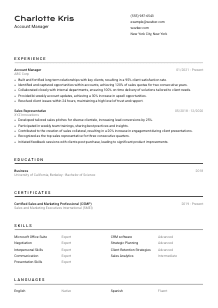
Use your full name in the most prominent text on the page. Account managers spend their time building trust, running calls, and staying visible to clients and internal stakeholders, so your CV should start with clear professional identification rather than decorative formatting.
Place "Account Manager" directly under your name when that is the role you are pursuing. Matching the title helps position your background around account growth, client retention, and relationship ownership from the first line.
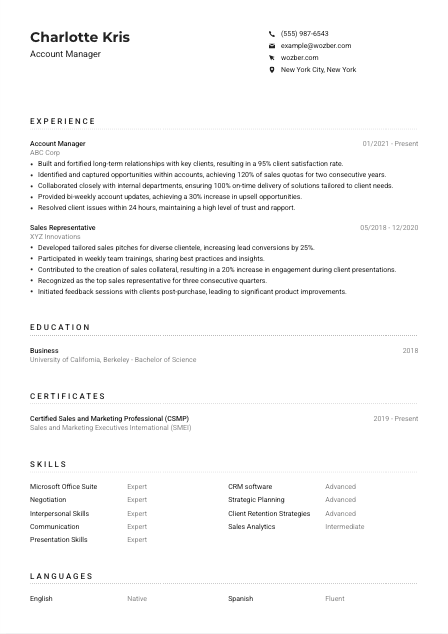
If the posting requires local presence, include your city and state. Here, listing "New York City, New York" immediately addresses a stated requirement, but only include location details to the level that helps your candidacy.
Include a LinkedIn profile or professional website if it supports your application with consistent titles, account portfolio scope, recommendations, or measurable sales wins. Make sure the information aligns with the CV, especially around dates, clients, and progression.
Your personal details should confirm who you are, how to reach you, and whether you meet any practical screening requirements. Once that is clear, the reader can move straight to your account growth, client management, and delivery record.




For Account Managers, the experience section carries most of the hiring weight. This is where you show how you managed client relationships, expanded revenue, coordinated with internal teams, and handled issues before they turned into churn.
Read the job description for the operating themes, not just the title. In this case, the employer is asking for long-term client relationship management, growth within accounts, cross-functional coordination, regular status updates and forecasts, and professional issue resolution. Those should shape which bullets you keep, rewrite, or move higher.
List your most recent role first and make each entry easy to scan with company, title, and dates. For account management, progression matters. Recruiters want to see whether you moved from lead generation or sales support into direct ownership of client accounts, renewals, upsells, and reporting cadence.
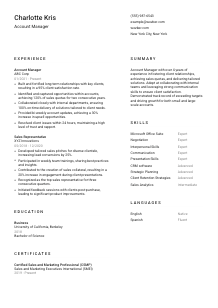
Each bullet should show what you owned and what happened because of it. The sample CV does this well with points such as building long-term client relationships that led to a 95% satisfaction rate and collaborating with internal teams to achieve 100% on-time delivery. That kind of phrasing tells the reader how you handled both the relationship and the operational outcome.
Numbers make your scope and performance easier to judge. Good metrics here include quota attainment, renewal rate, upsell revenue, client satisfaction, response time, delivery accuracy, account growth, and forecast accuracy. "Achieved 120% of sales quotas for two consecutive years" is stronger than a broad claim about driving growth because it anchors your commercial impact.
Cut or compress work that does not support account ownership, B2B sales, client communication, or relationship expansion. If you are bringing in earlier sales experience, frame it around consultative selling, conversion improvement, presentation delivery, or feedback loops with customers, as the sample does with increased lead conversions and post-purchase client feedback.
Your work history should show that you can retain clients, grow accounts, communicate clearly, and keep internal delivery on track. If the section does that with credible metrics and specific responsibilities, you are already answering the biggest questions attached to an Account Manager hire.
Education will rarely outweigh account performance, but it still helps confirm your business foundation. For a role that blends sales, client strategy, communication, and reporting, the degree details should be clear and relevant without taking too much space.
If the posting asks for a bachelor's degree in Business, Marketing, or a related field, make sure your education section reflects that clearly. Matching the stated requirement early prevents unnecessary questions about eligibility.
List the degree, field of study, school, and graduation year in a consistent format. Account management CVs work best when they stay easy to scan, especially when recruiters are moving quickly between experience, skills, and education.
When your degree directly supports the role, name it plainly. A "Bachelor of Science in Business," like the example CV, aligns naturally with account planning, sales process understanding, and client communication expectations.
If you are early in your career, selected coursework in sales, marketing, business communication, or analytics can help fill out the picture. For experienced Account Managers, those details usually matter less than account growth, retention, and CRM-driven reporting.
Honors, leadership roles, case competitions, or relevant projects are worth adding only if they reinforce commercial skills such as presenting, negotiating, analysing markets, or managing client scenarios. Keep the section focused and proportional to your level of experience.
This section should confirm that you meet the academic baseline and, where relevant, show early business training that supports client and revenue work. Then let your experience carry the heavier proof.
Certifications are optional in many account management searches, but the right one can strengthen your profile. They are most useful when they support consultative selling, customer relationship management, negotiation, or account growth.
If you hold a credential tied to sales, account management, customer success, or business development, include it. A certification such as "Certified Sales and Marketing Professional (CSMP)" works because it supports the commercial side of managing and growing accounts.
A short list of relevant certifications is more effective than a long list of generic training. Choose credentials that connect to how account managers are evaluated, including client communication, pipeline discipline, relationship management, or revenue expansion.
Include issue dates or active periods when the certification is current or time-bound. That helps show whether your training is recent and still aligned with current sales practices, client management methods, or platform knowledge.
Account management changes with market conditions, buying cycles, and customer expectations. Recent coursework or certifications can signal that you keep sharpening negotiation, CRM use, forecasting, or strategic account planning instead of relying only on past success.
Relevant certifications can support your experience with extra credibility, especially when they connect directly to client retention, revenue growth, or sales process discipline. Keep the emphasis on credentials that strengthen your case for managing accounts well.
Account Managers need a mix of commercial, relationship, and operational skills. Your skills section should reflect how the work actually gets done, from CRM tracking and forecasting to negotiation, client communication, and coordination with internal teams.
Pull both hard and soft skills from the posting, then keep only the ones you can support elsewhere in the CV. For this role, that includes CRM software, Microsoft Office Suite, communication, interpersonal skills, and negotiation, along with practical account work such as sales analytics or client retention strategy.
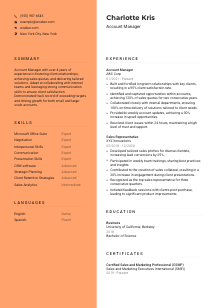
Lead with the capabilities that matter most to day-to-day account ownership. If the employer highlights CRM proficiency and communication, those should appear before broader abilities. The sample CV gets this right by clearly listing Microsoft Office Suite, negotiation, communication, and CRM software.
Keep the list concise and ordered so a recruiter can quickly see your commercial toolkit. Grouping client-facing skills with tools and analytical skills works well for Account Managers because the role depends on both relationship management and disciplined reporting.
Choose skills that match the job, support them through your experience bullets, and keep the list focused on account growth, client communication, and sales operations. That combination reads much better than a long inventory of generic strengths.
Language skills matter when the role involves reading client materials, handling multi-market accounts, or communicating with diverse stakeholders. For Account Managers, this section should stay factual and connect clearly to the communication demands of the job.
If the posting specifies English proficiency, make that visible. Here, the requirement is the ability to read complex texts in English, so listing English at the appropriate level directly addresses a stated need.
Extra languages are worth listing when they could help with customer relationships, regional coverage, or internal coordination across markets. Spanish, as shown in the example, can be useful in many client-facing environments even when it is not formally required.
List the language most important to the job first, then others in descending proficiency. This keeps the section practical and helps the reader connect language ability to real communication needs.
Choose clear levels such as "Native," "Fluent," "Intermediate," or "Basic." In account management, overstatement can become obvious quickly once interviews move into client scenarios, presentations, or written communication samples.
Only emphasize languages if they support the kind of accounts or stakeholders you may handle. If your target role serves multilingual clients or broader territories, this section becomes more valuable. If not, keep it brief and accurate.
When language skills support client communication or account coverage, include them clearly. The value comes from showing where they can help you manage relationships and communicate with confidence.
Your summary should quickly place you in the market as someone who can manage relationships and produce commercial results. For Account Managers, that usually means a compact mix of years of experience, account growth, client satisfaction, and cross-functional coordination.
Open with your title and level of experience in language that fits the role you want. A summary that immediately identifies you as an Account Manager with B2B experience is more useful than a broad statement about being driven or people-oriented.
Lead with the strengths that shape account performance, such as retaining clients, growing revenue within accounts, managing renewals, or collaborating with delivery teams. These are the themes that tell employers you understand the full scope of account ownership.
Work in a few concrete results or responsibilities that mirror the posting. The sample summary does this by mentioning client relationships, sales quotas, tailored solutions, and cross-functional collaboration. That combination aligns well with roles that require both revenue responsibility and service coordination.
Aim for three to five lines that are easy to read at a glance. Skip broad personality language and use the space for experience level, industry context, key tools or workflows, and one or two measurable strengths that support your candidacy.
By the time someone finishes your summary, they should already understand your level, your account management strengths, and the kind of results you deliver. That gives the rest of the CV a clear frame and makes your experience easier to read in context.
A strong Account Manager CV makes a few things easy to confirm quickly: you can manage client relationships, grow revenue inside existing accounts, communicate clearly across teams, and keep reporting disciplined through CRM and forecast updates.
Use Wozber's free CV builder to shape that story into an ATS-compliant CV, then refine it with Wozber's ATS CV scanner so your keywords, structure, and role language stay aligned with the job description. The final result should make your account ownership and commercial value immediately clear.