



Use Wozber and land your dream job
Create CV
No registration required
Orchestrating projects, but your CV feels disjointed? Sync up with this PMO Manager CV example, created with Wozber free CV builder. Learn how to bring together your governance and strategic expertise to match job expectations, leading your career's symphony to new milestones!
PMO Manager CVs are strongest when they show how you bring order to delivery at scale. Hiring teams want to see more than project coordination. They look for leadership across portfolios, practical governance, resource trade-offs, risk escalation, and the ability to keep senior stakeholders informed when timelines, budgets, or delivery standards start to slip.
A tailored PMO Manager CV quickly separates portfolio leadership from general project management. When your wording reflects the job's language around PMO procedures, resource planning, budgeting, and executive updates, Wozber's free CV builder helps you shape an ATS-compliant CV that surfaces the right operational scope early. That makes it easier to see whether you've led the kind of PMO cadence, reporting discipline, and process improvement this role needs.
For a PMO Manager, the top of the CV should read like someone who already operates at leadership level. Keep the section clean and direct so the employer can immediately place you in a PMO environment where oversight, stakeholder communication, and cross-project coordination matter.
Your name should be the clearest element on the page. Use a readable font size and simple formatting so the document opens with confidence and professionalism, the same qualities expected from someone running PMO standards and executive reporting.
Place "PMO Manager" directly under your name if that is the role you are pursuing. This creates immediate alignment with the position and helps frame the rest of the CV around PMO leadership rather than a broader project management background.
Use contact information that supports quick follow-up and presents you as a polished candidate for a leadership role.
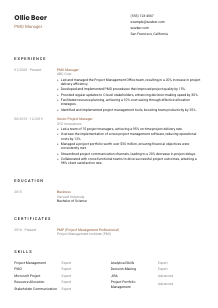
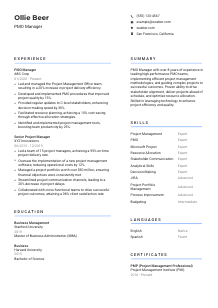
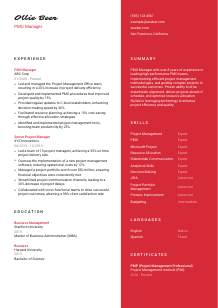
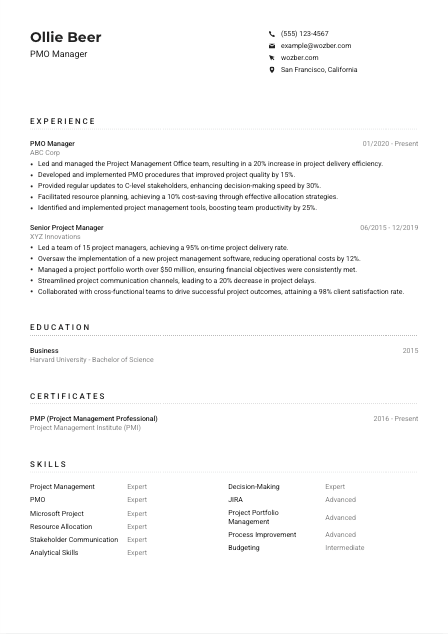
If the job requires a specific location or relocation readiness, state it clearly in this section. In the example, listing "San Francisco, California" directly supports a stated requirement and removes a basic point of uncertainty early.
Include LinkedIn or a professional website if it reinforces your PMO background with matching titles, portfolio scope, certifications, or leadership progression. Make sure the content mirrors your CV, especially around team leadership, governance work, and measurable delivery results.
This section should confirm that you are easy to contact, professionally presented, and already positioned for PMO leadership. Keep it tidy and factual so the hiring team can move straight to your delivery record.




This is the section that carries the most weight for a PMO Manager. Employers want to see how you led project portfolios, improved delivery discipline, managed PMO teams, and influenced decisions when projects faced risk, budget pressure, or competing resource demands.
Before rewriting bullets, pull out the operating themes in the job description. For this role, that includes leading the PMO team, improving procedures and standards, reporting to senior stakeholders, managing resource allocation, and reviewing tools and practices. Your experience should mirror that level of ownership, not stop at day-to-day project execution.
List positions in reverse chronological order and make the progression visible. A PMO Manager CV often reads best when it shows movement from project delivery into portfolio oversight, team leadership, governance, or enterprise process improvement. In the example, the path from Senior Project Manager to PMO Manager makes that transition easy to follow.
Every bullet should show what changed because of your leadership. PMO hiring teams look for outcomes such as faster decision-making, stronger delivery predictability, better portfolio visibility, reduced delays, improved quality, or better use of resources. The example does this well by tying PMO procedures to a 15% quality improvement and stakeholder updates to a 30% faster decision cycle.
Numbers help employers understand scale. Use metrics tied to PMO work such as on-time delivery rates, efficiency gains, cost savings, budget size, project volume, team size, or reductions in delays and reporting issues. A line like managing a $50 million portfolio or leading 15 project managers carries far more weight than a generic claim about handling complex programs.
Prioritise achievements that reflect PMO governance, planning, tooling, budgeting, stakeholder management, and leadership. If a bullet does not help demonstrate your ability to run a PMO, improve delivery standards, or guide senior decision-making, trim it or rewrite it. Use the space for evidence that matches the role's operational demands.
Your experience section should leave little doubt that you can run a PMO, not just contribute to one. Focus on leadership scope, delivery outcomes, portfolio control, and the systems you improved to keep projects moving.
Education matters in PMO hiring because it helps confirm your grounding in business operations, project delivery, and organizational management. It will not outweigh experience, but it should clearly support the level of leadership and structure the role requires.
Start by checking the education requirement in the posting and make sure the relevant degree is easy to find. Here, a bachelor's degree in Business, Project Management, or a related field is requested, so a business-focused degree should be presented clearly and without extra clutter.
List each degree with school, degree name, field of study, and graduation year. Reverse chronological order usually works best, especially if you have advanced education that strengthens your management profile, such as an MBA tied to operations, strategy, or organizational leadership.
When your degree connects naturally to PMO work, make that connection obvious. Business, project management, operations, engineering management, and related fields all support the planning, budgeting, and governance side of PMO leadership. In the example, both the business degree and MBA reinforce that broader management foundation.
Ongoing education, executive programs, or relevant coursework can help when they sharpen your profile in portfolio management, change management, financial oversight, or delivery methodology. Keep it relevant to PMO responsibilities rather than adding unrelated academic detail.
Academic honors, leadership roles, or relevant university activities can be worth mentioning if you are earlier in your PMO career or if they directly reinforce business leadership, analytical strength, or structured program work. For experienced PMO candidates, these details should stay brief and secondary to career results.
Keep education concise, relevant, and easy to scan. It should support your PMO leadership profile without distracting from the operational and portfolio results that matter most.
Certifications carry real weight in PMO hiring when they show formal command of project frameworks, delivery discipline, and professional standards. They are especially useful when the employer names a credential such as PMP or indicates a preference for structured project leadership experience.
Put certifications tied directly to PMO and project leadership first. PMP is the clearest example here because it aligns with governance, delivery standards, risk management, and stakeholder communication across project environments.
A short list of certifications with direct PMO value is stronger than a long list of loosely related courses. Focus on credentials that support portfolio oversight, methodology knowledge, delivery leadership, or process improvement rather than filling space with general training.
Show certification dates or active status when the credential requires renewal or demonstrates continued standing. In the example, listing PMP with an active date range signals that the certification is current and maintained, which matters for employers who prefer up-to-date professional standards.
If you hold certifications in Agile delivery, change management, risk management, or related PMO disciplines, include the ones that support the target role. This helps show that your PMO approach is informed by current practices, not only past experience.
For PMO Manager roles, certifications work best as proof of disciplined practice and current methodology knowledge. Keep the section focused on credentials that strengthen your authority in governance, delivery, and portfolio leadership.
A PMO Manager skills section should read like a map of how you run delivery, not a grab bag of generic strengths. The best mix includes PMO-specific capabilities, planning and reporting tools, and the communication skills needed to influence project teams and senior stakeholders.
Review the posting for the capabilities that drive the role. In this case, that includes PMO leadership, project management software, Microsoft Project, JIRA, analytical ability, communication, resource planning, budgeting, and process improvement. Those are the terms most likely to matter in both ATS screening and human review.
Only list skills that show up elsewhere in your CV through achievements, tools, or scope. If you claim project portfolio management, budgeting, or stakeholder communication, your experience bullets should back that up with concrete examples such as portfolio size, cost savings, executive reporting, or delivery improvements.
Put the most role-critical skills first. For a PMO Manager, that usually means PMO leadership, project management, portfolio oversight, resource allocation, stakeholder communication, process improvement, and core tools before more general soft skills. The example works because it keeps Microsoft Project, JIRA, resource allocation, and stakeholder communication close to the top, where hiring teams expect to find them.
This section should make it obvious that you can lead PMO operations, support structured delivery, and work confidently with both project teams and executives. Prioritise the skills that reflect how the PMO actually runs.
Language skills are usually a supporting section for PMO Manager roles, but they still matter when the posting names a required working language or the organisation operates across regions, vendors, or distributed teams. Keep the section factual and relevant to communication demands.
If the employer specifies a required language, list it clearly with your proficiency level. Here, English is required for speaking, reading, and writing, so it should appear first and without ambiguity.
Additional languages can strengthen your profile when PMO work involves global teams, regional delivery groups, or multilingual stakeholders. They are most useful when they support communication across project environments rather than serving as unrelated background information.
Use clear levels such as Native, Fluent, Advanced, Intermediate, or Basic. PMO roles depend on precise communication in meetings, status reports, risk escalations, and executive updates, so it is better to be exact than optimistic.
If you speak another language at a strong working level, include it when it could help with vendor coordination, cross-border project rollout, or communication with broader delivery teams. In the example, Spanish adds value because it suggests wider communication range beyond the required English baseline.
Not every PMO Manager job needs multiple languages, so avoid overplaying this section. Use it to support your profile when it genuinely connects to the organisation's operating model, project geography, or team structure.
Treat languages as a practical communication asset, not a headline feature unless the role depends on it. For PMO work, clarity and credibility matter more than an impressive-looking list.
The summary needs to place you at the right level within a few lines. For a PMO Manager, that means showing leadership tenure, delivery scope, PMO discipline, and the business outcomes you influence through governance, planning, and stakeholder alignment.
Start with the job description and identify the themes that should appear in your opening lines. For this role, those themes include PMO leadership, project delivery performance, methodology improvement, stakeholder communication, tool proficiency, and resource planning. Use those priorities to decide what belongs in the summary and what can wait for later sections.
Lead with your title or professional identity and a clear experience range, such as 8+ years in project management and PMO leadership. That immediately places you in the right hiring bracket and helps distinguish you from candidates whose background is limited to project coordination or single-project delivery.
Choose strengths that reflect how PMO Managers are evaluated. Useful examples include improving delivery efficiency, guiding portfolio governance, aligning senior stakeholders, optimising resource allocation, or implementing better PMO procedures and tools. The example summary succeeds because it connects leadership with schedule performance, stakeholder alignment, and operational efficiency.
Aim for a short paragraph that sounds grounded in actual PMO work. Avoid vague claims about being results-driven or strategic unless you tie them to something concrete such as project quality, delivery speed, portfolio oversight, or executive reporting. By the end of the summary, the reader should already understand your management scope and the kind of PMO environment you can lead.
Your summary should quickly establish that you can lead a PMO, improve how projects are governed, and communicate with senior stakeholders in a way that drives action. If those points are clear, the rest of the CV has a strong opening.
A PMO Manager CV works when every section supports the same picture: you can lead delivery frameworks, improve PMO operations, manage resources wisely, and keep stakeholders aligned when project pressure rises.
Use Wozber's free CV builder to organise that story in an ATS-friendly CV format, then refine the language so the experience, tools, and leadership scope match the role you are targeting.
The finished CV should make one conclusion easy to reach. You know how to run a PMO that keeps projects moving and decisions informed.




