



Use Wozber and land your dream job
Create CV
No registration required
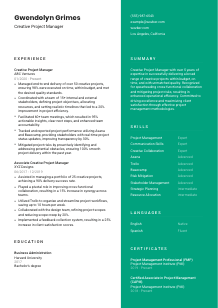
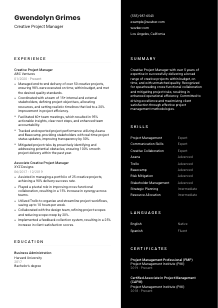
Juggling wild ideas, but your CV feels a bit tame? Explore this Creative Project Manager CV example, created with Wozber free CV builder. It shows how to align your imaginative ventures with job specifics, and set your career on a path as vibrant as your projects!
Creative project management sits at the point where ideas, deadlines, budgets, and client expectations all collide. Hiring teams want to see that you can keep designers, writers, marketers, and stakeholders moving in the same direction without letting quality slip or scope sprawl. Your CV needs to show that kind of control clearly, especially through delivery results, workflow ownership, and the way you manage communication across a creative pipeline.
When the CV is tailored well, it becomes much easier to separate creative project managers from general coordinators or operations candidates. Wozber's free CV builder helps you line up your wording with the job description, keep an ATS-compliant CV structure, and surface the project tools, delivery metrics, and stakeholder work that matter first. That gives the hiring team a faster read on whether you can run creative work from kickoff to final delivery.
For a Creative Project Manager, the header should do what a solid kickoff document does. It gives the essentials fast, avoids clutter, and removes any friction before the real work begins. Keep this section clean, professional, and aligned with any practical requirements named in the posting.
Use your full name as the most visible element in the header. Choose a simple, readable font and enough size contrast so it stands apart from the rest of the contact details. For a role built on clarity and coordination, a cluttered or overly stylized header sends the wrong message.
Place the title "Creative Project Manager" directly beneath your name when that is the role you are applying for. Matching the title used in the posting helps frame your experience correctly from the start and keeps you from being read as a general project coordinator, account manager, or producer if your background overlaps with those functions.
List one reliable phone number and a professional email address, ideally based on your name. If you include a website or LinkedIn profile, make sure it supports your application with relevant project work, portfolio context, or career history rather than acting as a placeholder link.
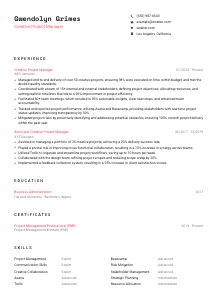
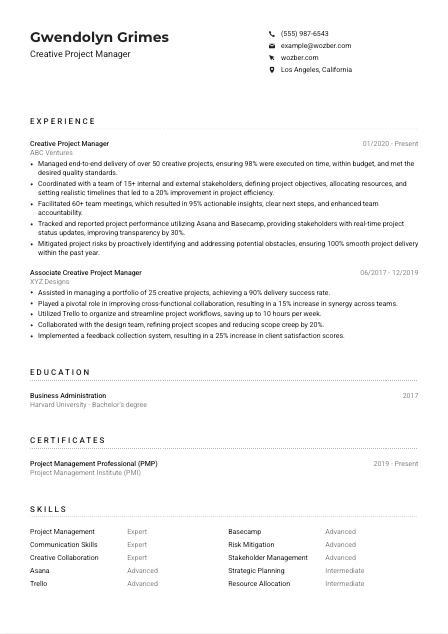
If a posting includes a location requirement, reflect it in your header. In the example here, Los Angeles, California is part of the stated criteria, so showing that city and state removes an avoidable screening issue. Treat location as a tailoring point for that application, not as a rule for every Creative Project Manager CV.
Creative project managers often benefit from linking to a polished LinkedIn profile, personal site, or portfolio page that shows campaign work, agency experience, or cross-functional delivery context. Keep the content current and consistent with your CV so titles, dates, and achievements tell the same story.
This section should confirm basic eligibility and present you as organised from the first line. If the header is clean, accurate, and tailored to the posting, the reader can move straight to your project delivery background.




This is the section that carries the most weight for Creative Project Manager hiring. Employers want to see how you handled deadlines, budgets, stakeholder communication, resourcing, meeting cadence, and delivery quality across actual creative work. The most convincing bullets show both the operational side of project management and the outcomes your coordination produced.
Read the description closely and mark the recurring responsibilities. For this role, the essentials include end-to-end project delivery, coordination with internal and external stakeholders, meeting facilitation, reporting through project management tools, and risk mitigation. Those themes should guide which achievements you feature and how you phrase them.
Start with your most recent role and work backward. For each position, include your title, employer, and dates, then follow with bullets that show scope and results. That format makes it easier to track your progression from supporting project delivery to owning timelines, resources, and client-facing communication.
Each bullet should show what you managed, who you worked with, and what improved because of your work. Strong examples for this profession include reducing scope creep, improving on-time delivery, increasing stakeholder transparency, or keeping creative output on brief. In the sample CV, bullets around coordinating 15+ stakeholders and facilitating 60+ meetings work because they connect activity to efficiency and accountability.
Metrics matter here because project management performance is measurable. Use project volume, on-time delivery rate, budget adherence, workflow efficiency, meeting follow-through, client satisfaction, or hours saved through better process management. The sample's "50 creative projects" and "98% on time" are effective because they show scale and consistency, not just effort.
Prioritise bullets that reinforce creative operations, stakeholder management, resource planning, reporting, and risk control. If an older role includes useful overlap, rewrite it through a project lens. For example, an achievement about improving collaboration becomes stronger when it explains the mechanism, such as refining scopes, tightening workflows in Trello, or reducing revision loops.
By the end of this section, the reader should understand what kinds of creative projects you have run, how you keep teams aligned, and whether your process leads to reliable delivery. That is the distinction this role needs.
Education is rarely the deciding factor for an experienced Creative Project Manager, but it still matters when the posting asks for a specific degree background. Keep it straightforward and use it to confirm that you meet the baseline requirement without distracting from your project work.
If the employer asks for a bachelor's degree in Marketing, Business, or a related field, make sure your degree is easy to find and written clearly. In the example, a Bachelor's degree in Business Administration aligns well because it supports planning, stakeholder communication, and business-side project coordination.
List degree, field of study, school, and graduation year in a consistent order. Avoid overdesign here. A hiring manager should be able to scan this section in seconds and confirm that you meet the educational requirement.
Write the field out in full rather than relying on abbreviations or vague labels. "Business Administration" or "Marketing" gives clearer context than a shortened form and helps when a role screens for related academic background.
If you are early in your career, relevant coursework in marketing, account management, production, operations, or communications can add useful context. Once you have several years of agency or in-house delivery experience, degree details usually matter less than your record of managing projects successfully.
Honors, leadership roles, or capstone projects are worth adding only if they connect to planning, team coordination, or creative business work. Keep this section lean so it supports your candidacy without competing with stronger evidence from your experience section.
Your education section should quickly confirm that you meet the stated academic requirement and have a relevant foundation for client work, planning, and project delivery. Then let your professional experience do the heavier lifting.
Certifications can add useful weight in Creative Project Manager hiring, especially when they show formal training in project planning, risk management, and delivery discipline. They are usually a supporting signal rather than the main reason you get hired, so present them clearly and keep the focus on relevance.
Start with the certifications mentioned in the job description. Here, PMP and CAPM are listed as a plus, which means they can strengthen your application even if they are not mandatory. When a credential appears in the posting, it deserves space on the CV if you hold it.
List credentials that support schedule management, budget control, process discipline, or stakeholder leadership. For this profession, PMP, CAPM, Agile-related training, or agency workflow certifications are more useful than broad professional development courses that do not connect to delivery work.
Add the year earned or the active date range, especially for certifications that remain in good standing through continuing education. The sample CV handles this well by showing active PMP and CAPM credentials, which reassures the reader that the certification is current.
As your responsibilities expand, your certifications should reflect that growth. If you move from project coordination into larger budget ownership, multi-team planning, or process leadership, updated credentials can reinforce that shift and support promotion-level applications.
Relevant credentials help confirm that your project management practice is structured and current. They work best when they reinforce the delivery record already shown in your experience section.
A Creative Project Manager skills section should read like a practical operating toolkit. The best lists combine workflow tools, planning capabilities, and communication strengths that matter in agency or creative team environments. Keep it focused enough for ATS optimisation, but specific enough that a hiring manager can picture how you work.
Start with the explicit requirements in the posting, then add closely related skills you genuinely use. In this example, project management software, stakeholder collaboration, communication, and risk mitigation are central, so those should appear in the CV in natural, accurate language.
If you have hands-on experience with platforms like Asana, Trello, or Basecamp, list them directly. Tool names matter in this field because they tell the employer how quickly you can plug into an existing workflow. The sample CV does this well by pairing those platforms with broader skills like resource allocation and stakeholder management.
Avoid filling this section with every soft skill you have ever used. Choose the skills that support creative project delivery, such as timeline management, meeting facilitation, scope control, reporting, cross-functional collaboration, and client communication. A shorter list with real relevance will serve you better than a long generic one.
Your skills section should make it easy to see the systems, coordination strengths, and delivery habits you bring to a creative team. When it matches the language of the job and your actual experience, it supports both ATS alignment and human review.
Language skills matter in this profession when the work involves client communication, cross-functional teams, or regional and international collaboration. Even when only one language is required, listing languages clearly can support your case if communication is a visible part of the role.
If the role requires clear English communication, include English and state your proficiency level plainly. That matters for a Creative Project Manager because project briefs, status reports, stakeholder meetings, and follow-up notes all depend on precise language.
Place required or highly relevant languages first. Additional languages can be useful when agencies work with diverse clients, regional markets, or distributed teams. In the example, Spanish adds practical value, but English remains the lead requirement because it is specifically called out in the job description.
If you can communicate with clients, vendors, or collaborators in more than one language, list that capability. It can be especially useful in creative environments where feedback moves quickly and nuance matters across teams.
Stick to clear ratings such as Native, Fluent, Intermediate, or Basic. Inflated language proficiency creates problems fast in a role that depends on accurate meeting notes, client communication, and expectation setting.
Not every Creative Project Manager job needs multiple languages, so do not force this section. Include it when it adds real value, such as supporting client relationships, smoother collaboration, or broader market coverage.
For this role, language skills should reinforce your ability to communicate clearly with teams and stakeholders. Lead with the required language, then add others only when they strengthen that story.
The summary sits at the top of the CV, so it needs to establish your level quickly. For a Creative Project Manager, that usually means years of experience, the kind of environments you have worked in, and the delivery results you are known for. Keep it concise, but make it specific enough to distinguish you from a general project or marketing candidate.
Read the posting and identify the two or three things the employer cares about most. Here, that includes end-to-end creative project delivery, stakeholder coordination, and managing timelines, budgets, and risk. Those priorities should shape your opening lines.
Open with your title and years of experience in agency, design, marketing, or other creative delivery settings. This gives immediate context. A line such as "Creative Project Manager with 5+ years leading cross-functional creative projects" is stronger than a broad statement about being results-driven.
Choose a few specifics that reflect how you operate. Strong summary material includes project volume, on-time delivery performance, familiarity with platforms like Asana or Trello, client-facing coordination, or success reducing risk and improving process flow. The sample summary works best where it points to delivery within budget and improved operational efficiency.
Aim for two to four sentences. Use direct language, avoid buzzwords, and make every line earn its place. The summary should give a hiring manager an immediate sense of whether you can manage creative workflows, keep stakeholders aligned, and deliver reliably under deadlines.
After reading the summary, a hiring manager should already know your level, your creative project environment, and the kind of delivery results you bring. That makes the rest of the CV easier to trust and easier to read.
A Creative Project Manager CV should show more than organisation. It should make your control of timelines, stakeholders, tools, and creative output easy to spot in a quick scan. When your sections are tailored to the posting and supported by specific outcomes, the hiring team can picture you running real work, not just supporting it.
Use Wozber's free CV builder to organise your content in an ATS-friendly CV format, tighten the language around the job description, and improve ATS optimisation without losing the human side of your experience. The finished CV should make one point clear immediately: you can keep creative projects moving and land them well.