



Use Wozber and land your dream job
Create CV
No registration required
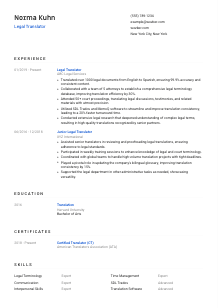
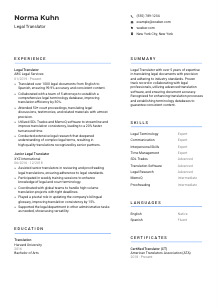
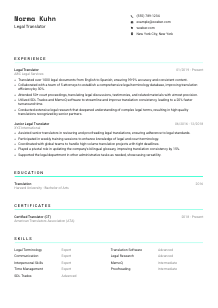
Decoding laws, but your CV seems like a foreign language? Check out this Legal Translator CV example, created with Wozber free CV builder. It shows how to bring your linguistic flair in line with legal landscapes, making your career story as clear as courtroom directives!
Legal translation work is reviewed through a much tighter lens than general bilingual writing. Hiring teams want to see that you can handle legal documents, court terminology, and context-sensitive language without drifting from the source meaning. Your CV needs to show precision, research depth, and the ability to work alongside attorneys or court-facing teams where wording errors can affect filings, testimony, or case preparation.
A tailored CV changes how quickly that capability becomes clear. When your experience, tools, and terminology match the posting, an employer can distinguish legal translation from broader translation work much faster, and Wozber's free CV builder helps shape that into an ATS-compliant CV that surfaces the right legal keywords and workflow details early. That matters when the first screening pass is trying to confirm that you can translate accurately in legal settings, not just across languages.
For a Legal Translator, the header does more than identify you. It should immediately confirm practical basics an employer may screen for first, such as your professional title, reliable contact information, and, when relevant to the posting, location. Keep this section plain, exact, and easy to scan.
Use your full name as the clearest visual anchor on the page. Set it slightly larger than the body text so it is easy to find when a hiring manager is moving quickly between CVs for language-focused roles that often receive side-by-side comparison.
Place "Legal Translator" beneath your name if that reflects your actual work. This helps position you correctly from the first line and separates you from candidates whose background is in general translation, localization, or interpretation rather than legal content.
List a phone number you answer, a professional email address, and only links that support your application. If you include a portfolio or LinkedIn profile, make sure the content reflects translation work, legal subject matter, or relevant certifications rather than unrelated material.
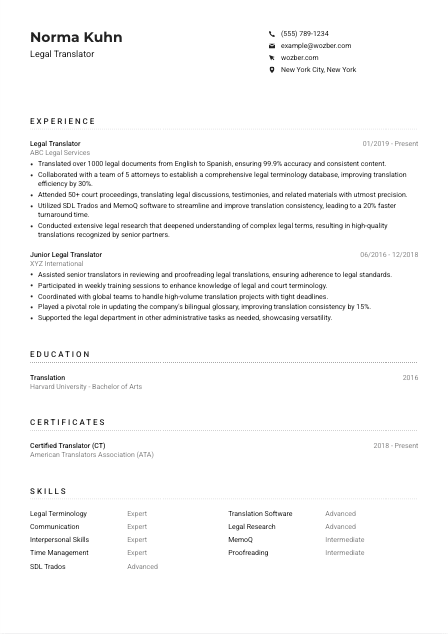
Some legal employers screen for court access, office proximity, or local availability. In the example posting, New York City is an explicit requirement, so listing "New York City, New York" in the header removes an avoidable question early in the process.
If you link to a profile, match the job titles, dates, and credentials exactly. Legal employers notice inconsistencies quickly, especially when the role requires careful handling of terminology, documentation, and factual detail.
Your header should confirm who you are, how to reach you, and whether you meet any practical filters attached to the role. For legal translation work, clean accuracy starts here.




This is the section where legal translation stops being a claim and becomes a track record. Employers look for document volume, subject-matter complexity, terminology control, quality checks, and collaboration with legal professionals. Your bullets should show how you handled real legal content and what improved because of your work.
Read the description for the actual work patterns behind the title. Here, the priorities include translating legal documents, researching legal concepts, maintaining terminology databases, proofreading for legal standards, and supporting court-related communication. Build your bullets around those functions so your experience reads as role-specific rather than broadly bilingual.
List each role with title, employer, and dates in reverse order. That format makes it easy to trace your progression from junior translation work into higher-stakes legal assignments such as direct attorney collaboration, terminology management, or courtroom support.
Replace generic task language with results tied to legal translation workflows. The sample CV does this well by moving beyond "used SDL Trados" and stating that SDL Trados and MemoQ improved consistency and cut turnaround time by 20%. That kind of bullet shows both tool fluency and operational value.
Metrics work especially well here when they reflect translation volume, accuracy, turnaround, glossary adoption, or court exposure. Examples like translating 1000+ legal documents, attending 50+ court proceedings, or improving terminology efficiency by 30% give hiring teams a realistic sense of pace, pressure, and impact.
Prioritise experience that involves legal documents, court terminology, proofreading, legal research, or collaboration with attorneys and paralegals. If you include broader translation work, frame it only if it strengthens your case for precision, confidentiality, or multilingual document handling under deadline.
By the end of this section, a legal employer should be able to see the kinds of documents you handled, the legal environment you worked in, and the results you delivered. That is what turns experience into a credible case for interview.
Education matters in legal translation because it helps establish formal language training and subject-matter grounding. Keep the section straightforward, but make sure the degree and field are easy to connect to the role, especially when the posting names a bachelor's degree in Translation, Interpretation, or a related area.
If you hold the exact degree requested, state it plainly. If your degree is adjacent, such as languages, linguistics, or interpretation, present the field in a way that still shows direct relevance to translation work. In the example, a bachelor's degree in Translation lines up cleanly with the requirement.
List degree, field of study, institution, and graduation year. Legal employers do not need decoration here. They need to confirm quickly that your education supports the language discipline and analytical rigor the role requires.
For this profession, the field matters almost as much as the degree level. "Bachelor of Arts in Translation" immediately carries more value than a vague degree label because it connects your academic base to terminology handling, source analysis, and target-language precision.
If you are early in your career or moving into legal translation, coursework in legal terminology, comparative law, interpretation, linguistics, or translation technology can help fill experience gaps. Keep it brief and include it only when it adds something your work history does not yet show.
Academic awards, research projects, or language-focused activities can support your profile when they relate to translation quality, writing, or legal subject matter. Leave out unrelated achievements that do not add to your credibility for legal document work.
This section should confirm that your training is relevant and professionally grounded. For legal translation roles, a clear degree entry helps support the precision and discipline your experience section is already claiming.
Certifications are especially useful in translation because they support credibility in a field built on accuracy, standards, and trust. For Legal Translators, the best credentials strengthen your standing in language practice, legal specialization, or recognized professional association work.
Put translation credentials first, especially those recognized in the profession. The posting here does not require a certification, but an ATA Certified Translator credential is still a strong addition because it reinforces professional standards and language competency.
A short list of respected credentials is better than a crowded block of loosely related courses. Prioritise certifications tied to translation, legal terminology, interpretation, or CAT tool proficiency if those tools are central to the jobs you are targeting.
If a certification is active, renewable, or current, make that easy to read. The example's "2018 - Present" formatting works because it tells the employer the credential is ongoing rather than outdated.
Legal practices, court procedures, and translation technologies keep shifting. Updated certifications in legal translation, compliance-heavy subject areas, or tools like SDL Trados can strengthen your CV when employers need someone who can step into modern document workflows quickly.
Use this section to show recognized professional commitment and current practice. In legal translation, the right credential adds confidence that your language work meets formal standards.
A Legal Translator's skills section should read like a concise map of the work: legal terminology, research, proofreading, CAT tools, and communication with legal staff. This is also one of the first places ATS systems look for alignment, so the wording should closely reflect the posting without becoming a keyword dump.
Start with the skills the employer names directly, then add closely related capabilities you genuinely use. In this posting, that includes legal and court terminology, legal research, proofreading, communication, SDL Trados, and MemoQ. Those belong higher on the list than broad labels like "multitasking."
Legal translation depends on both hard skills and working style. Pair tool and subject-matter strengths such as CAT software, terminology management, and editing with communication skills needed for coordinating with attorneys, paralegals, and court staff.
Do not try to capture every skill you have ever used. Put the most role-critical items first, especially legal terminology, translation software, legal research, and proofreading. A compact, focused list gives a stronger picture than a long generic inventory.
After scanning this section, an employer should understand the legal language work you can perform, the software you can use, and the kind of professional environment you can operate in.
In legal translation, language ability is not a decorative section. It is central to the role, and employers read it closely for fluency, clarity, and practical working range. Present your languages in a way that shows you can handle legal meaning accurately across source and target texts.
List required languages first and label proficiency clearly. Here, fluent and articulate English is explicitly required, so English should appear prominently with an honest level such as Native or Fluent, depending on your background.
Employers need to understand the actual translation direction you can handle. If your work centers on English to Spanish legal documents, for example, listing both languages clearly helps connect your background to the documents and proceedings you have worked on.
Stick with familiar terms such as Native, Fluent, Advanced, Intermediate, or Basic. They are easier to read than creative labels and better suited to professional screening, especially for roles where precise language judgment matters.
Additional languages can be valuable if they support your target market, court environment, or client base. Include them when they expand your legal translation profile, not simply to make the section look broader.
Be exact about proficiency. Legal translation work depends on nuance, register, and terminology accuracy, so overstating a language level can raise doubts later in interviews or written assessments.
This section should tell an employer which languages you can work in and how confidently you can handle them in legal settings. Clear labels and honest proficiency matter.
Your summary should establish, in a few lines, that your background is in legal translation specifically. Focus on years of experience, the type of legal work you handle, the tools or workflows you use, and one or two concrete results that show accuracy or efficiency.
Start with your professional identity and level of experience. "Legal Translator with 5+ years of experience" works because it places you in the field immediately and matches the kind of screening language employers use when separating specialists from general translators.
Mention the kind of legal work you support, such as legal document translation, court proceedings, terminology research, or collaboration with legal teams. This gives the reader a usable picture of your practice area within two sentences.
A short summary becomes stronger when it includes one concrete point, such as improving turnaround time with SDL Trados and MemoQ, building terminology databases, or maintaining high translation accuracy across large document volumes. The sample summary uses this approach effectively by tying experience to process improvement and consistency.
Aim for three to five lines with no filler. Skip soft claims that are not backed up elsewhere and focus on facts you can support in the experience section, such as years in role, legal specialization, software proficiency, and collaboration with attorneys or court-related teams.
A well-written summary should make one thing clear right away: you are experienced in legal translation, you understand the professional setting, and you can deliver accurate work in that environment.
A Legal Translator CV works best when every section points toward the same conclusion: you can translate legal material accurately, handle terminology with discipline, and work effectively with legal professionals and court-related content. That clarity should show up in your title, your document-focused achievements, your software fluency, and your language pair.
Use Wozber's AI CV builder to tighten that alignment, surface missing requirements, and present your experience in an ATS-friendly CV format that reflects the employer's language without forcing it. When the CV is tailored well, both ATS screening and human review can quickly see your legal translation depth.
The final check is simple. Your CV should make it easy to judge whether you can step into legal document translation and deliver precise, reliable work from day one.




