



Use Wozber and land your dream job
Create CV
No registration required
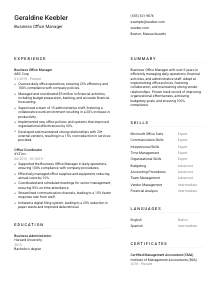
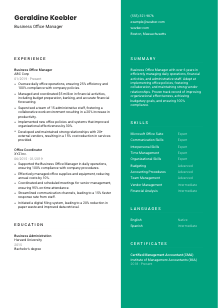
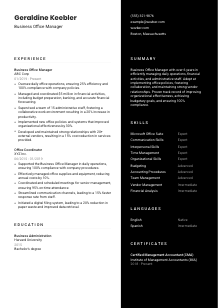
Running the office show, but your CV is off-script? Check out this Business Office Manager CV example, created with Wozber free CV builder. Learn how to spotlight your coordinating skills to match job criteria, propelling your career to a standing ovation!
Business Office Managers sit at the point where daily operations, financial control, and administrative support meet. Hiring teams look for people who can keep an office running smoothly while also handling budgets, policy compliance, vendor coordination, and staff supervision without losing track of details that affect cost, service, or risk.
When your CV is tailored well, those responsibilities are easier to recognize in both an ATS-compliant CV and a first human review. Wozber's free CV builder helps organise your experience around the language employers use for office operations, budgeting, and team oversight, so the CV quickly shows whether you've managed the same kind of operational and financial workload.
This section does not need much space, but it does need to remove friction. For a Business Office Manager role, clean contact details and a matching title help hiring teams move straight to your operations and finance experience instead of pausing over avoidable gaps.
Place your full name at the top in a format that is easy to read. Keep it simple and professional so the focus stays on your background in office operations, budgeting, and team management rather than on styling choices.
Add "Business Office Manager" beneath your name when that is the role you are pursuing. This creates immediate alignment with the posting and helps frame the rest of your CV around office administration, financial oversight, and staff supervision.
Include a phone number you answer and a professional email address, ideally in a straightforward format such as firstname.lastname@email.com. Administrative leadership roles depend on dependable communication, so even this section should reflect accuracy and professionalism.
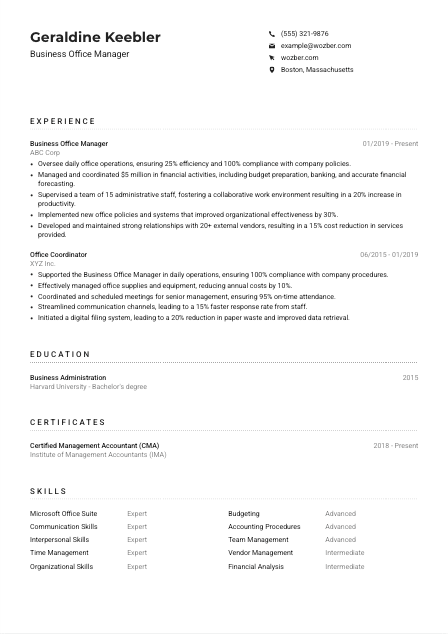
If a posting requires local residency, state your city and state clearly. In the example here, Boston, Massachusetts matters because the employer specifically asked for a candidate based there. Use location this way as a tailoring move, not as a universal rule for every Business Office Manager CV.
A LinkedIn profile or professional website can help if it reinforces your CV with consistent titles, dates, and accomplishments. For this kind of position, it is especially useful when it shows progression into office leadership, finance-facing responsibilities, or vendor and staff management.
Your personal details should confirm that you are reachable, professionally presented, and logistically aligned with the role. Once that is clear, the reader can focus on the parts that matter most for a Business Office Manager, namely your control of operations, finances, and people.




For Business Office Manager hiring, the experience section carries most of the decision weight. Employers want to see that you have managed office workflows, handled money responsibly, improved systems, and supervised staff in ways that produced measurable operational results.
Before writing bullets, mark the responsibilities that define the role. In this description, daily office operations, budget preparation, banking, forecasting, policy compliance, staff supervision, and vendor relationships are the anchors. Those themes should appear across your recent roles wherever they reflect work you actually performed.
Start with your most recent position and work backward, showing job title, employer, and dates for each role. This format makes it easy to trace whether you progressed from coordination or administrative support into broader operational ownership and financial responsibility.
Use bullet points that show what you managed and what changed because of your work. The example CV does this well with lines such as improving office efficiency by 25 percent, managing $5 million in financial activity, and increasing staff productivity by 20 percent. That kind of wording tells a hiring manager far more than a generic statement like "responsible for office operations."
Numbers matter in this field because they show control, scale, and accountability. Include budget size, team size, compliance rates, cost savings, forecasting accuracy, vendor count, turnaround improvements, or policy adoption results where possible. Metrics are especially useful for proving that your work affected business operations, not just administrative tasks.
Choose bullets that support the role you want now. For a Business Office Manager CV, prioritise office systems, budgeting, accounting procedures, reporting, process improvement, vendor oversight, and staff leadership. A useful filter is simple: if a bullet does not strengthen your case for running office operations efficiently, it probably does not need the space.
This section should leave no doubt that you can oversee office operations with financial discipline and steady team leadership. The best bullets make your scope visible through budgets, compliance, productivity gains, process improvements, and vendor results.
Education is usually a straightforward section for Business Office Manager candidates, but it still matters because many postings set a degree requirement. Present it in a way that quickly confirms you meet the baseline and, where relevant, connects your studies to finance or business operations.
If the posting calls for a bachelor's degree in Business Administration, Finance, or a related field, make that easy to see. In the example, a Bachelor's degree in Business Administration aligns directly with the requirement and should appear without extra wording that hides the match.
List your degree, field of study, school, and graduation year in a clean sequence. Recruiters and HR teams often review this section quickly, so simple structure helps them confirm qualifications without hunting for details.
When the employer names a preferred academic background, the field deserves clear placement. "Bachelor's degree, Business Administration" is more useful than a vague degree line because it immediately supports your candidacy for an operations and finance-facing management role.
Most experienced candidates can keep this section short. Coursework can help if you are earlier in your career or if classes in accounting, budgeting, business systems, or organizational management directly reinforce the role you are targeting.
Honors, leadership roles, or standout projects are worth noting when they add something meaningful, especially for newer candidates. If you have several years of office management experience already, keep the focus on the degree itself unless an academic achievement directly supports financial management or administrative leadership.
Your education section should quickly show that you meet the stated academic requirement and have a credible foundation in business or finance. For most Business Office Manager CVs, clarity matters more here than detail.
Certifications are not always required for Business Office Manager roles, but the right one can strengthen your profile, especially when the job includes budgeting, accounting procedures, forecasting, or process oversight. Use this section to support the responsibilities already shown in your experience.
List certifications that connect to financial management, accounting controls, office administration, or business operations. A credential such as Certified Management Accountant, shown in the example, supports the finance side of a Business Office Manager role and gives extra weight to budgeting and forecasting experience.
A short list of well-matched certifications is more effective than several loosely related ones. Prioritise credentials that strengthen your ability to manage budgets, reporting, compliance, or administrative systems rather than certificates with only broad professional value.
Show issue dates, renewal periods, or active status for certifications that need ongoing maintenance. This is particularly useful for finance-related credentials because it indicates current standing and continued professional engagement.
If you pursue training in office systems, budgeting, leadership, or accounting practices, keep this section updated. Business Office Managers often work across operations and finance, so current knowledge in both areas can sharpen your positioning, especially when employers want someone who can improve procedures as well as maintain them.
The strongest certifications add context to your management experience. They work best when they reinforce the parts of the role that require financial judgment, operational control, or process discipline.
A Business Office Manager skills section should read like the operating toolkit for the job. That usually means a mix of office systems, financial administration, communication, staff supervision, and process management rather than a long list of generic strengths.
Start with the terms the employer already uses. Here, that includes Microsoft Office Suite, financial management, budgeting, accounting procedures, interpersonal communication, and team management. Mirroring this language helps with ATS optimisation and shows that your background lines up with the day-to-day demands of the role.
Business Office Managers are hired for both operational control and coordination across people. Include hard skills such as budgeting, financial analysis, reporting, office software, and vendor management alongside soft skills that matter in practice, such as communication, organisation, and team supervision. The example skill list handles that balance well.
Do not try to capture every capability you have developed over your career. Prioritise the skills that support office efficiency, financial accuracy, policy compliance, and staff productivity. A tighter list is easier to scan and more convincing than a broad inventory with little connection to the target role.
When this section is tailored well, it should look like the skill set needed to run office operations, support financial controls, and manage people effectively. That is the combination employers are usually trying to confirm.
Language skills matter differently depending on the employer, customer base, and team structure. For Business Office Manager roles, the first priority is usually clear communication with staff, leadership, vendors, and service providers across daily operations.
If the employer names a required language, place it first and state your proficiency plainly. In this job description, clear communication in English is essential, so English should be easy to find in the section.
List English prominently when it is central to the role, especially in positions that involve policy communication, team supervision, vendor coordination, and financial administration. Those functions depend on precise written and verbal communication.
Extra languages can be worth listing when they support the workplace, client interactions, or a multilingual staff environment. In the example, Spanish adds range, though it is a bonus rather than a stated requirement.
Describe your level with clear terms such as Native, Fluent, Advanced, or Intermediate. This helps set accurate expectations, which matters in management roles where misrepresented communication ability can affect operations and team coordination.
If the position includes vendor relations, staff oversight, or cross-functional support, language ability can matter beyond formal requirements. Still, keep this section proportional. For most Business Office Manager CVs, language skills support the application rather than drive it.
For this kind of role, language details should quickly confirm that you can communicate clearly in the environment the employer operates in. Any additional languages are a useful bonus when they have practical workplace value.
The summary is your chance to frame your experience before the reader gets into the details. For a Business Office Manager, it should quickly connect years of experience with the work that matters most: running office operations, managing finances, improving procedures, and leading administrative staff.
Write the summary around the core functions of Business Office Management rather than broad administrative language. Office operations, budgeting, financial coordination, compliance, staff oversight, and vendor management are stronger anchors than generic claims about being organised or results-driven.
Start with your title or area of specialization and your years of relevant work. The example's "over 6 years" works because it immediately places the candidate at a level consistent with a posting asking for 5+ years in office management or related roles.
Select two or three strengths that directly match the posting. For this role, that might be financial management, policy implementation, team supervision, or improving office efficiency. Keep the language specific enough to sound credible in an operations setting.
Aim for a brief paragraph that captures your scope without repeating the entire CV. Strong summaries often mention improvements in efficiency, compliance, budget control, or organizational effectiveness because those are the outcomes a Business Office Manager is usually hired to protect or improve.
A well-written summary should make the rest of your CV feel coherent. By the time the reader reaches your experience section, they should already expect to see operational control, financial responsibility, and effective administrative leadership.
A Business Office Manager CV works best when it shows how you run office operations, manage budgets and procedures, support staff performance, and keep the business side of the workplace under control. That means tailoring each section to the role's actual workload instead of relying on broad administrative language.
Use Wozber's free CV builder to shape that information into an ATS-friendly CV format, strengthen ATS optimisation with role-specific wording, and check alignment with an ATS CV scanner. The result should make it easy to recognize your readiness to oversee operations, finances, and administrative teams from day one.




